STEG Academic Writing Workshop Equips Graduate Students with Research and Publication Skills
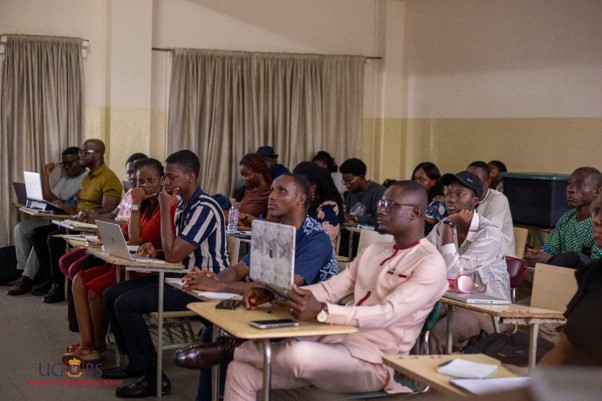
The Transform Africa from Within (TaFW) Training Group at the University of Ghana Business School (UGBS), in collaboration with the School of Graduate Studies, and the UGBS Research and Grant Management Office has organised an Academic Writing Workshop to equip graduate students with practical skills in thesis development and journal paper publication. The workshop was held on 19th August 2026 as part of the activities of the Structural Transformation and Economic Growth (STEG) programme. It focused on two key areas of graduate research: developing a thesis from the research problem to completion and transforming research into publishable journal articles.
The first session, “Thesis Development for Graduate Students: A Practical Roadmap from Research Problem to Publication,” was facilitated by Dr. Micheal Effah Asamoah, Senior Lecturer in the Department of Accounting at UGBS. Dr. Asamoah took participants through the various stages of thesis development, beginning with identifying and formulating a research problem. He explained that a thesis is more than a set of chapters, describing it as a research argument that answers a meaningful question and makes a defensible claim. He encouraged students to identify real and unresolved issues within their fields through extensive reading and to formulate research problems that are significant, feasible and original. Students were also advised to align their research topics with their areas of specialisation, expertise and available resources, while engaging their supervisors early to refine their research ideas.
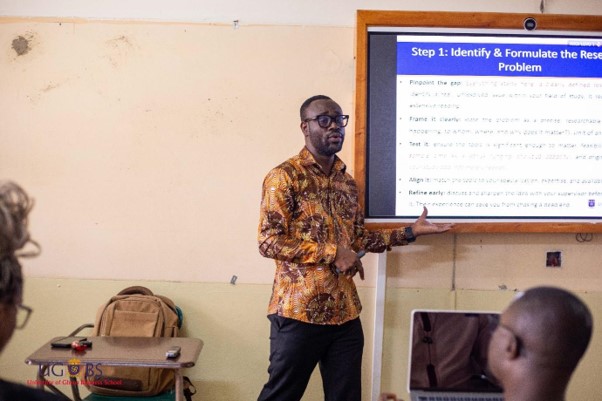
Dr. Micheal Effah Asamoah lecturing at the STEG Academic Writing Workshop.
The session further examined approaches to conducting and organising literature reviews. Participants were introduced to practical literature-searching strategies, including the use of academic databases, institutional repositories and reference management tools. They were encouraged to organise literature around themes, debates, methods and findings rather than simply listing studies. Dr. Asamoah also discussed the use of Artificial Intelligence (AI) in research, encouraging students to regard AI as a research assistant rather than a replacement for their own intellectual work. He stressed the need for students to verify citations, claims and calculations against original sources and to comply with institutional requirements on the use and disclosure of AI. The session also addressed academic writing, research ethics, time management, the student-supervisor relationship and the process of turning a thesis into publishable research.
The second session focused on academic writing and journal paper publication and was facilitated by Prof. Mohammed Amidu, Department of Accounting. The session sought to help graduate students understand how academic articles are conceptualised, structured, revised and prepared for submission to journals. Prof. Amidu explained that having completed research, collected data or obtained findings does not automatically mean that a publishable article has been produced. Rather, an article must present a clear argument aimed at a specific audience and suited to a specific journal. Participants were encouraged to identify the central argument of their research by asking a fundamental question: What is this article trying to convince the reader of? The facilitator distinguished between a research topic, research question and article argument, stressing that journals publish arguments rather than topics.
The workshop also addressed the structure of a typical journal article, including the introduction, literature review, methods, results, discussion and conclusion. Participants were guided on how each section contributes to the overall argument of an article. Attention was given to the introduction, with students encouraged to state the research problem early, identify the gap, announce the argument and signal the contribution of the study. The literature review was similarly presented as an opportunity to engage with existing debates and establish where the article fits within the wider body of scholarship. The discussion section was identified as an important part of the article because it provides an opportunity for researchers to interpret their findings and explain their significance. Students were encouraged to consider questions such as “So what?”, “Why does this matter?” and “How does this change understanding?” when developing their discussions.
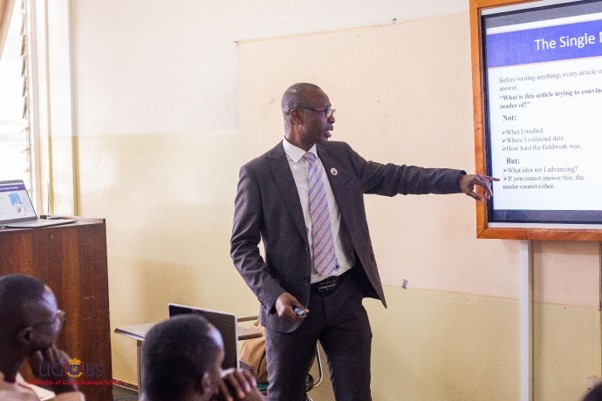
Prof. Mohammed Amidu lecturing at the STEG Academic Writing Workshop.
The facilitator further addressed revision and feedback as essential parts of academic publishing. Students were reminded that published papers often undergo multiple revisions and that reviewer comments should be viewed as part of the academic process rather than as personal criticism. As part of the practical exercises, participants worked on identifying potential journals for their research, developing working titles and preparing brief abstract sketches outlining what their proposed articles would do, why they matter and what they contribute. The sessions also encouraged participants to approach research writing as a skill that can be developed through practice, feedback, revision and engagement with the conventions of academic publishing.