
UGBS Department of Accounting, ICAG and Chartered Institute of Taxation Host Roundtable Discussion on VAT Reforms in Africa
The Department of Accounting at the University of Ghana Business School (UGBS) in collaboration with the Institute of Chartered Accountants Ghana (ICAG), and the Chartered Institute of Taxation, hosted a roundtable discussion on 25th March 2026 at the UG Cedi Conference Centre. The event, themed “Value Added Tax in Africa: The Ghana Experience,” brought together academics, policymakers, tax practitioners, and about 700 students to examine Ghana’s VAT reforms and their implications for domestic revenue mobilisation and economic development. Mr. Anthony Kwasi Sarpong represented the Guest of Honour, Hon. Julius Debrah, Chief of Staff, while Hon. Seth Terkper, Presidential Advisor on the Economy, served as Guest Speaker. The programme was chaired by Mr. James Otieku, former lecturer at the Department of Accounting, and moderated by Dr. Rita Amoah Bekoe, Senior Lecturer at UGBS.
Prof. Godfred Matthew Owusu, Head of the Department of Accounting, described the roundtable as a reflection of the department’s commitment to strengthening industry engagement. He noted that over the past six months, the department had interacted with key stakeholders, including auditing firms and regulators, and explained that the collaboration with ICAG and the Chartered Institute of Taxation demonstrated this strategic direction. According to him, such partnerships are aimed at harnessing industry experience to enhance the practical relevance of academic work and deliver the transformative learning experience envisioned by the University’s Vice-Chancellor, Prof. Nana Aba Appiah Amfo.
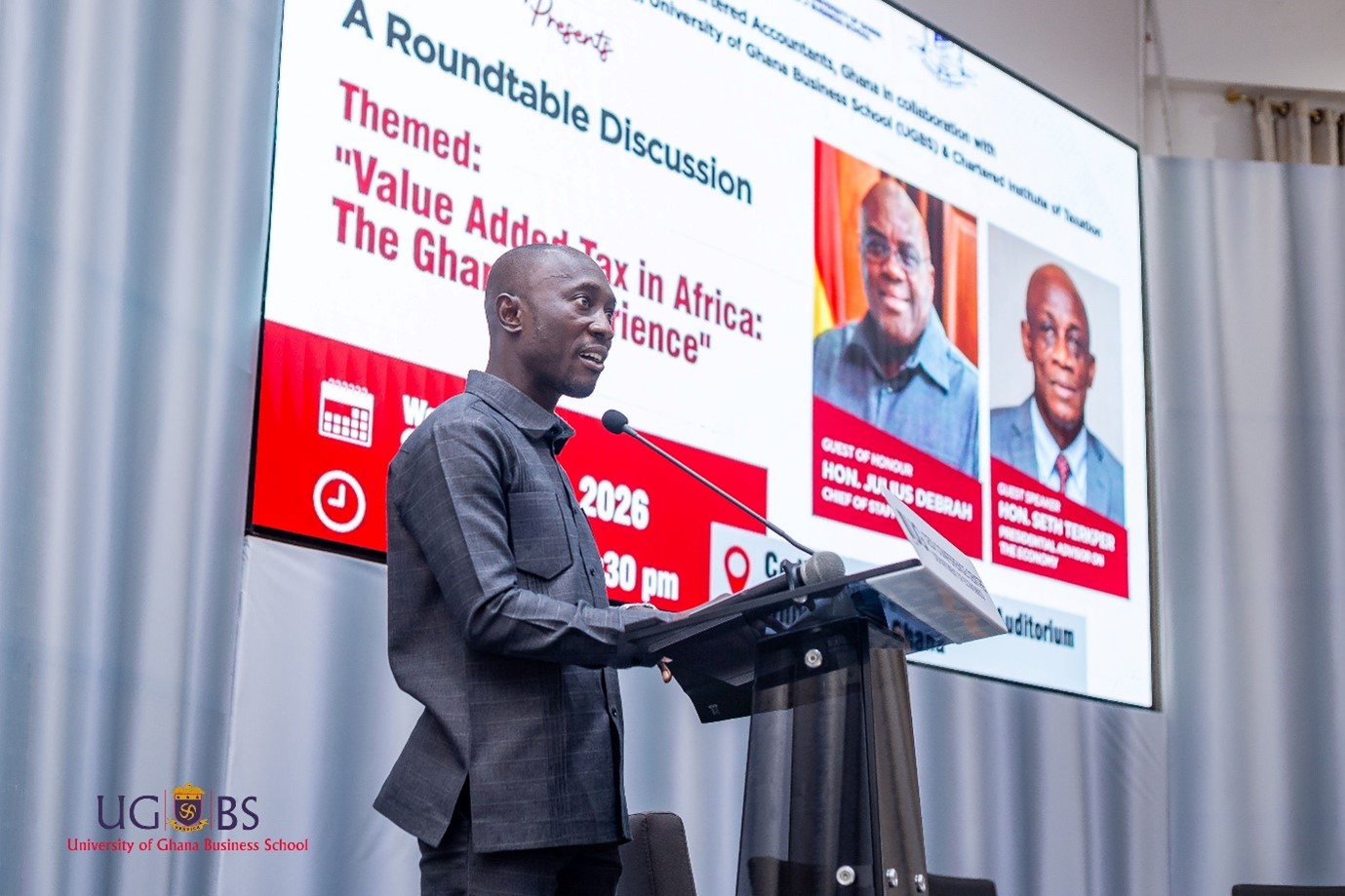
Prof. Godfred Matthew Owusu, Head of the Department of Accounting delivering his remarks
Prof. Owusu further indicated that the roundtable forms part of a long-term initiative to institutionalise engagement between academia, practitioners, and policymakers. He explained that the department intends to make the roundtable an annual event to shape public discourse on taxation and related accounting issues. He extended an invitation to the Commissioner-General and his leadership team to support the initiative, noting that their involvement would help align discussions with national tax administration and policy formulation. He also explained the importance of addressing tax compliance behaviour by improving public understanding of tax responsibilities and strengthening collaboration among academia, industry, and regulatory bodies to build an efficient and equitable tax system.
In his remarks, Chairman of the programme, Mr. James Otieku, emphasised that generating internal revenue is critical for national development. He applauded students for their participation and noted that before VAT became widely understood, many citizens were unaware they were paying taxes. He described the roundtable as an opportunity to reflect on Ghana’s progress in VAT administration and the role of digitalisation in strengthening compliance.
Mrs. Patience Mawusi Dzikunu, Council Member of ICAG, stated that the Institute was honoured to contribute to the discussion at a pivotal moment in Ghana’s VAT reform. She highlighted recent measures such as the integration of selected levies into the VAT base, abolition of the COVID-19 levy, and reduction of the effective VAT burden from approximately 21.9% to 20%, describing them as deliberate steps towards simplification and fairness. She also noted the increase in the VAT registration threshold from GHS 200,000 to GHS 750,000, which she said would ease compliance pressures on micro and small enterprises.
She emphasised that VAT is not only a revenue tool but also a reflection of the social contract, administrative efficiency, and public trust. While acknowledging the potential of digitalisation, she pointed out uneven adoption among SMEs, particularly outside urban centres, and called for improved access to digital tax tools. She further advocated evidence-based policymaking, professional collaboration, and sustained taxpayer education, stressing that simplification reduces non-compliance and administrative distortions. She concluded that VAT reforms should promote fairness, simplicity, and sustainability to strengthen tax systems and build citizen trust.
Hon. Seth Terkper, in his presentation on “VAT in Ghana: Principles, Implementation and Operational Challenges,” explained that VAT forms part of the indirect tax regime imposed on goods and services, replacing manufacturing- and import-based taxes as well as selected service taxes. He discussed the ideal consumption tax structure, turnover or cascading taxes, and the importance of VAT registration at every stage of production and distribution. He also highlighted the role of input tax credits, VAT refunds, and zero-rating of exports in ensuring competitiveness, and introduced his book on taxation to participants.
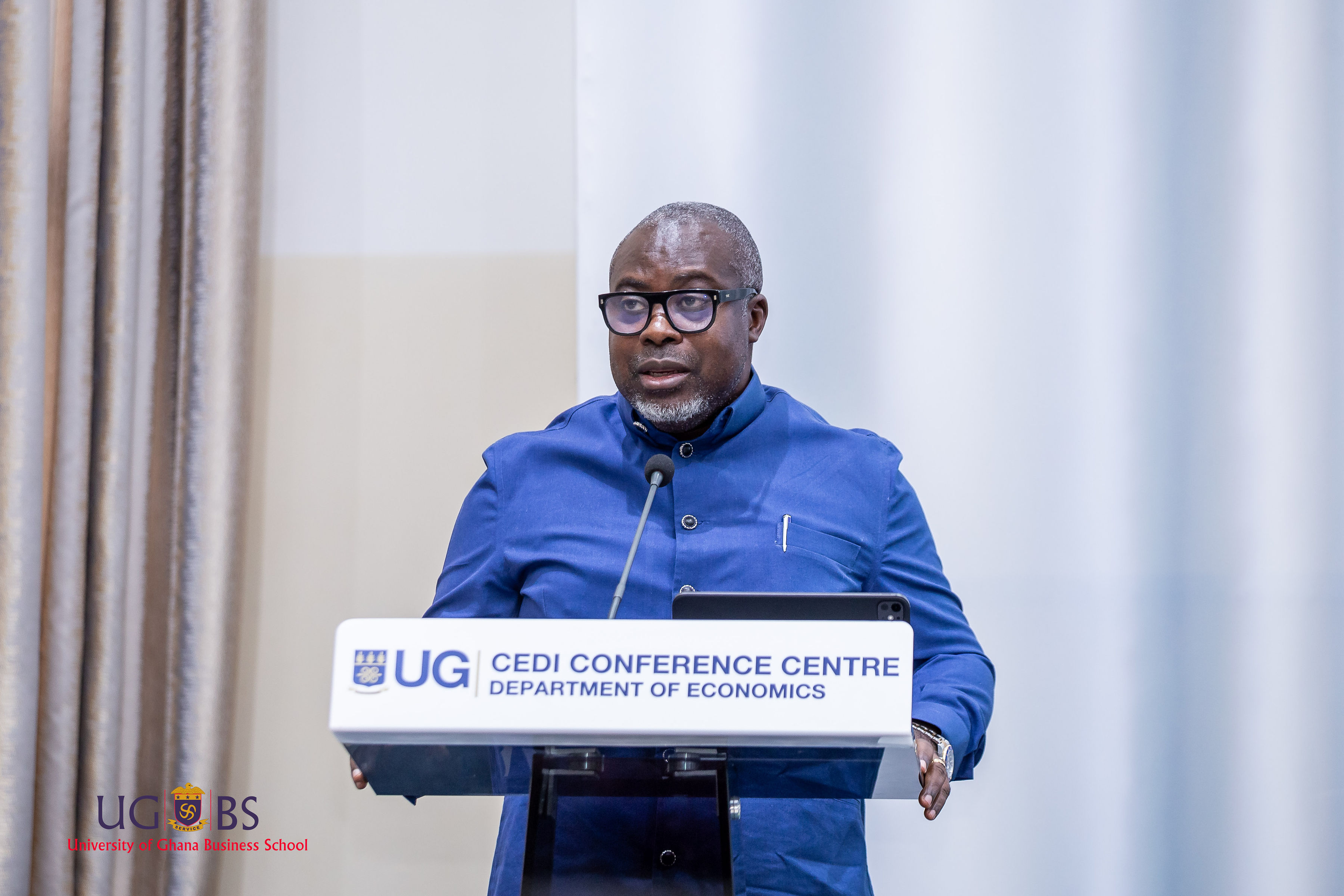
Mr. Anthony Kwasi Sarpong, Ag. Commissioner-General of GRA
Representing the Guest of Honour, Acting Commissioner-General of the Ghana Revenue Authority, Mr. Anthony Kwasi Sarpong, described the theme as purposeful, noting that Ghana’s tax reform journey, though challenging, offers valuable lessons for shared learning. Mr. Sarpong noted that Ghana’s VAT gap remains above 60%, indicating that many eligible businesses are not charging or remitting VAT. He explained that although VAT was introduced in 1998, successive levies created complexity and compliance challenges. He highlighted the passage of the Value Added Tax Act, 2025 (Act 1151), effective 1 January 2026, describing it as a comprehensive overhaul built on simplification, fairness, and revenue productivity. He also highlighted the increase in the VAT threshold, digitalisation initiatives, introduction of Fiscal and Electronic Devices, a VAT reward scheme, and an e-commerce monitoring tool aimed at improving compliance and broadening the tax base.
The programme also featured a panel discussion moderated by Naa Adorkor Codjoe, CA, Consulting Specialist. Panellists included Mr. Abeku Gyan Quansah, Partner at PwC; Prof. Ali Abdallah Nakyea, School of Law and Director of WTS Ghana; Dr. Dominic D. Naab, Head of Domestic Revenue Division at GRA; and Prof. Mohammed Amidu, Professor of Accounting and Finance at UGBS. Mr. Abeku Gyan Quansah described current VAT reforms as the fourth major phase since the initial attempt in 1995. He provided a historical overview of VAT reforms and stressed the need for clarity in tax discussions, including identifying taxable products, consumption location, and accounting processes. He also addressed VAT gaps, legal structures, exemptions, and the political considerations in taxing income.
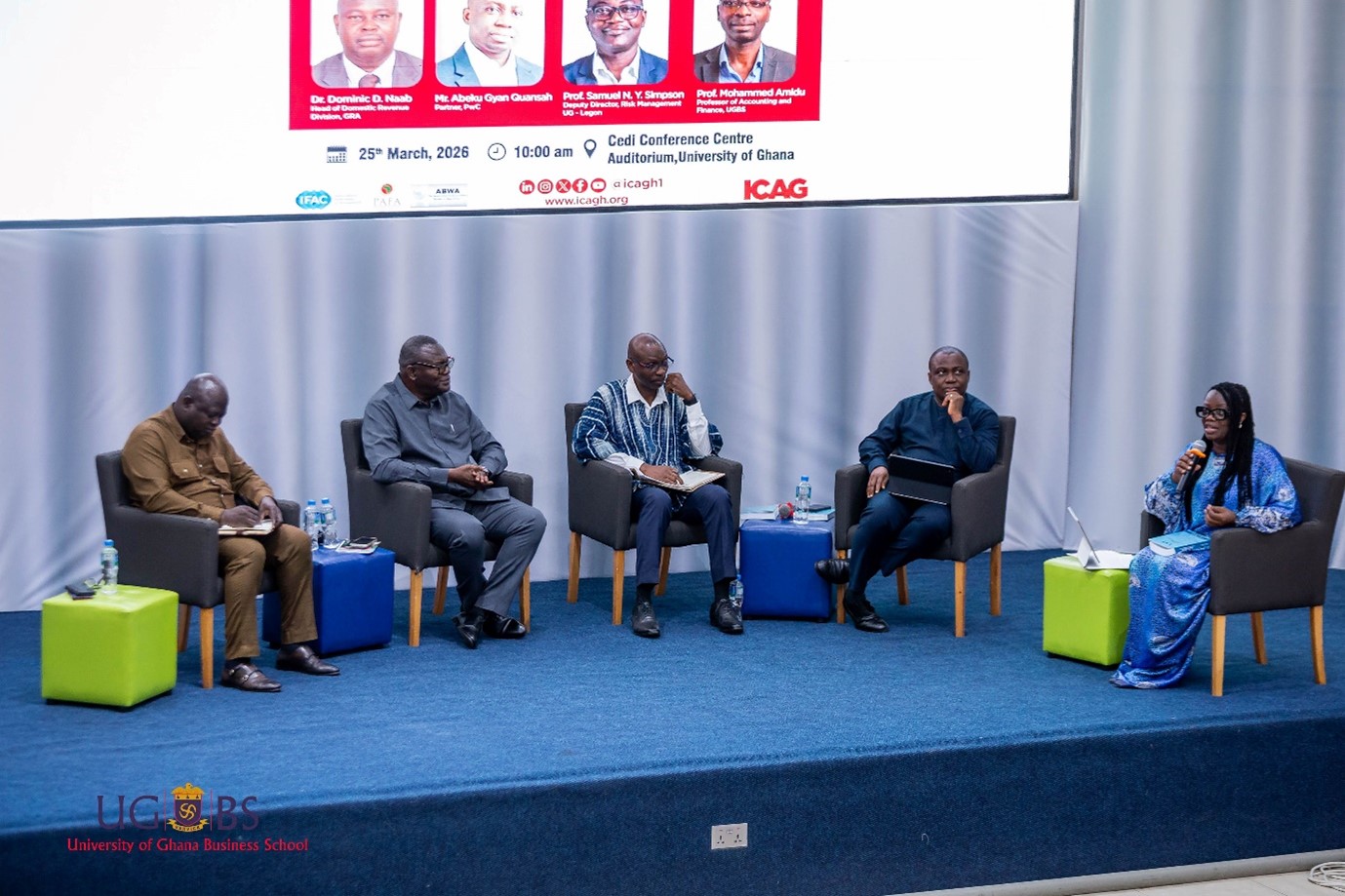
During the panel discussion
Prof. Ali Nakyea discussed how VAT reforms have affected small and medium enterprises, noting that instability often arises from non-compliance with tax laws. He advocated improved tax refund mechanisms, particularly in cases of overpayment. Dr. Dominic D. Naab examined VAT performance relative to Gross Domestic Product (GDP), highlighting the importance of compliance following recent reforms. He emphasised public awareness of VAT-inclusive pricing, effective tax rates, VAT relief purchase orders, and the role of digitalisation in strengthening tax administration. Prof. Mohammed Amidu highlighted the need for improved academic and public understanding of VAT, advocating for a stable VAT rate and better management of input and output VAT flows. He also emphasised public education, political management of tax policies, and the importance of learning from positive tax revenue trends across other African countries.