Prof. Alagidede’s Indigenous Enterprises Seminar Explores Mushroom Economy as a Pathway to Jobs, Wealth Creation and Sustainable Economic Development
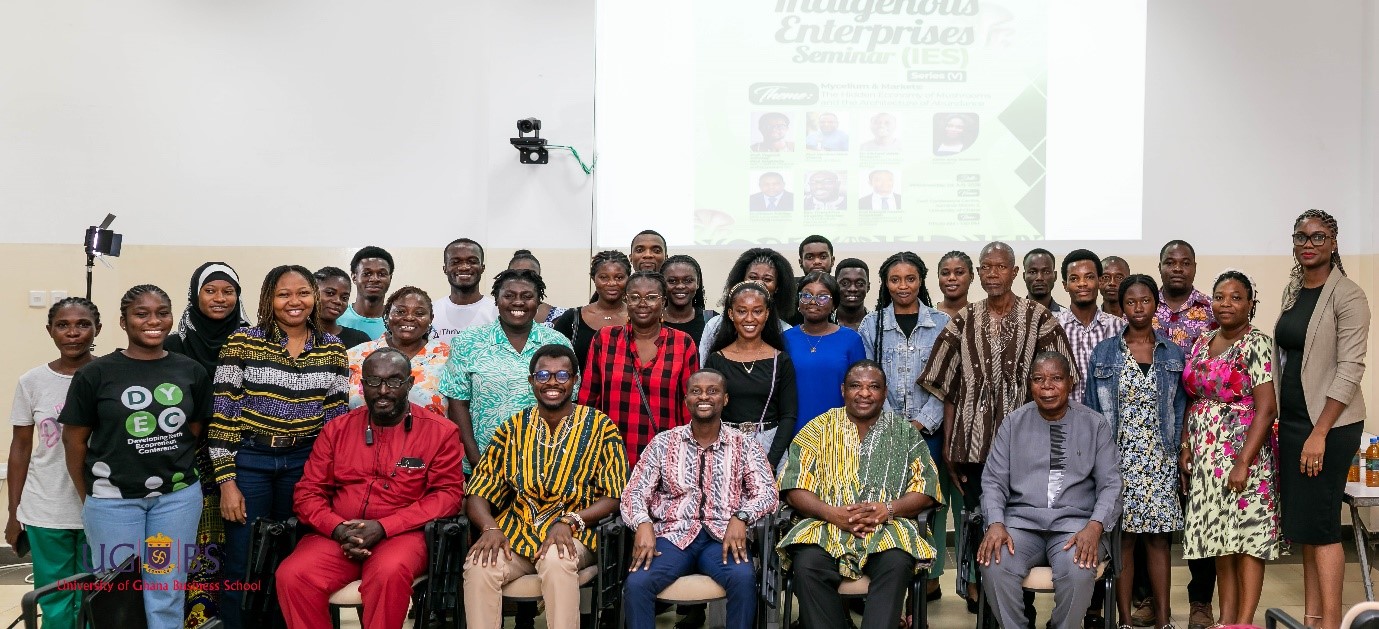
Prof. Yegandi Imhotep Paul Alagidede, the Bank of Ghana Chair in Finance and Economics, at UG, hosted the 5th edition of the Indigenous Enterprises Seminar Series on 1st July 2026 at the Cedi Conference Centre. Held under the theme, "Mycelium & Markets: The Hidden Economy of Mushrooms and the Architecture of Abundance," the seminar examined the economic, scientific and entrepreneurial potential of mushroom production as a viable indigenous enterprise capable of creating employment, promoting food security and driving sustainable economic growth. The seminar was moderated by Ms. Alelia Amy Asamoah, and brought together researchers, industry practitioners, entrepreneurs and students to explore how mushroom cultivation can contribute to Ghana's economic transformation through innovation, research and enterprise development.
In his welcome address, Prof. Yegandi Imhotep Paul Alagidede introduced participants to his concept of Metanomics & Mycelium in Action: The Little Legon Experiment in Abundance. He explained that the theme of the seminar was inspired by his mushroom farming experiment conducted in the Little Legon Forest, where he sought to demonstrate how indigenous enterprises can generate sustainable livelihoods while restoring natural ecosystems. Prof. Alagidede described mycelium as the unseen network of relationships, knowledge and cooperative exchange beneath the visible mushroom, noting that wealth creation often depends on invisible systems rather than what is immediately apparent. He explained that mushrooms provide a fitting metaphor for Metanomics because they regenerate discarded materials into food, medicine and income instead of depleting natural resources.

Prof. Alagidede explaining the inspiration behind his Little Legon Mushroom Experiment
Drawing from the Little Legon experiment, he explained that mushroom farming operates within a closed-loop production system where waste from one process becomes the input for another. According to him, the experiment demonstrated that the greatest barriers to mushroom production are not land availability but access to knowledge, quality spawn and modest start-up capital, all of which can be addressed through existing institutional support. Speaking on the broader significance of the research, Prof. Alagidede stressed the need for Ghana to identify alternative enterprises capable of creating employment beyond the public sector. He observed that the country's educational institutions continue to produce thousands of graduates annually, while the formal job market lacks the capacity to absorb them. He explained that the Indigenous Enterprises Seminar Series seeks to identify practical, affordable and easily replicable businesses that create forward and backward linkages across value chains while providing sustainable livelihoods for young people. He encouraged graduates to explore entrepreneurship as a means of generating additional income beyond monthly salaries, describing mushroom farming as an enterprise that combines economic opportunity with personal fulfilment.
Rev. Kingsley Quartey, Executive Director of the Ghana Mushroom Growers and Exporters Federation and Professor of Practice at Nile Valley Multiversity, delivered a presentation on "From Spawns to Harvest: Mushrooms as a Vehicle for Food Security, Jobs and Wealth in Ghana." He explained that mushrooms naturally grow on decaying organic matter, converting agricultural waste into nutritious food and high-value export products. He noted that mushroom spawn serves as the seed used to establish new crops and guided participants through the mushroom value chain, from laboratory production to cultivation, processing and export, highlighting the industry's significant potential for employment and wealth creation. Dr. Michael Wiafe-Kwagyan, Senior Lecturer in Plant and Environmental Biology, presented on "The Hidden Kingdom: Fungi, the Mycelial Network and the Science of Food." He described fungi as one of the least understood kingdoms of life, noting that more than 90% of fungal diversity remains undiscovered. He explained the important role fungi play in food production, preservation, nutrition and biotechnology, while also introducing participants to different mushroom varieties and the biological processes through which mushrooms develop from underground fungal networks into edible fruiting bodies.
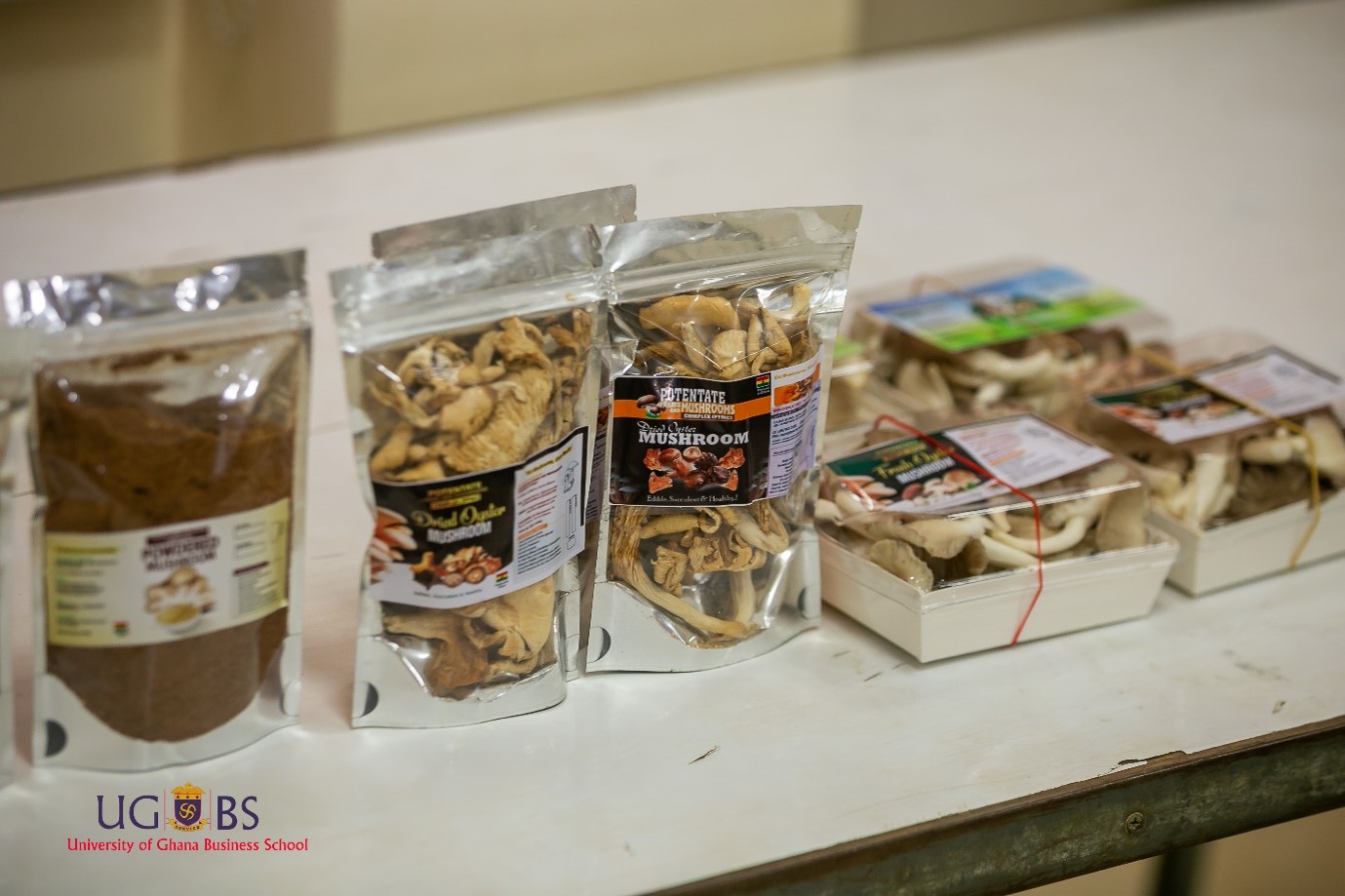
Exhibition of some processed mushrooms
Speaking on "Medicines from Mushrooms: Healing, Wellbeing and Fungal Enterprise," Dr. Gideon Adotey, Biochemist and Fungal Biotechnologist, highlighted the medicinal properties of mushrooms and their growing importance in modern healthcare. He explained that as mushrooms mature, they develop bioactive compounds with significant therapeutic value. According to him, scientific research has demonstrated that medicinal mushrooms possess immunomodulatory, antioxidant, antiviral, anti-inflammatory, antidiabetic and anti-tumour properties. Dr. Adotey further explained that the polysaccharides found in medicinal mushrooms bind to immune receptors, activating signalling pathways that strengthen the body's natural defence systems. He noted that medicinal mushrooms help regulate the immune system, improve resilience to stress, support mental clarity, enhance immunity and restore physiological balance. He also discussed the relationship between medicinal mushrooms and gut health, explaining that mushroom compounds nourish beneficial bacteria, strengthen the intestinal barrier and reduce inflammation. He concluded by demonstrating the medicinal uses of several mushroom species and their potential applications in healthcare and enterprise development.
The Provost of the College of Basic and Applied Sciences, Prof. Sandow Mark Yidana, delivered a presentation on "From Laboratory to Livelihood: The University as an Engine of Enterprise." He emphasised that mushroom farming requires relatively low start-up capital while offering significant commercial opportunities. He explained that mushroom and poultry production represent successful examples of indigenous practices that have been strengthened through scientific research and are supported by growing market demand. Prof. Yidana further noted that these enterprises form part of a broader portfolio of commercially viable agricultural research currently undertaken on University of Ghana lands, including aquaculture, rice breeding, oil palm cultivation and tree crop development. He stressed that these innovations are developed by university researchers and already possess commercial potential capable of generating employment and contributing to national development. He concluded by stating that the University's responsibility extends beyond research to creating enterprises, testing innovations and transferring them to society for sustainable economic impact.
The session continued with questions and answers discussing how mushroom production offers significant opportunities for enterprise creation, healthcare innovation and sustainable wealth generation, while highlighting the University's role in translating research into practical solutions for national development.
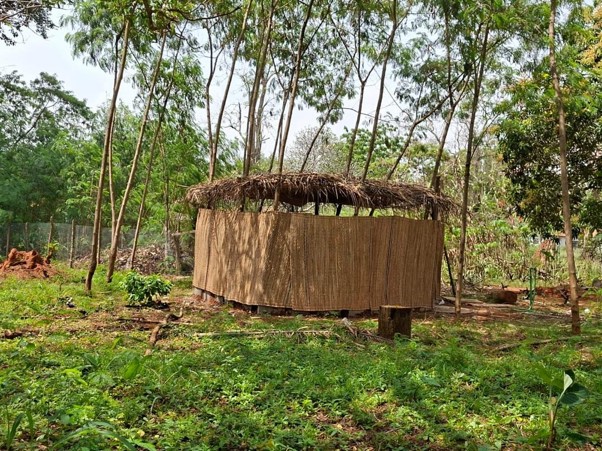
The Little Legon Mushroom Farm Growing House