Bank of Ghana Chair in Finance and Economics Hosts 3rd Indigenous Enterprises Seminar Series on Women-Led Indigenous Enterprises
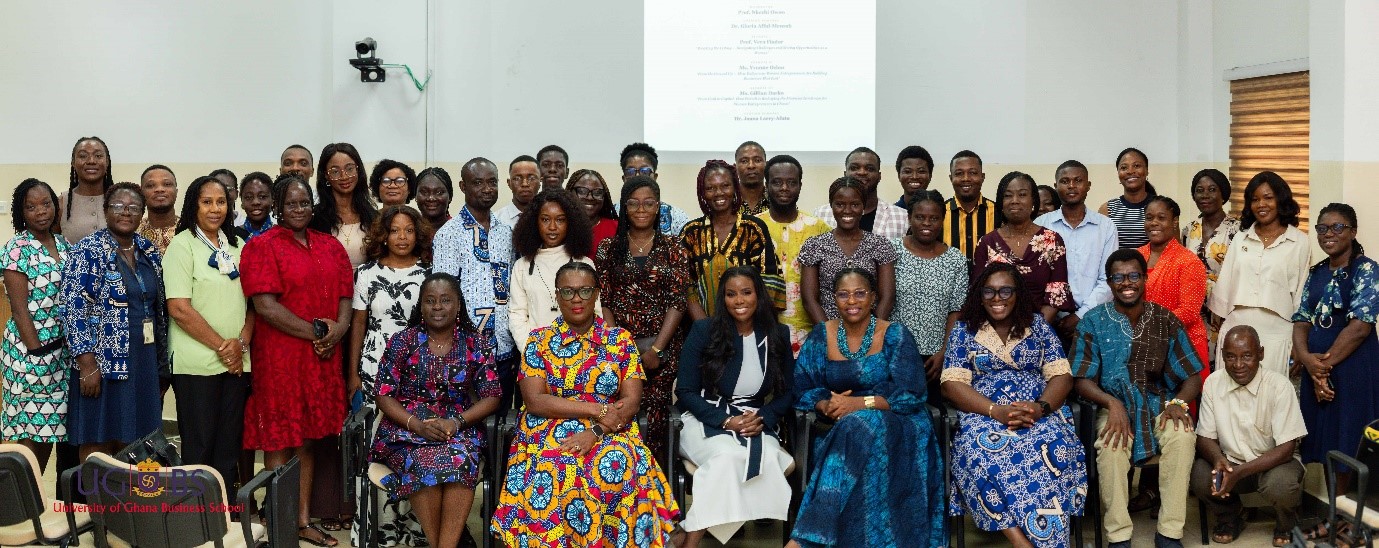
The Bank of Ghana Chair in Finance and Economics at the University of Ghana, Prof. Paul Yegandi Imhotep Alagidede, has hosted the 3rd edition of the Indigenous Enterprises Seminar Series themed “Rooted & Rising: Women at the Forefront of Indigenous Enterprises.” The seminar was held on 20th May 2026 at the University of Ghana Cedi Conference Centre, and it brought together scholars, industry leaders, and entrepreneurs to discuss how Ghanaian women are shaping, sustaining, and scaling businesses that carry their culture forward through keynote dialogues, practical strategy, and professional exchange. The speakers for the seminar were Prof. Vera Ogeh Fiador, Head of the Department of Finance at the University of Ghana Business School (UGBS); Ms. Yvonne Ocloo, Chief Executive Officer of TopDog Africa and an EWN EXCOM member; and Ms. Gillian Darko, Vice President, Strategy at Yellow Card.
In her presentation titled “Breaking the Ceiling: Navigating Challenges and Seizing Opportunities as a Woman,” Prof. Vera Fiador discussed the structural, cultural, and personal barriers that continue to hinder women’s advancement in leadership and entrepreneurship. She stressed that breaking barriers requires first identifying and understanding them, noting that many ceilings are often invisible and reinforced through social norms, networks, and silence. Prof. Fiador further encouraged women to “unlearn smallness,” reject excessive self-limitation, and confidently claim positions of leadership and authority. She also explained the importance of recognition, time, support systems, and shared responsibility in empowering women, adding that true empowerment should lead not only to individual success but also to generational transformation that creates opportunities for others.
She further noted that women’s empowerment must go beyond visibility and symbolic inclusion to creating lasting systems that support future generations. According to Prof. Fiador, when women are given the opportunity to lead, own value, and influence decision-making, the impact extends beyond the individual to families, communities, and national development. She therefore called for deliberate efforts to redesign institutional and social structures to make leadership spaces more inclusive and accessible for women. Prof. Fiador also encouraged women to build networks, build relationships, and get into the right places. She urged women to document their business ideas and data before presenting to potential investors and to seek help where necessary. She further called for attention to the realities of women’s enterprises and structural barriers, stressing the need to change norms that are made to be believed and focus on rising.
Speaking on the theme “How Indigenous Women Entrepreneurs are Building Businesses that Last,” Ms. Yvonne Ocloo, Chief Executive Officer of TopDog Africa and EWN ExCom member, traced her entrepreneurial journey from her university days at the University of Ghana, where she co-led the revival of the Miss Legon pageant. She described how early experiences, family skills, and informal apprenticeships in areas such as catering, fashion, and hairdressing shaped her ability to build and execute large-scale projects in later life. She called for a deeper recognition and re-evaluation of indigenous women entrepreneurs, arguing that their lived experiences and informal systems of knowledge are central to business creation and sustainability in Ghana. Ms. Ocloo emphasised that many women-led enterprises are built on “rootedness,” a combination of family networks, community knowledge, informal finance, and practical skills which often remain undervalued in formal business and academic systems.
She noted that despite women being central to indigenous enterprise as owners, financiers, and trainers, they are often recognised for resilience rather than strategy and excluded from policy and financial decision-making spaces. She also highlighted structural barriers facing women entrepreneurs, including limited access to financing for service-based or idea-driven businesses, bias in procurement processes, and what she described as a “credibility tax” that women pay to prove their leadership and business legitimacy. According to her, many women-led businesses struggle not due to lack of competence, but due to systemic scepticism and underinvestment. Reflecting on her experience building TopDog Africa, she explained that credibility in business is often costly, requiring consistency, sacrifice, and sustained excellence. She added that indigenous entrepreneurs operate in complex environments where informal and formal systems intersect, demanding high levels of adaptability and intelligence. Ms. Ocloo concluded by urging a shift in how women-led enterprises are supported, calling for a transition from passion-driven entrepreneurship to structured value creation, stronger systems, strategic networks, and institutional legacy building. She further advocated for greater inclusion of women in advisory boards, financial product design, and research, stressing that indigenous women entrepreneurs must be recognised not only as participants in the economy but as builders of lasting institutions.
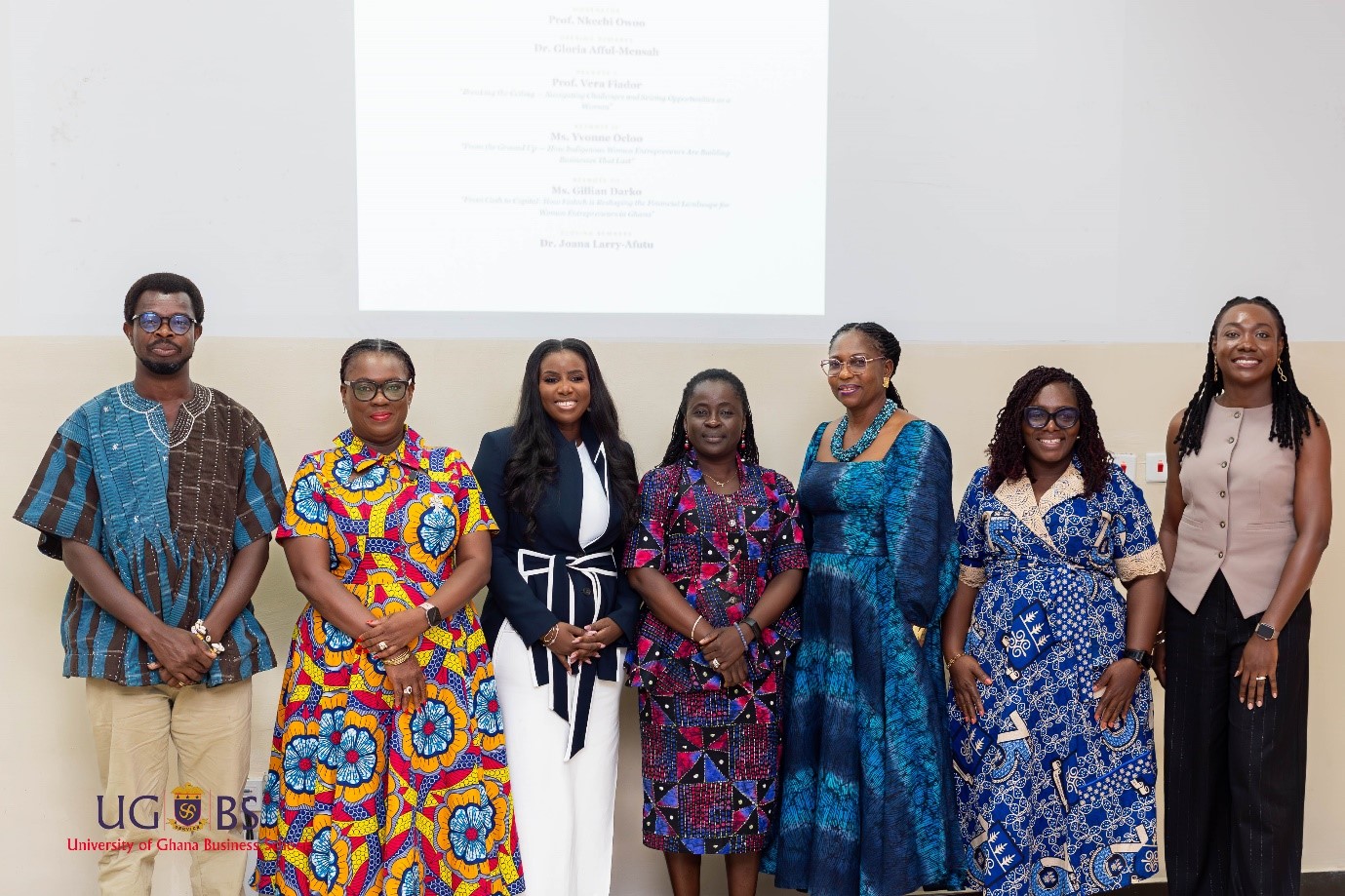
Prof. Alagidede with the speakers and moderator for the seminar
Ms. Gillian Darko, Vice President, Strategy at Yellow Card, delivered a presentation on the theme “From Cash to Capital: How fintech is reshaping the financial landscape for women entrepreneurs in Ghana.” She examined the evolution of Ghana’s financial ecosystem and highlighted the transformative role of mobile money in expanding economic opportunities for women entrepreneurs. According to her, the introduction of MTN Mobile Money (MoMo) and MoMo Pay has enabled many women traders to receive digital payments, build transaction records, and reach more customers without relying on traditional banking systems. She further noted that initiatives such as the GSMA Connected Women programme have contributed to increasing women’s participation in digital finance and entrepreneurship. Presenting data on women entrepreneurship in Ghana, Ms. Darko observed that although women dominate entrepreneurship in the country, with over 46% participation, nearly 80% of women-led businesses remain at the micro level due to barriers such as lack of collateral, low financial literacy, and limited access to formal finance. She explained that fintech is changing this reality by creating digital financial footprints through mobile money, merchant payment systems, and accessible digital platforms that do not require physical bank branches.
She also pointed out that Ghana’s improving digital infrastructure and cybersecurity environment continue to strengthen confidence in digital finance solutions for businesses. Ms. Darko also discussed the growing relevance of stablecoins and tokenisation in creating new economic opportunities for women entrepreneurs. She explained that stablecoins can help protect business savings from cedi depreciation, reduce the cost of remittances and cross-border transactions, and enable women-owned businesses to participate more effectively in global markets. She stated that tokenisation could allow women to raise capital, preserve wealth digitally, and build generational wealth through their businesses and assets. She encouraged women entrepreneurs to fully embrace digital payments, invest in financial literacy, formalise their businesses, and prepare for the future of digital finance.