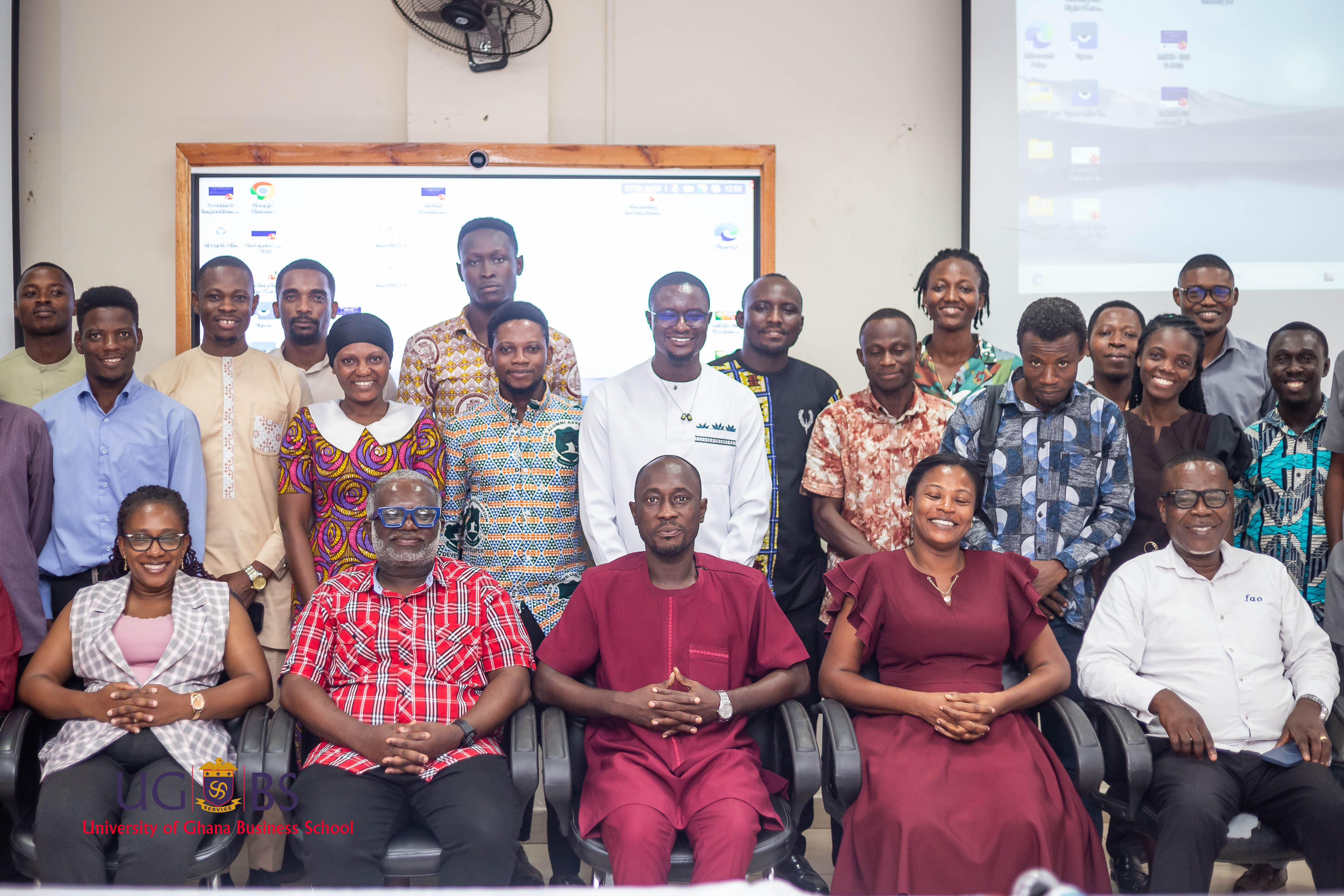
Department of Accounting Holds Seminar on Conceptualisation of Grant Proposal Writing
The Department of Accounting at the University of Ghana Business School (UGBS) has organised a seminar on the conceptualisation of grant proposal writing, featuring Prof. Richard Boateng, Head of Grantsmanship. The session was held at the UGBS Graduate Building on 9th February 2026 and brought together faculty members and postgraduate students to deepen their understanding of grant development and improve their competitiveness in securing research funding.
In his presentation, Prof. Boateng addressed common mistakes in proposal writing and outlined practical rules relevant to the current research era. He emphasised that beyond technical excellence, funders increasingly expect intellectual coherence combined with managerial competence. Prof. Boateng presented four key practical guidelines for researchers operating at the intersection of theory, policy, and implementation: the use the Theory of Change to explain why an intervention matters, the use the Logframe to demonstrate the capacity and manage results, Avoiding Logframe development first, as this often leads to mechanical and incoherent projects and Ensuring that indicators measure change, not merely activity volume.
He explained that the distinction between Theory of Change and Logframe must translate into concrete practice. According to him, many proposals appear complete but lack an internally consistent change pathway. This, he noted, often results in reviewer comments such as “activities are not clearly linked to outcomes” or “impact claims are insufficiently justified.” For business school researchers, particularly those working in policy, entrepreneurship, digital transformation, and skills development, Prof. Boateng advised that they demonstrate clear causal reasoning. Funders, he said, are no longer satisfied with technically sound proposals alone; they want to understand how and why an intervention will generate measurable impact.
Prof. Boateng further observed that many high-quality research projects fail to influence policy, not because the evidence is weak, but because policy uptake was never designed into the research process. He noted that funders increasingly ask, “How will this research influence decisions, not just publications?” Designing for policy uptake, he explained, requires moving beyond dissemination strategies to mapping institutional pathways of influence. The session therefore covered practical approaches to designing outputs for policy use, a checklist for proposal development, and revised strategies for embedding research in contexts with high policy uptake potential.
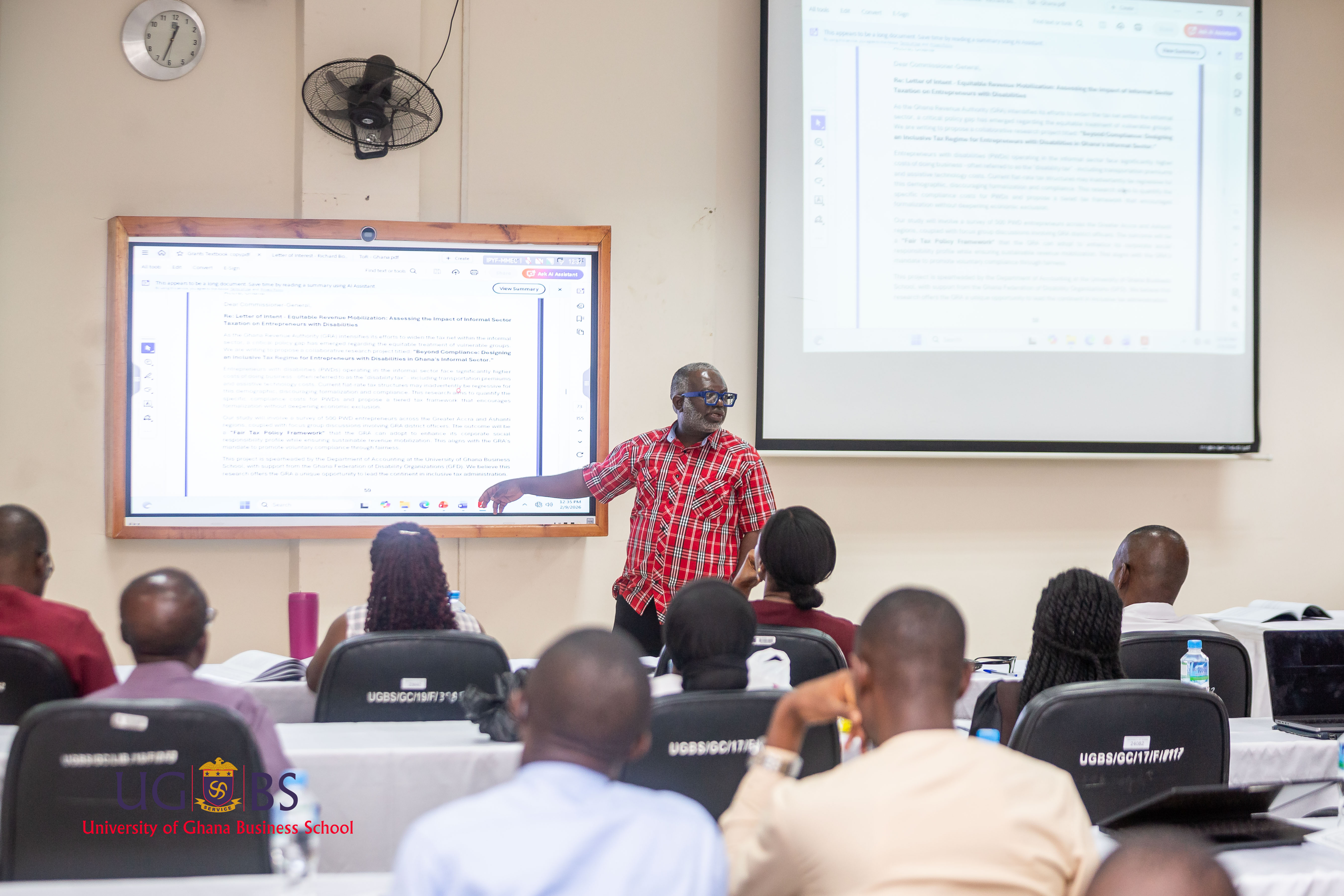
Prof. Boateng and participants during the seminar
In the latter part of the seminar, Prof. Boateng discussed “The Art of Proposal Writing,” providing guidance on drafting compelling institutional profiles and presenting research teams effectively. He advised participants to remove what he described as “PhD language” without losing rigour. According to him, such language often signals scholarly sophistication but obscures meaning. While it may be rewarded in academic journals, it is frequently penalised in grant reviews where clarity and precision are paramount. He also shared practical editing rules aimed at improving readability, coherence, and persuasiveness in grant applications.