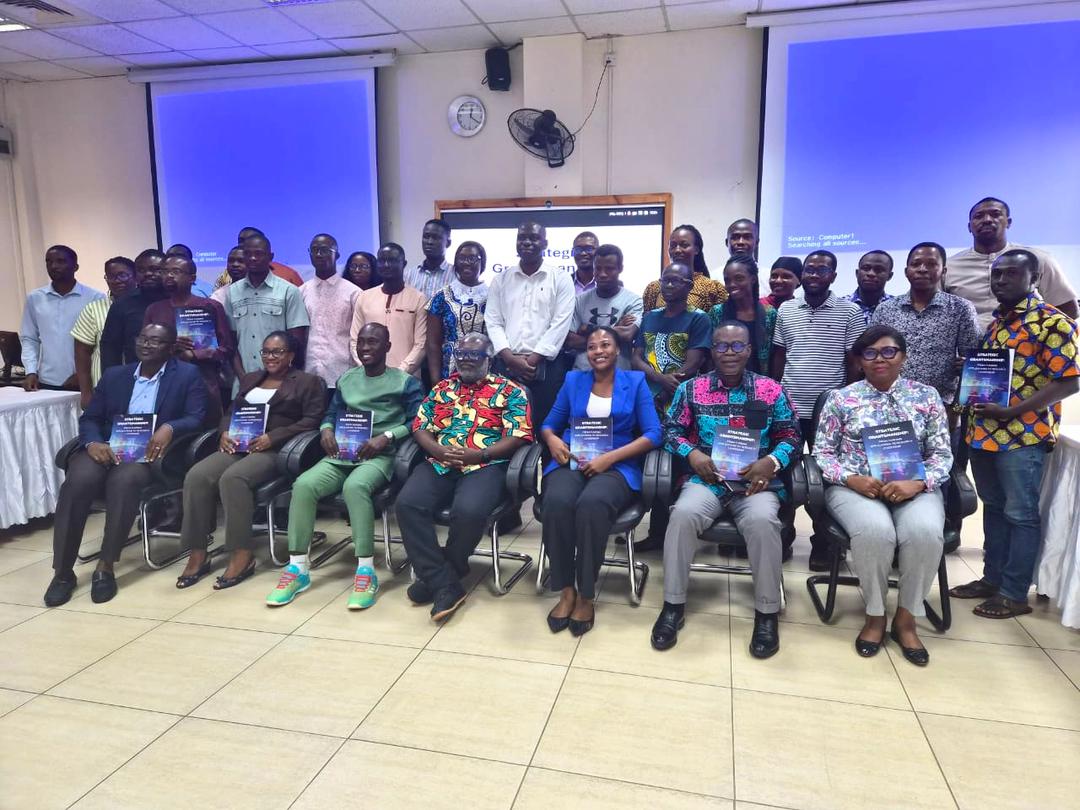
UGBS Department of Accounting Holds Grantsmanship Capacity-Building Programme
The Department of Accounting at the University of Ghana Business School (UGBS) has organised a grantsmanship capacity-building programme for Faculty members along with thesis-based students (MPhil and PhD candidates) of the Department. The programme was held on 4th February 2026, at the UGBS Graduate Building. Welcoming participants, the Head of the Department of Accounting, Prof. Godfred Matthew Yaw Owusu, explained the importance of grantsmanship to faculty and staff development, noting that it remains a key priority of the Department. He explained that the initiative was instituted by the Dean of UGBS as part of efforts to strengthen the school’s research capacity.
According to Prof. Owusu, the Department of Accounting, being the largest department in the school, took the lead by working collaboratively with students to equip them with essential grantsmanship skills. He stated that the programme was designed to enhance students’ capacity while improving the Department’s overall research experience. He further disclosed that the session marked the first of three capacity-building programmes scheduled for the semester. Prof. Owusu encouraged participants to value skill transfer among colleagues, develop strategic approaches to improving their performance, and actively engage in collaborative learning.
The keynote presentation was delivered by Prof. Richard Boateng of the Department of Operations and Management Information Systems, who is also the Head of Grantsmanship at UGBS. His presentation, titled “Strategic Grantsmanship: From Funding Applications to Research Leadership,” focused on positioning researchers to move beyond grant applications to sustained research leadership. As part of his presentation, Prof. Boateng introduced participants to his book, Strategic Grantsmanship: From Funding Applications to Research Leadership, which he noted is aligned with the University of Ghana’s Research Policy and serves as a practical guide for researchers navigating the funding landscape.
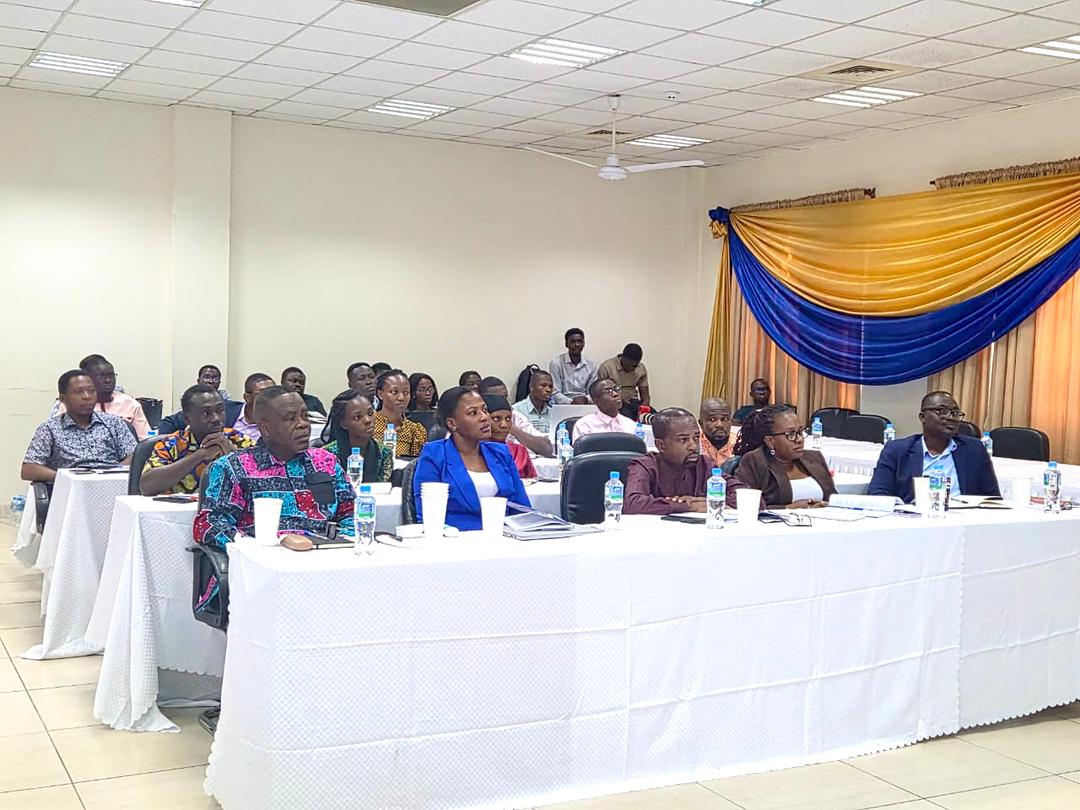
Participants at the programme
He provided an in-depth overview of the global and regional funding landscape, explaining that although funding opportunities are vast, they are not random but structured according to distinct funder typologies, each driven by specific motivations and strategic interests. He emphasised that successful grantsmanship requires tailoring research proposals to align with the priorities of different funding bodies. Prof. Boateng discussed various funding sources, including bilateral and multilateral agencies, private foundations and philanthropic organisations, corporate and industry funders, and government research councils. He introduced participants to funding institutions such as GIZ, the World Bank, Mastercard Foundation, the Bill & Melinda Gates Foundation, and Google Research Grants, sharing strategic insights on how to approach and apply to these institutions effectively.
He also spoke about scholarly recognition and ethical research practice, encouraging students to acknowledge and appreciate the work of scholars whose ideas inform their research. According to him, this not only strengthens academic networks but also increases opportunities for future research collaborations and grant partnerships. In addition, Prof. Boateng encouraged participants to position themselves as experts by producing simple handbooks and practitioner-oriented publications. He noted that such outputs help researchers gain visibility, attract speaking and training opportunities, and build institutional and individual research capacity.
He introduced participants to what he described as a “seed-to-scale” strategy, which leverages non-traditional funding sources as a pathway to securing large grants. He explained that researchers can begin by identifying institutions facing specific operational challenges, investing time or internal seed funding to conduct pilot studies, publishing initial findings in practitioner outlets, and subsequently pitching preliminary results to potential funders to support larger-scale research projects. He also discussed donor agenda shifts and cautioned participants against the use of expired donor language, emphasising the need to stay current with funder expectations. He further introduced participants to tools such as Pivot-RP and institutional resources like the University of Ghana Research, Innovation and Development (RID) website, which can be used to automate the search for funding opportunities.
The Dean of UGBS, Prof. Ernest Yaw Tweneboah-Koduah, was also in attendance. In his remarks, he stated that grantsmanship is central to his vision for the school, stressing the need for both faculty and students to be actively engaged in grant acquisition and management. He noted that acquiring such skills internally is cost-effective, as external training opportunities can be expensive. Prof. Tweneboah-Koduah emphasised that equipping emerging researchers with grantsmanship skills reduces the financial burden associated with research and enables them to devote more time and effort to producing high-quality scholarly work. He observed that, in many cases, resources are available but remain inaccessible due to limited knowledge of funding opportunities. He expressed appreciation to the Head of Department, faculty members, speakers, and students for the successful organisation of the programme and announced that all other departments within UGBS would organise similar programmes within a stipulated timeframe.
The programme concluded with an interactive question-and-answer session, during which participants sought clarification on various issues, and faculty members contributed extensively to the discussion. Participants learned that effective grantsmanship begins with identifying the right partners whose missions align with their research interests. Participants were further assured of the University of Ghana’s administrative and logistical support for resource mobilisation efforts, as outlined in Section 5.9 of the University’s Research Policy.