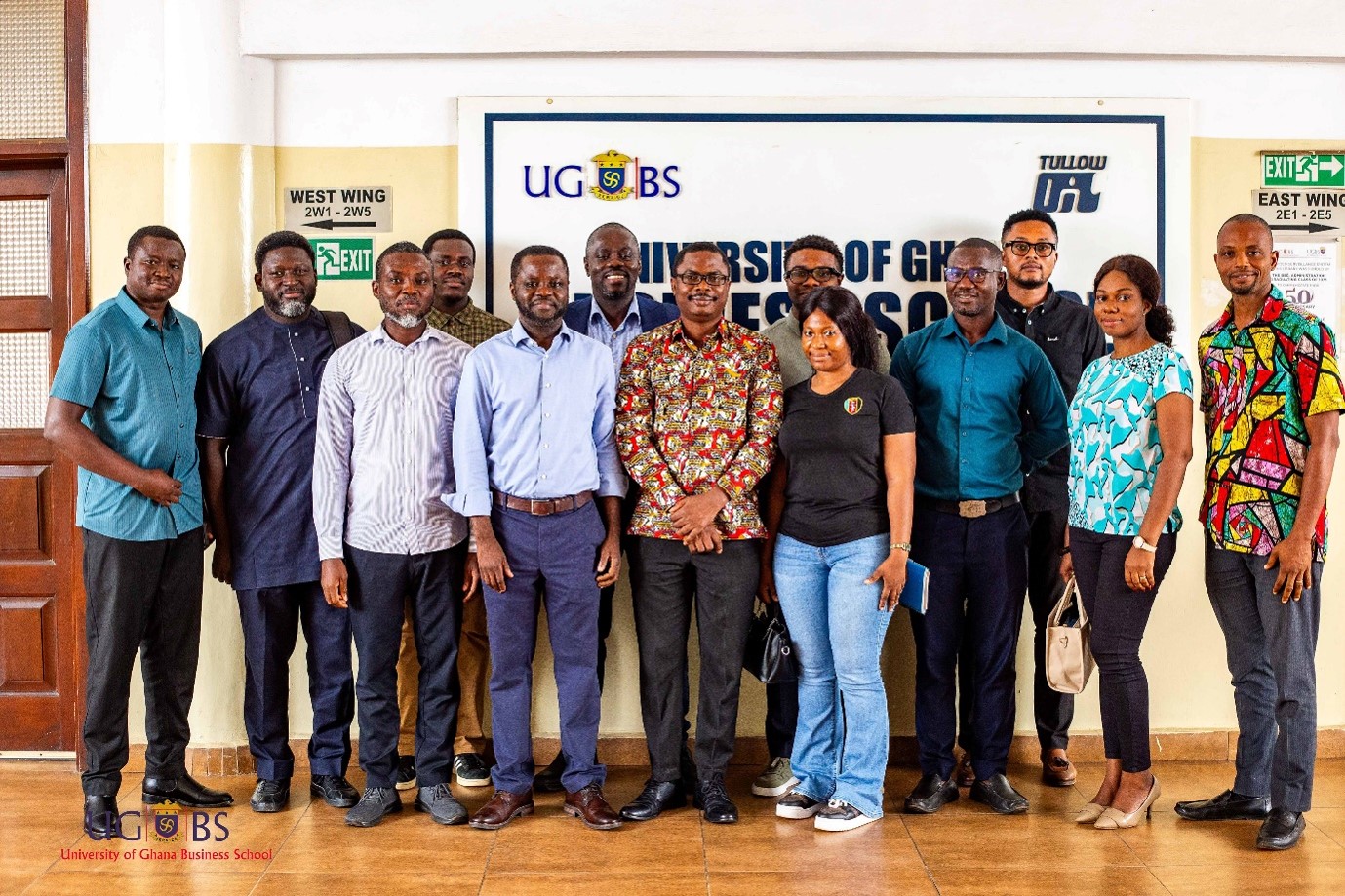
UGBS PhD Programmes Unit holds Workshop on the Realities of Doctoral Success
The PhD Programmes Unit at the University of Ghana Business School (UGBS) organised a workshop to equip doctoral students with practical insights into the realities, challenges and less-discussed aspects of pursuing a PhD. The workshop, themed “The Secret Source of Academic Success: What We Don’t Typically Talk About in PhD Programmes,” was held on 30th July 2026 at the UGBS Graduate Building. It was facilitated by Prof. Samuel Adomako, Chair in Entrepreneurship and Innovation at Birmingham Business School, University of Birmingham, UK, and moderated by Dr. Baah Aye Kusi of the Department of Finance, UGBS. The session provided participants with an honest perspective on doctoral education, covering persistence, academic criticism, publication, supervision, academic culture, mental wellbeing, work-life balance and the transition from doctoral studies into professional life. In his welcome remarks, Dr Baah Aye Kusi noted that a PhD is a grooming process and emphasised that such seminars and engagements equip doctoral students to navigate and overcome challenges that may arise during their research journey.
Prof. Adomako began the workshop by sharing aspects of his personal PhD journey and experiences, using them to encourage participants and provide perspective on the doctoral experience. He explained that people pursue PhDs for different reasons but stressed that doctoral education goes beyond acquiring a qualification. According to him, a PhD develops independent thinking, research design and problem-solving, intellectual confidence under uncertainty, writing, analysis, communication and independent learning. He noted that while everyone admitted to a PhD programme is academically capable, intelligence alone is not enough to guarantee success. Persistence, he said, often matters more than brilliance, while emotional resilience becomes essential in navigating the uncertainties of doctoral research. Prof. Adomako described the PhD journey as “messy and not linear”, noting that confusion and revision are normal parts of the process. He explained that discovery often comes through failure, research questions may evolve, data collection may not go as planned, and frameworks and methods may change as the research progresses. He further observed that doctoral work involves considerable ambiguity because answers are not always obvious.
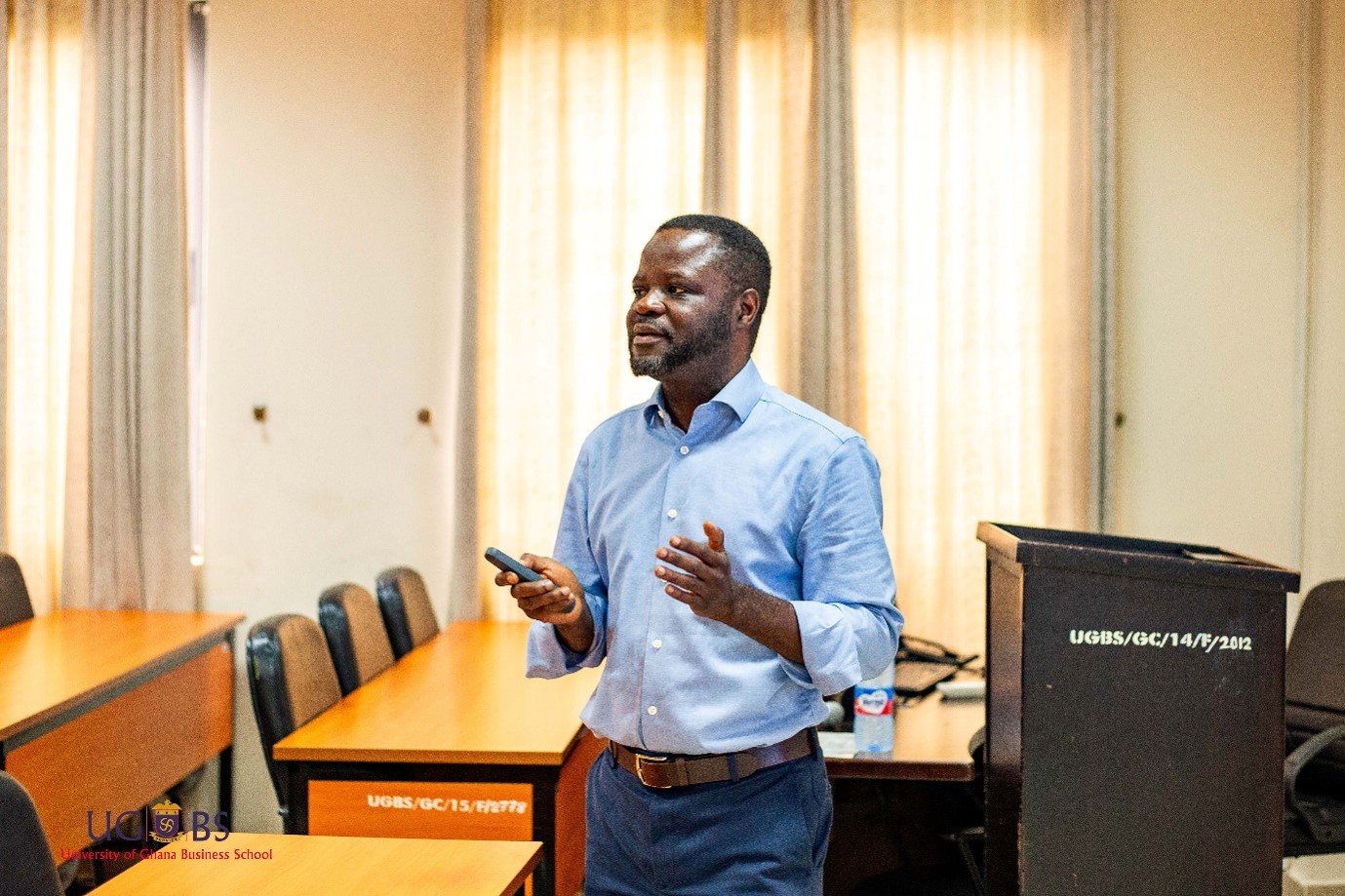
Prof. Samuel Adomako delivering a presentation at the UGBS Doctoral Workshop
A key message from the workshop was the importance of persistence. Prof. Adomako noted that success depends on consistency, continuing despite setbacks and recognising that progress is often slow. He also shared insights into the difficulties researchers face in publishing, noting that rejection is part of academic life. Drawing from his own experiences, including challenges he encountered as a researcher from the Global South, he encouraged students not to allow rejection or setbacks to derail their academic aspirations. He stressed that failure is part of the process and recovery skills are essential for researchers. He also cautioned participants against comparing their doctoral journeys with those of their peers, stressing that every PhD experience is different. He therefore encouraged students to develop a sustainable system that works for their personality, goals and circumstances, rather than attempting to follow a universal formula for doctoral success. He reminded participants that a thesis does not define their entire future. While many students may believe that their thesis topic will permanently determine their careers, he explained that a PhD develops transferable skills such as critical thinking, research design, problem-solving, writing, analysis, communication and independent learning. These skills, he noted, can support careers beyond academia, including consulting, industry, government and policy, entrepreneurship, technology and leadership roles.
Another major focus of the workshop was the pressure students place on themselves to produce perfect work. Prof. Adomako explained that some students believe every chapter must be exceptional, every sentence flawless and every argument airtight. Such perfectionism, he noted, can lead to paralysis and delay progress. He encouraged students to recognise that no thesis is flawless, and contribution matters more than perfection. In his advice to doctoral students, he stressed that “done is better than perfect”, explaining that a submitted thesis is better than an unfinished masterpiece. Prof. Adomako also addressed the role of criticism in academic development. He explained that doctoral students will have their ideas challenged by supervisors, reviewers, conference audiences, examiners and peers but strong researchers learn to use criticism constructively and develop the resilience necessary to improve their research in response to feedback.
The facilitator further drew participants’ attention to the realities of academic politics and culture. He noted that academia is not purely merit-based and that departments can involve power struggles, intellectual factions, competition, ego clashes, territorial behaviour and gatekeeping networks. Prof. Adomako consequently emphasised the importance of professional visibility. He encouraged doctoral students to present their work, build an academic presence and network, noting that visibility and professional relationships can support career growth. He explained that supervisors vary considerably: while some are highly supportive, others may be less available, and some may be brilliant researchers but less effective mentors. He therefore stressed the importance of taking ownership of the doctoral project. Prof. Adomako also addressed the personal challenges associated with doctoral research, noting that PhD study can be deeply isolating. Independent work, he said, can affect students’ wellbeing, while anxiety and burnout can affect productivity.
Prof. Adomako concluded his presentation with practical advice drawn from the experiences of PhD graduates. He encouraged students to write from day one, even badly, because editing is easier than staring at a blank page, find a community of peers who understand the realities of doctoral study. In his closing remarks, Dr. Baah Aye Kusi encouraged participants to remain persistent throughout their doctoral journey and to recognise their supervisors as guides in the research process. He advised students to follow their supervisors’ guidance and instructions, while also paying attention to how their supervisor’s approach academic writing. He encouraged them to learn from these approaches and, over time, develop their own writing styles and professional identities.