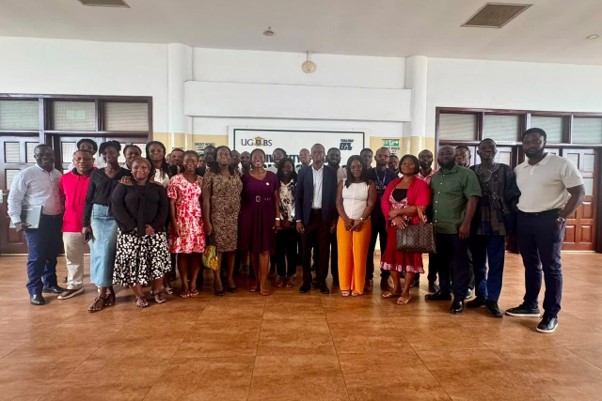
TaFW Training Group Hosts Fourth STEG Workshop on Research Grantsmanship
The Transform Africa from Within (TaFW) Training Group at the University of Ghana Business School (UGBS) Grant Management Office, in collaboration with the School of Graduate Studies, hosted its fourth Structural Transformation and Economic Growth (STEG) Workshop, focusing on practical approaches to securing research grants. The workshop, themed “Grant Writing for Graduate Students” was held on 30th July 2026, at the UGBS Graduate Building and facilitated by Prof. Edward Asiedu of the Department of Finance, UGBS. The training was designed to equip graduate students and faculty with practical knowledge and skills required to develop competitive research grant proposals and successfully navigate the grant application process.
In his opening remarks, Prof. Asiedu provided participants with an overview of the STEG project, its focus on building research capacity and efficiency, and the various training sessions undertaken since its inception. He explained that research is fundamentally about collaboration, noting that the TaFW Training Group’s approach to selecting participants was informed by the need to create an environment where meaningful networking and collaboration could take place. Prof. Asiedu explained the importance of grants to the quality and scope of research researchers can undertake, particularly international research, which can be expensive and requires adequate financial support. He noted that a researcher’s career extends beyond retirement and therefore encouraged researchers to view grant acquisition as an important component of building sustainable research careers. Discussing why grants matter, Prof. Asiedu examined the benefits to researchers, institutions and the wider competitive research landscape. He encouraged researchers to budget appropriately for their time based on the amount of funding available, stressing the importance of honest and realistic budgeting in grant proposals. On the competitive landscape for research funding, he explained that success is often determined by three major factors: methodological rigour, policy alignment and institutional capability.
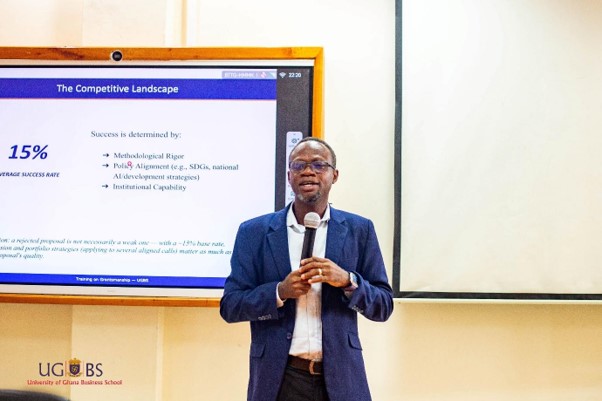
Prof. Edward Asiedu at the 4th STEG Workshop
Prof. Asiedu also drew a distinction between grant proposals and published academic papers, explaining that although both require strong writing and analytical skills, they serve different purposes. He noted that academic papers can report null or unexpected results as valid contributions to knowledge, whereas grant proposals must project confidence in achieving the stated outcomes while also demonstrating that potential risks and contingencies have been considered and appropriately budgeted for. He identified several important skills required for successful proposal writing, including storytelling, persuasive writing, financial literacy for budgeting, stakeholder mapping, strict compliance with formatting and page-limit requirements, and cross-institutional teamwork. He added that paper-writing skills and proposal-writing skills reinforce each other. Prof. Asiedu explained that most funding organisations screen research ideas through several stages before committing resources to a full proposal. Understanding this funding “funnel”, he said, helps researchers save time and focus their efforts at every stage. The typical process may involve a concept note, letter of inquiry, invited full proposal, due diligence and negotiation, followed by a grant agreement and award. He, however, cautioned that not all funders use every stage of the process. He subsequently took participants through the purpose, format and typical length of letters of inquiry and letters of intent. He discussed what these documents should contain, how topics should be structured, and the core areas that can persuade funders to move an application to the next stage.
A major component of the workshop was a practical session during which Prof. Asiedu guided participants through the process of identifying available grant funding opportunities and explained, step by step, how researchers could position themselves to take advantage of such opportunities. He encouraged participants to identify potential collaborators and adopt the right approach when seeking research partnerships. He explained that the ability to identify the right researchers and personnel for a project is an important part of successful grantsmanship. Prof. Asiedu also discussed what reviewers look for in grant proposals and some of the common scoring criteria used in assessing applications. He stressed that problem identification is key, as properly identifying a problem can open opportunities for researchers to develop more researchable questions and stronger proposals. He further encouraged participants to understand the funder’s priorities and eligibility requirements before investing significant time in developing an application.
Prof. Asiedu emphasised that successful grant acquisition is not solely the responsibility of individual researchers. He explained that institutional support is equally important, particularly at the pre-award stage. He outlined several responsibilities that an efficient research support unit within an institution should undertake. These include searching for grant Request for Proposals (RFPs) and sharing relevant opportunities with faculty, following Research and Innovation Directorate (RID) emails for calls, and providing letters of support for grant applications. He advised researchers to inform their institutions ahead of time when applying for grants, particularly where institutional documentation or approval is required, while keeping the submission deadline in mind. According to Prof. Asiedu, funders may want to know, even at the pre-award stage, who within the university will be responsible for managing the grant. He therefore highlighted the importance of clear procedures for grant administration and management. He also discussed institutional overhead requirements, noting that universities may have standard overhead rates, such as 15 or 20 percent. Researchers, he advised, must always check the RFP for applicable overhead thresholds or waivers.
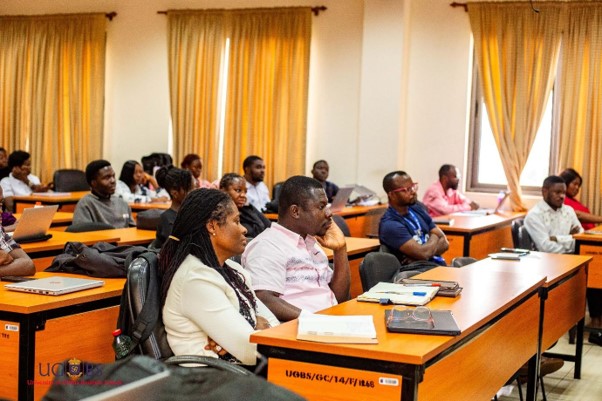
Some participants at the 4th STEG Workshop
Prof. Asiedu encouraged participants to use different keywords and multiple search iterations when looking for grants. He recommended searches such as “Call for proposal”, “Request for research proposal (RFP)”, “for universities” and “research centres”, among others. He also encouraged participants to leverage calls posted on other university websites and subsequently navigate to the funder’s own website to find the original call and access the full details. He explained that searching calls circulated by other universities can sometimes help researchers identify opportunities but stressed the importance of going to the funder’s original page to verify the call and obtain the complete requirements. Prof. Asiedu further introduced participants to major global funders, the types of projects they support and how researchers can access their funding opportunities. He noted that while research areas may change, the skills required for successful research do not; rather, those skills should continually improve. The workshop also addressed the practical aspects of managing grants once an opportunity has been identified. Prof. Asiedu discussed the importance of managing timelines, building and managing grant teams, coordinating co-Principal Investigators and managing cross-institutional relationships. He also cautioned participants to pay close attention to deadlines, particularly when submitting proposals to international funders because of time-zone differences. He also drew participants’ attention to the expanding opportunities in AI and development funding in 2026. He encouraged researchers to remain attentive to emerging funding priorities and to develop the skills required to position their research ideas competitively within these changing funding landscapes.