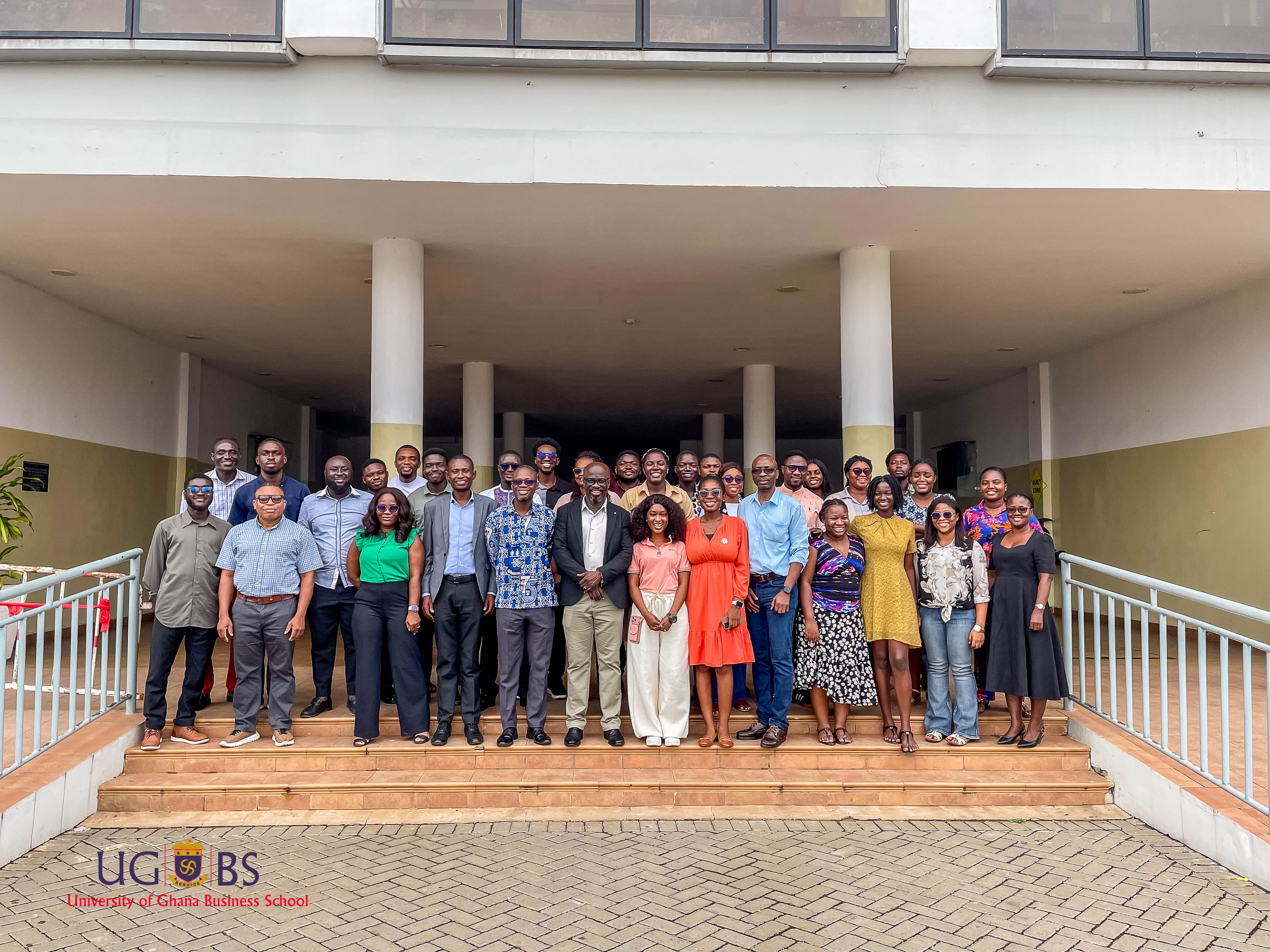
TaFW Group Organises STEG Workshop on Agricultural Productivity and Sectoral Gap Analysis
The University of Ghana Business School (UGBS) Research and Grant Management Office, in collaboration with the School of Graduate Studies and the Transform Africa from Within (TaFW) Group organised a two-day STEG Graduate Students Workshop on “Agricultural Productivity and Sectoral Gap Analysis: Empirical Methods for Productivity Measurement.” The workshop was held from 27th to 28th August 2026 at the University of Ghana Business School Graduate Building and was facilitated by Prof. Edward Ebo Onumah, Associate Professor of Agricultural Economics at the University of Ghana, and Dr. Theophilus Tweneboah Koduah, Senior Lecturer at the University of Professional Studies, Accra. The two-day programme focused on equipping graduate students with empirical approaches to understanding and measuring agricultural productivity, efficiency and technological differences. The sessions combined theoretical discussions with practical applications using empirical agricultural studies.
At the beginning of the workshop, participants were introduced to the concept of agricultural productivity and its relationship with production, efficiency and technology. The facilitators explained agricultural productivity as a measure of the efficiency with which a farming system operates, with productivity generally expressed as the ratio of output to the inputs used, including land, labour, seed and fertiliser. The workshop also distinguished between agricultural production and productivity, noting that while production considers the number of crops or livestock produced, productivity considers how efficiently resources are transformed into output. The facilitators illustrated this distinction using examples of farms with different levels of output and land productivity. Participants were further introduced to production functions as quantitative or mathematical descriptions of the technical production possibilities available to a farm. The sessions covered a range of production function specifications, including linear, Cobb–Douglas, quadratic, normalised quadratic, translog, and generalised Leontief functional forms.
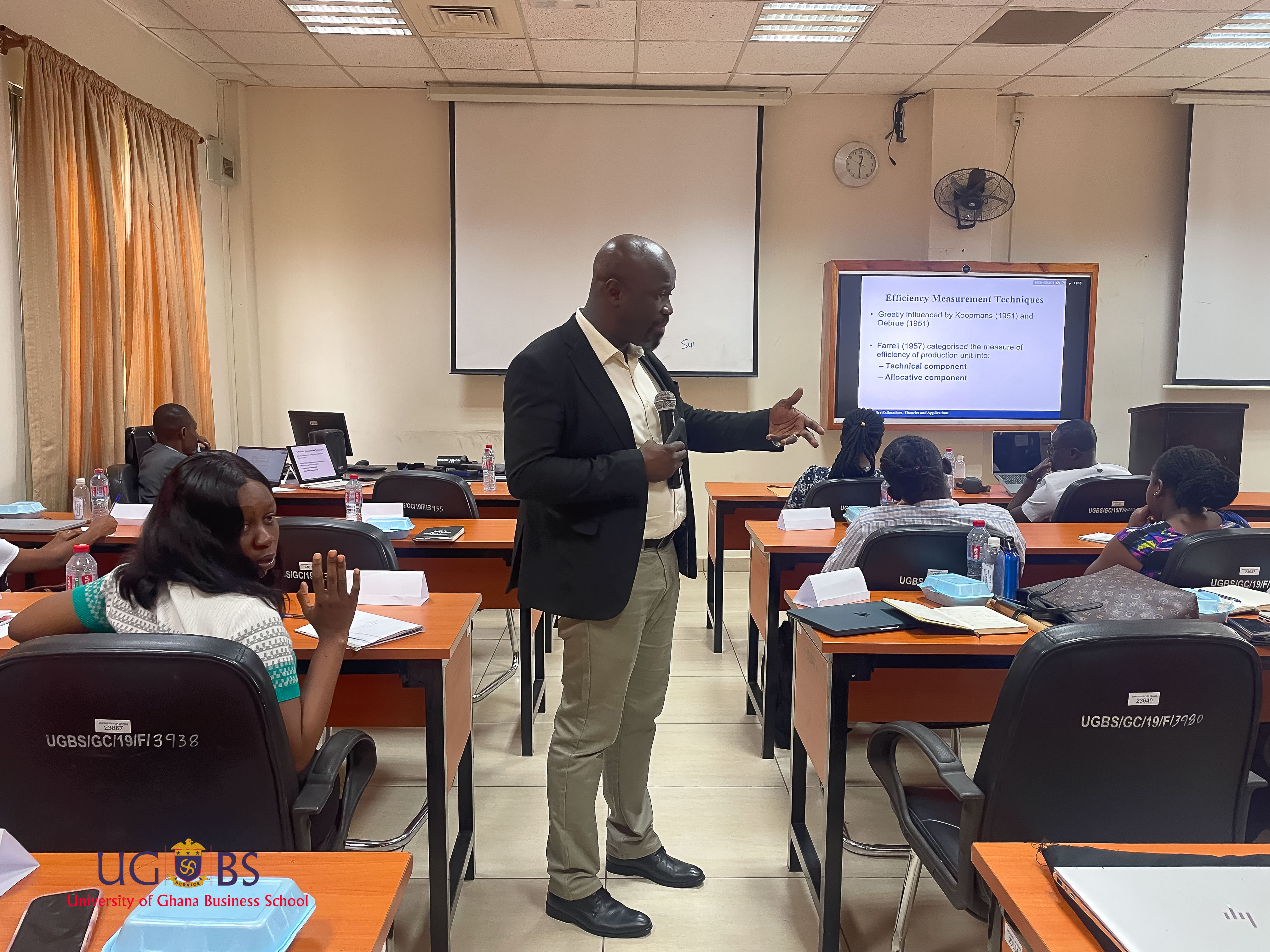
Prof. Edward Ebo Onumah lecturing at the STEG workshop on Agricultural Productivity and Sectoral Gap Analysis
A key area of the workshop was the relationship between productivity, efficiency and technology. Using a three-farm scenario, the facilitators demonstrated how differences in productivity can arise from the technology available to farmers, technical efficiency and the amount of output obtained from a given level of input. The discussion also showed how farmers may have good technology but poor management, good management but poor technology, or both good technology and good management. The facilitators subsequently examined efficiency measurement techniques, drawing on the contributions of Koopmans, Debreu and Farrell. Participants were introduced to technical efficiency, allocative efficiency and economic efficiency, as well as the distinction between parametric and non-parametric approaches to frontier estimation.
The workshop also covered Data Envelopment Analysis (DEA) as a non-parametric frontier technique and Stochastic Frontier Analysis (SFA) as a parametric approach. In discussing SFA, the facilitators explained how the method accounts for technical inefficiency while also capturing random shocks that may affect production. Participants were taken through deterministic and stochastic frontier estimation, alternative functional forms, estimation procedures and distributional assumptions relating to statistical noise and inefficiency effects. The sessions further addressed the estimation of stochastic frontier models, including the use of Corrected Ordinary Least Squares (COLS) and Maximum Likelihood (ML) methods, with the facilitators noting the preference for the ML estimator because of its asymptotic efficiency. Participants were also introduced to hypothesis testing techniques, including the T-test and Log-likelihood Ratio Test. Another component of the workshop focused on incorporating exogenous influences into efficiency measurement. The facilitators also examined how factors such as competitive pressure, input and output indicators, network characteristics, socio-economic conditions, and managerial variables can influence efficiency, and introduced participants to different approaches, including two-stage and single-stage methods, for incorporating these factors into stochastic frontier models.
Dr. Theophilus Tweneboah Koduah engaging participants at the STEG Workshop
The second part of the workshop focused on sectoral gap analysis, with attention to the factors that can prevent agricultural systems from achieving their full potential. Participants examined the differences between observed output and potential, attainable and frontier yields. The facilitators noted that a productivity gap should not automatically be interpreted as a technology gap, as it could also result from input constraints, management inefficiencies, inadequate infrastructure, weather shocks, unfavourable market conditions, institutional constraints, and limited access to knowledge and finance. Participants were also taken through the conceptual decomposition of productivity gaps into input-use gaps, technical inefficiency gaps, technology gaps, allocative inefficiency and environmental gaps.
The workshop further introduced participants to the stochastic meta-frontier technique, which allows researchers to investigate the technical efficiency of farms or firms operating with different technologies. The approach estimates technology gaps relative to the potential technology available to the industry as a whole and provides a basis for comparing production frontiers across different groups or regions. A practical session enabled participants to apply the concepts and methods discussed during the workshop to empirical agricultural studies. The studies referenced included research on technical efficiency in fish farms in Ghana, meta-frontier analysis of organic and conventional cocoa production in Ghana, and technical efficiency of improved and local variety seed maize farms in Ghana.
During the workshop, Prof. Edward Asiedu and Prof. Mohammed Amidu also joined the sessions to engage participants on the broader opportunities available under the STEG programme. They briefed participants on the forthcoming STEG Workshop on Impact Evaluation, highlighting its relevance to strengthening participants’ capacity to design and undertake rigorous empirical research. They also drew attention to available support for conference participation and travel, as well as data collection for research projects, encouraging participants to identify and take advantage of these opportunities to advance their research. The professors further encouraged participants to become more actively involved in STEG activities, including workshops, research initiatives, and other capacity-building programmes. Their engagement emphasised the importance of sustained participation in the programme, not only for developing methodological and research skills but also for strengthening research outputs, expanding professional networks, and contributing to the broader objectives of the STEG programme.
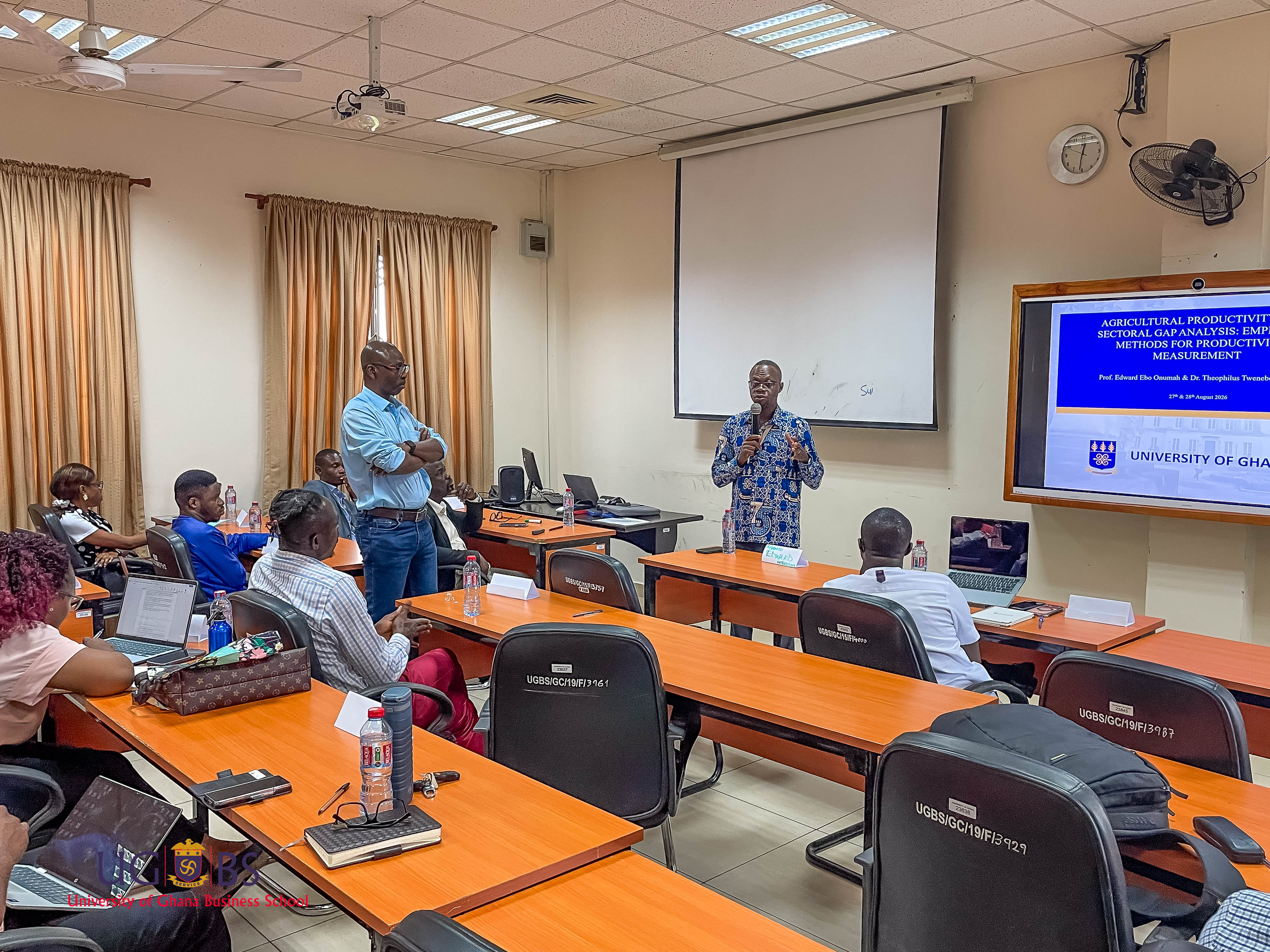
Prof. Edward Asiedu and Prof. Mohammed Amidu addressing participants at the STEG workshop