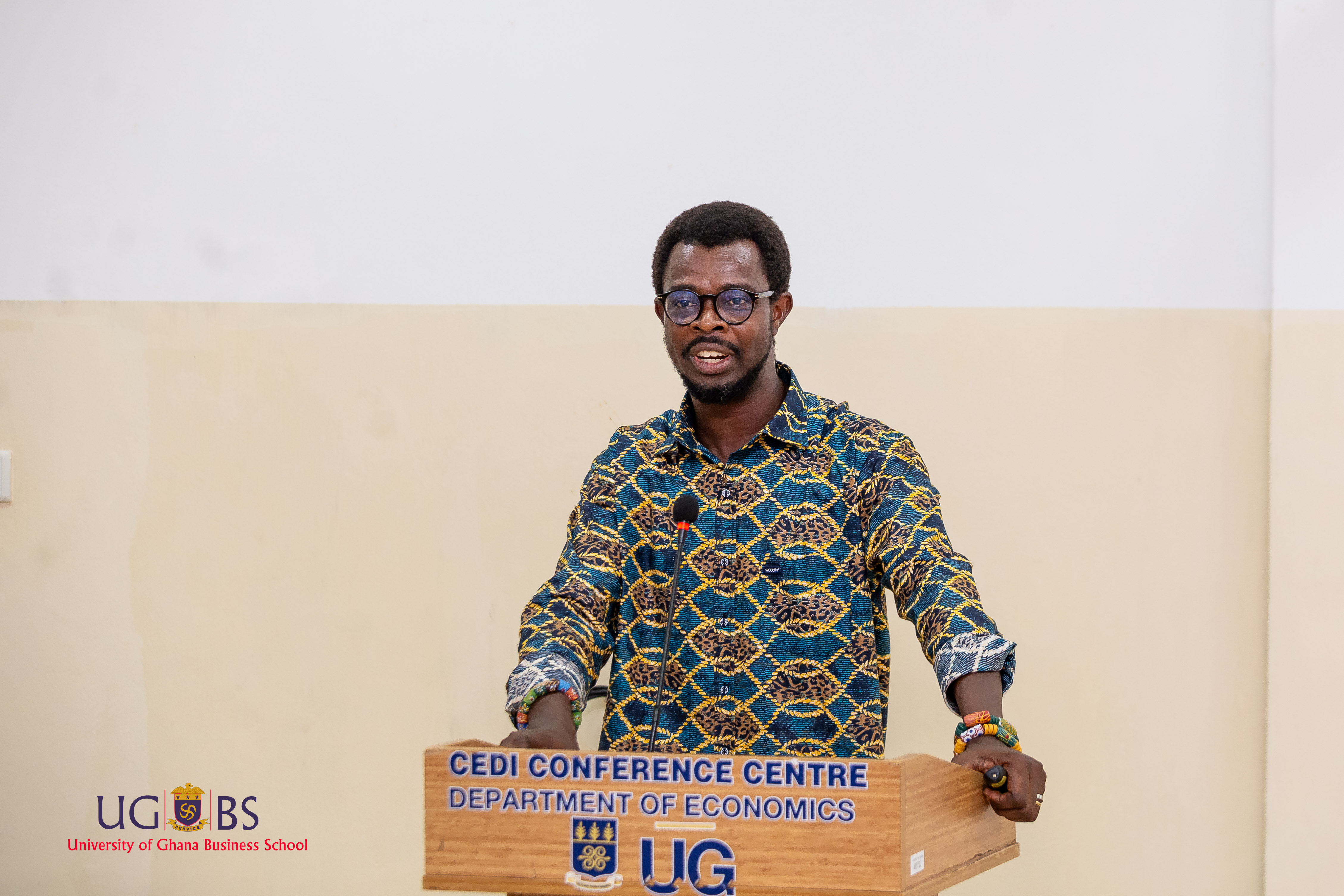
Bank of Ghana Chair in Finance and Economics, Prof. Paul Yegandi Imhotep Alagidede Delivers Lecture on Structural Challenges in the Global Cocoa Economy
The Bank of Ghana Chair in Finance and Economics at the University of Ghana, Prof. Paul Yegandi Imhotep Alagidede delivered a lecture on 4th March 2026, highlighting the structural challenges in the global cocoa economy that continue to limit the benefits accruing to African cocoa farmers. The lecture formed part of the Department of Economics Lecture Series organised by Prof. Nkechi Owoo of the Department of Economics at the University of Ghana. The presentation examined findings from Prof. Alagidede’s latest research, which investigates the structural dynamics shaping value distribution in the global cocoa industry.
The lecture was delivered against the backdrop of the ongoing cocoa market crisis in West Africa. Global cocoa prices, which reached a peak of $11,530 per tonne in June 2024, declined sharply to about $3,000 per tonne by March 2026. In response, Côte d’Ivoire significantly reduced its mid-crop farmgate price in March 2026, while Ghana implemented an in-season price adjustment earlier in February. According to Prof. Nkechi Owoo, “Prof. Alagidede’s work could not be timelier as both Ghana and Côte d’Ivoire grapple with the fallout of the cocoa price collapse, this research provides the rigorous, evidence-based framework that policymakers urgently need.”
Titled “The Commodity Governance Trap: Price Dependence, Institutional Capture, and Asymmetric Transmission in the Global Cocoa Economy,” the study analysed data from ten cocoa-producing countries spanning 1961 to 2023. The research integrated three key strands of economic theory — the Prebisch–Singer hypothesis on declining commodity terms of trade, global value chain analysis, and the resource curse literature — into a unified framework to explain persistent inequality in the cocoa sector. According to Prof. Alagidede, cocoa farmers today receive only about six cents of every dollar spent on chocolate globally, a significant decline from the sixteen cents recorded in 1980. This occurs despite farmers in countries such as Ghana and Côte d’Ivoire producing more than 70 percent of the world’s cocoa supply.

Some participants at the lecture
He described the situation as a “development trap” in which structural features of the global cocoa economy prevent producing countries from capturing a fair share of value. He explained that while multinational corporations benefit during periods of rising prices, smallholder farmers bear the full impact when prices decline. The research highlighted the scale of inequality within the approximately $130 billion global chocolate industry. Although around two million smallholder farmers in Ghana and Côte d’Ivoire produce over 60% of the world’s cocoa, they receive only a small fraction of the final retail value.
At the processing level, multinational grinding firms such as Barry Callebaut, Cargill, and Olam Group collectively control about 60 percent of global cocoa grinding capacity. Meanwhile, major chocolate manufacturers including Mars, Incorporated, Nestlé, Ferrero, and Mondelēz International capture more than 80 percent of final retail value through branding and product differentiation. Prof. Alagidede’s study identifies three interconnected factors that reinforce what he describes as the “Commodity Governance Trap.” These include a long-term decline in real cocoa prices, structural imbalances in the global value chain that favour downstream processors and manufacturers, and institutional arrangements within producing countries that concentrate decision-making power within marketing boards.
The study noted that real cocoa prices have declined from approximately $3,441 per tonne in the 1960s to about $1,586 per tonne in the 2000s. Econometric analysis also shows that countries highly dependent on cocoa exports experience greater economic shocks when global prices fall. According to the findings, a ten percent decline in cocoa prices leads to a loss of about 1.41 percentage points in GDP growth in highly cocoa-dependent economies, while more diversified economies experience little or no measurable impact.
The research also suggested that countries operating marketing boards, including the Ghana Cocoa Board, tend to experience reduced growth benefits during cocoa price booms, indicating that windfall gains may not always translate into broader economic benefits. Prof. Alagidede emphasised that addressing the structural challenges in the cocoa sector requires coordinated reforms in price stabilisation mechanisms, governance of marketing institutions, and policies that support value addition and cocoa processing in producing countries. He concluded that breaking the “Commodity Governance Trap” will require simultaneous action on price stabilisation, value-chain governance, and institutional reform.