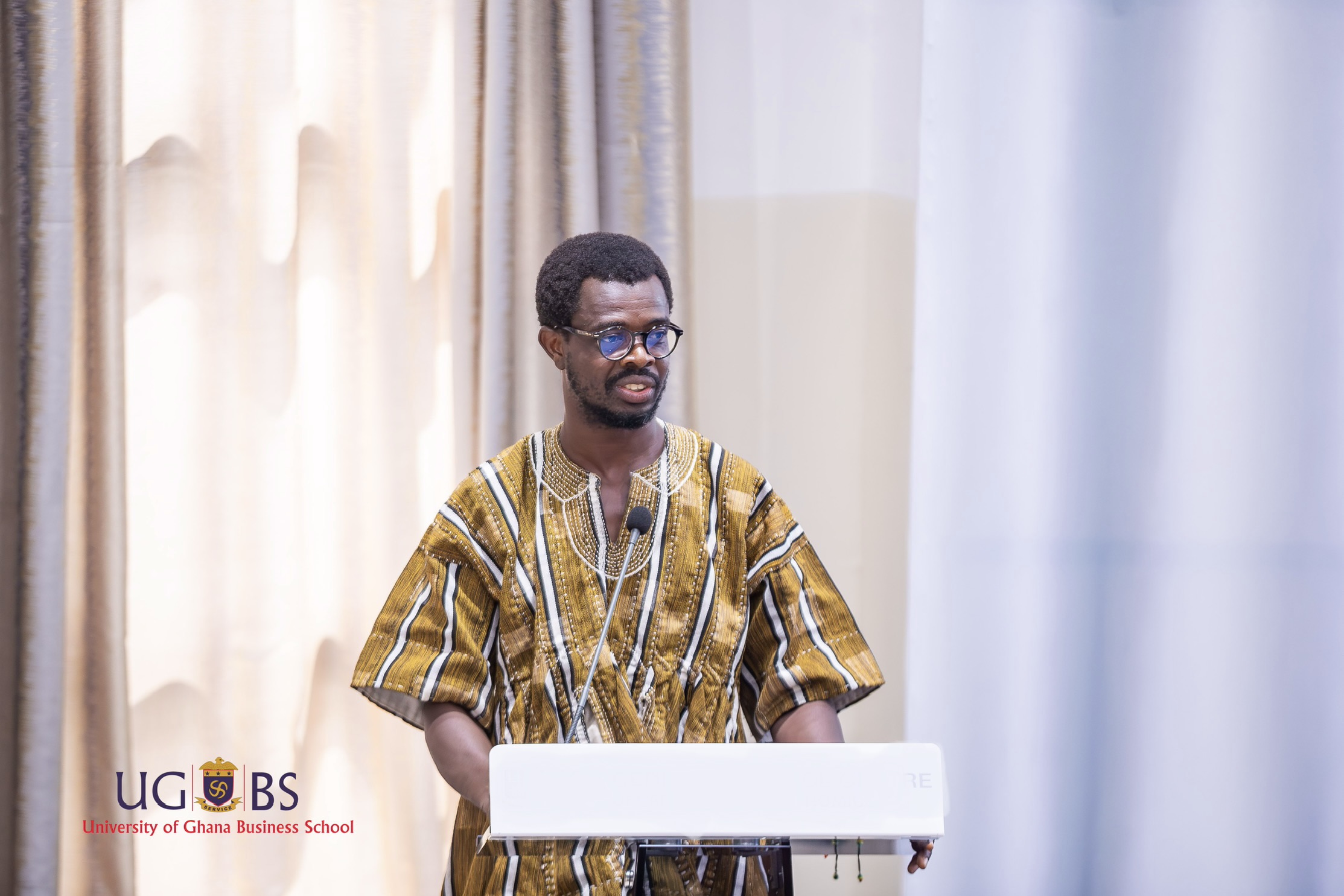
Bank of Ghana Chair in Finance and Economics, Prof. Alagidede Delivers Keynote at the 9th Annual SSS Conference on Africa’s Economic Sovereignty
The Bank of Ghana Chair in Finance and Economics at the University of Ghana, Prof. Paul Imhotep Yegandi Alagidede, has called for a strategic shift in Africa’s development approach through the introduction of a new framework for measuring economic sovereignty. The Conference brought together academics, students, and policymakers to deliberate on critical socio-economic issues. Delivering the keynote address at the 9th Annual School of Social Sciences (SSS) Conference held on 12th March 2026 at the University of Ghana, Prof. Alagidede unveiled the Eagle–Chicken Economy Index, a tool designed to assess the level of economic independence across all 54 African countries.
The index evaluated countries based on their ability to build self-sufficient economies, retain value from natural resources, and maintain control over their economic trajectory. According to the findings, Africa recorded an average score of 48.7 out of 100, falling below the “Eagle Economy” benchmark of 60. Prof. Alagidede noted that only 13 African countries currently qualify as “Eagle Economies,” having achieved relatively higher levels of economic sovereignty through deliberate policy choices, including value addition, domestic financial system development, and knowledge protection.
Ghana ranked 25th out of the 54 countries with a score of 45.1. While acknowledging the country’s strengths in areas such as mobile money, renewable energy, and the creative economy, Prof. Alagidede identified structural challenges, particularly the limited value addition in key export commodities such as cocoa. “Ghana has Eagle sectors, but what holds it below the threshold is not lack of capacity. It is the continued export of raw commodities with minimal value retention,” he stated.
Prof. Alagidede emphasised that Africa’s economic position does not reflect its vast resource endowment. He highlighted that the continent possesses approximately 60 per cent of the world’s unused arable land, mineral resources valued at over $82 trillion, and a youthful population with significant productive potential. He also underscored the ecological and intellectual assets of the continent, including the Congo Basin’s contribution to global carbon absorption and Africa’s extensive indigenous knowledge systems, which remain largely undervalued in the global economy.
The keynote further outlined a five-point Indigenous Intelligence Framework aimed at transitioning African economies toward greater sovereignty. The framework advocates prioritising African knowledge systems in education, protecting indigenous innovations, properly valuing natural resources, promoting local value addition, and adopting governance systems rooted in African values such as Ubuntu. According to Prof. Alagidede, achieving economic sovereignty requires deliberate policy direction and a reorientation of development strategies across the continent. “Africa does not need development. Africa needs recovery,” he stated.