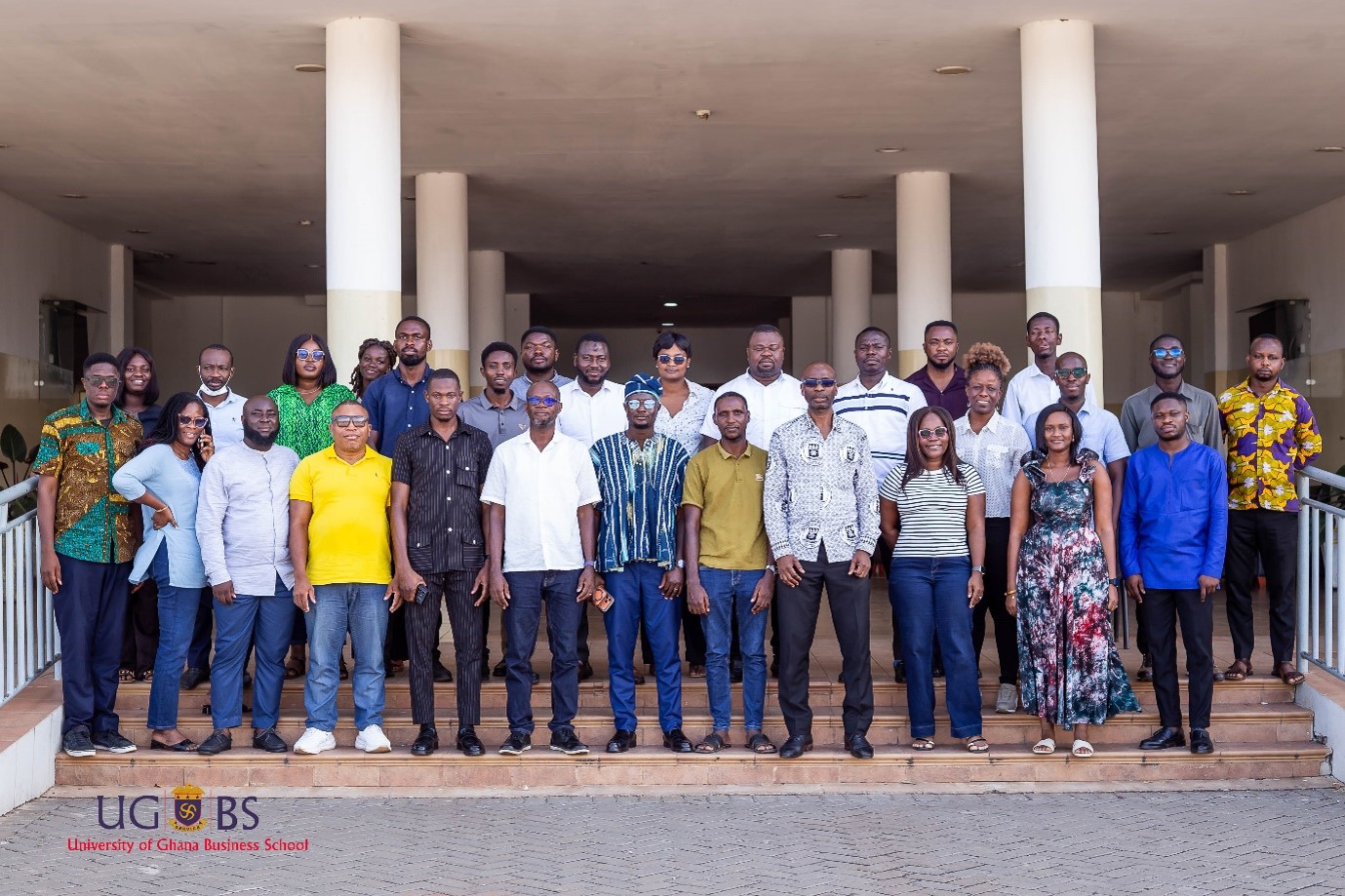
STEG Workshop Equips Researchers with Practical Skills in Manuscript Revision and Writing Persuasive Response Letters
The University of Ghana Business School (UGBS) Research and Grant Management Office, in collaboration with the School of Graduate Studies and the Transform Africa from Within (TaFW) Group, organised the 8th STEG Graduate Students’ Workshop to equip participants with practical skills in revising academic manuscripts and writing effective responses to editors. The theme for this workshop was Journal Paper Reviews, Decision Letter and Response to Reviewers’ Comments. Held on 14th October 2026 at the UGBS Graduate Building, the workshop provided participants with practical guidance on navigating the publication process, responding constructively to criticism and contributing to the quality and integrity of scholarly research. The sessions were facilitated by Prof. Mohammed Amidu and Prof. Edward Asiedu.
The first session, led by Prof. Amidu, focused on “Journal Paper Reviews, Decision Letter and Response to Reviewers’ Comments: A Practical Guide for Revising Manuscripts, Managing Critique, and Writing Persuasive Response Letters.” Prof. Amidu explained that the objective of responding to reviewers is not to win an argument with them, but to make acceptance the editor’s easiest defensible decision. He emphasised the need for researchers to read reviewer comments critically, determine what to change, defend or clarify, develop a revision plan and prepare evidence-based responses. He explained that reviewer comments are not an interruption to the research process but an integral part of manuscript development and publication. Researchers, he noted, need to understand the implications of editorial decisions and respond appropriately rather than approach feedback emotionally.
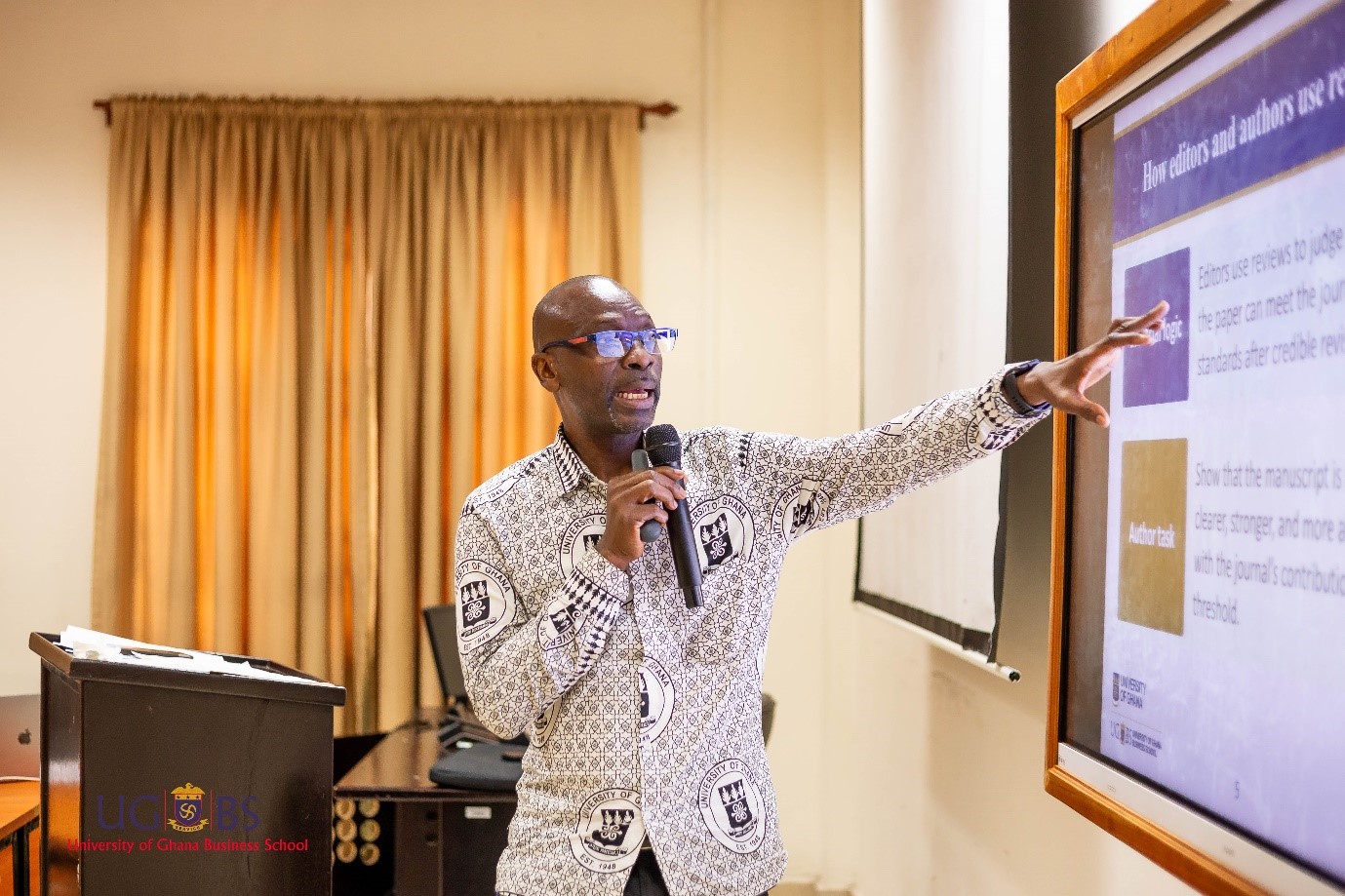
Prof. Mohammed Amidu teaching at the 8th STEG Workshop
On manuscript rejection, Prof. Amidu encouraged students to learn from the reviewers’ comments, reposition their papers where necessary and submit them to more suitable journals. He explained that a rejection could still provide useful lessons for improving a manuscript before its next submission. For papers receiving a revise-and-resubmit decision, he advised researchers to treat the opportunity as an invitation to rebuild and strengthen their work rather than a guarantee of eventual acceptance. He also explained the implications of minor revisions and conditional acceptance, urging participants to analyse editorial and reviewer comments carefully before making changes. Prof. Amidu further introduced a classification of reviewer comments to help researchers identify the nature of the issues raised and determine how best to address them. These included gatekeeping issues relating to journal fit, originality, contribution and scope; argument issues concerning the research question, logic, framing and theory; design issues involving sampling, measurement, cases, data and ethics; evidence issues relating to analysis, robustness, quotations, tables and statistics; and presentation issues covering structure, writing, references and formatting. He recommended the use of a response matrix to organise the revision process, explaining that it helps researchers track individual comments and avoid omissions, repetitive or vague responses, and errors in page references.
On writing effective response letters, Prof. Amidu outlined the key components, including an opening note, a summary of major revisions and point-by-point responses to reviewers’ comments. He explained that effective responses should be polite, specific and traceable, making it easy for editors to verify what had been changed, the reasons for the changes and where the revisions appeared in the manuscript. He also advised researchers to handle disagreements between reviewers carefully rather than casually favouring one position over another. They should acknowledge the differing views, explain how they had balanced the concerns in revising the manuscript and demonstrate how the changes addressed the editor’s likely concerns. Where a reviewer misunderstands or incorrectly interprets an aspect of a paper, Prof. Amidu urged researchers to correct the misunderstanding respectfully and, where possible, improve the manuscript to prevent similar misinterpretations by future readers. He also discussed common mistakes that weaken manuscript revisions and encouraged participants to regard reviewer reports as a valuable opportunity for developmental feedback rather than wasted effort.
The second session, led by Prof. Asiedu, focused on “How to Review a Journal Manuscript”. He provided practical guidance on conducting rigorous, ethical and constructive reviews. Prof. Asiedu explained that the primary responsibility of a reviewer is to exercise sound evaluative judgement rather than assume editorial ownership of a manuscript. Reviewers, he said, should assess submissions in relation to the journal’s aims and evaluate their originality, logic, evidence, methodology, ethical considerations and scholarly contribution. He stressed the importance of distinguishing fundamental flaws from weaknesses that could be corrected and writing comments that were sufficiently clear to guide authors in improving their work.
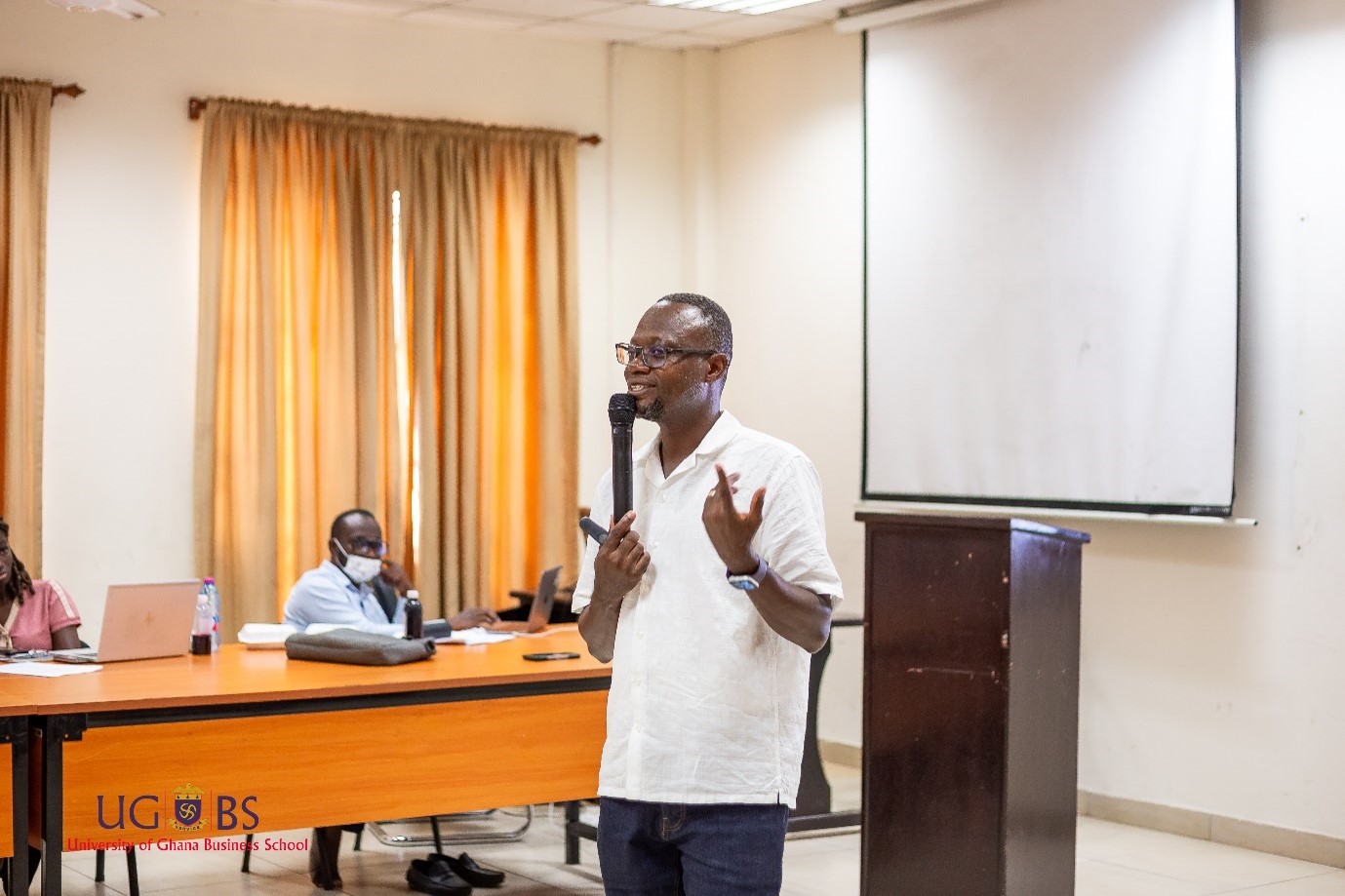
Prof. Edward Asiedu teaching at the 8th STEG Workshop
Prof. Asiedu cautioned reviewers against demanding citations of their own publications without clear relevance, rewriting manuscripts to reflect their personal stylistic preferences, using ideas from unpublished manuscripts before publication, contacting authors directly or disclosing confidential manuscript information. He further emphasised that responsible peer review begins before a reviewer accepts an invitation. Reviewers, he noted, should consider whether they possess the necessary expertise, have sufficient time to complete the assessment, have any conflicts of interest and can maintain confidentiality throughout the process. On evaluating the research problem and contribution, Prof. Asiedu outlined key questions reviewers should consider, including whether the research problem was clearly defined and justified, whether the research question aligned with the study’s design, and whether the paper established a genuine research gap rather than simply focusing on an under-studied setting. He also urged reviewers to examine how well a manuscript was positioned within the relevant literature and whether its findings offered insights that advanced existing knowledge.
In assessing theory and literature use, Prof. Asiedu explained that extensive literature coverage alone does not guarantee a strong academic paper. Rather, the literature should be current, relevant and selective, with theoretical concepts clearly defined and consistently applied. He added that a sound manuscript should explain the logic linking its concepts, with hypotheses or propositions emerging naturally from the arguments presented. Prof. Asiedu advised reviewers to evaluate the appropriateness of the method in relation to the research question rather than judge it against their preferred methodological approach. He discussed the importance of examining the fit between the research design and the question, as well as the suitability of sampling procedures, measures and data.
He further addressed the evaluation of evidence, analysis and results, stressing that reviewers should establish whether the claims made by authors were adequately supported by the evidence presented. He encouraged reviewers to ask for evidence to support conclusions rather than simply seek agreement with their own interpretations. The session also addressed reading strategies for reviewers, reinforcing the need for a systematic and objective approach to evaluating manuscripts. In concluding his session, Prof. Asiedu explained that peer review serves two complementary purposes: advising the editor on a manuscript’s suitability for publication and helping authors improve their work. The final publication decision, he noted, remained the responsibility of the editor. He encouraged reviewers to assess scholarly quality, determine a manuscript’s suitability for the journal, identify the changes required and safeguard research integrity. He cautioned that peer review should not be treated as a rewriting service, an opportunity to produce a rejection memo or a means of imposing personal preferences on authors. Participants had the opportunity to ask questions and seek clarification on the issues discussed during the two sessions.
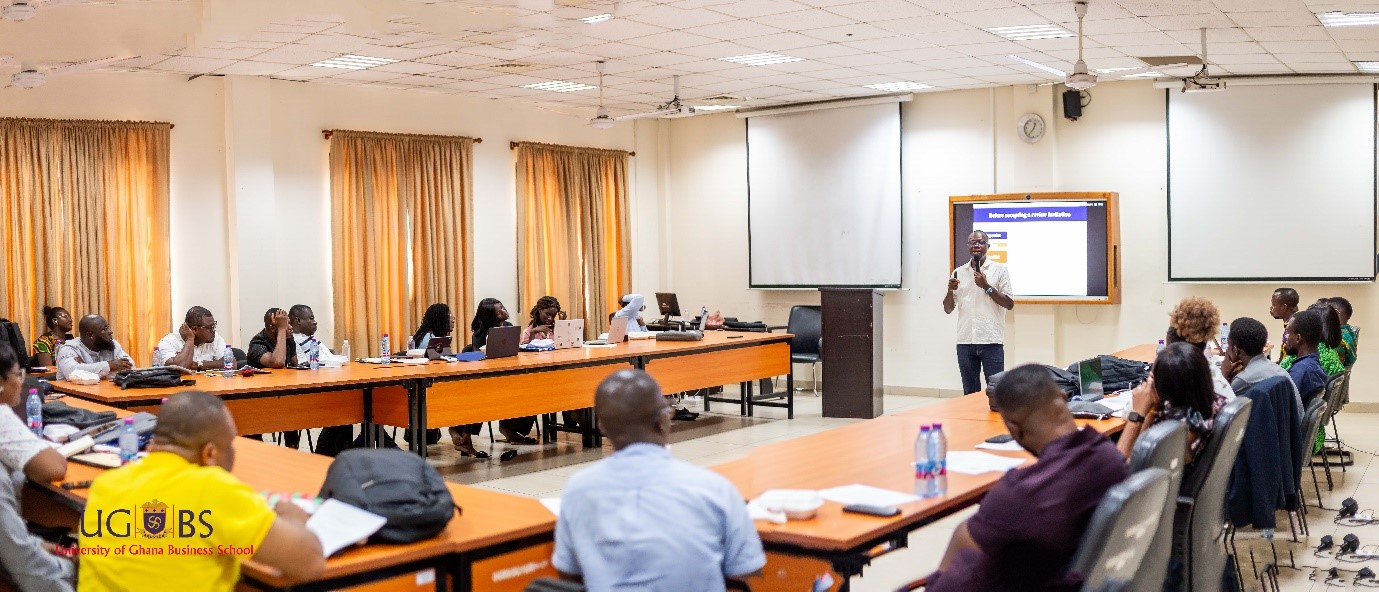
Cross-section of participants at the 8th STEG Workshop