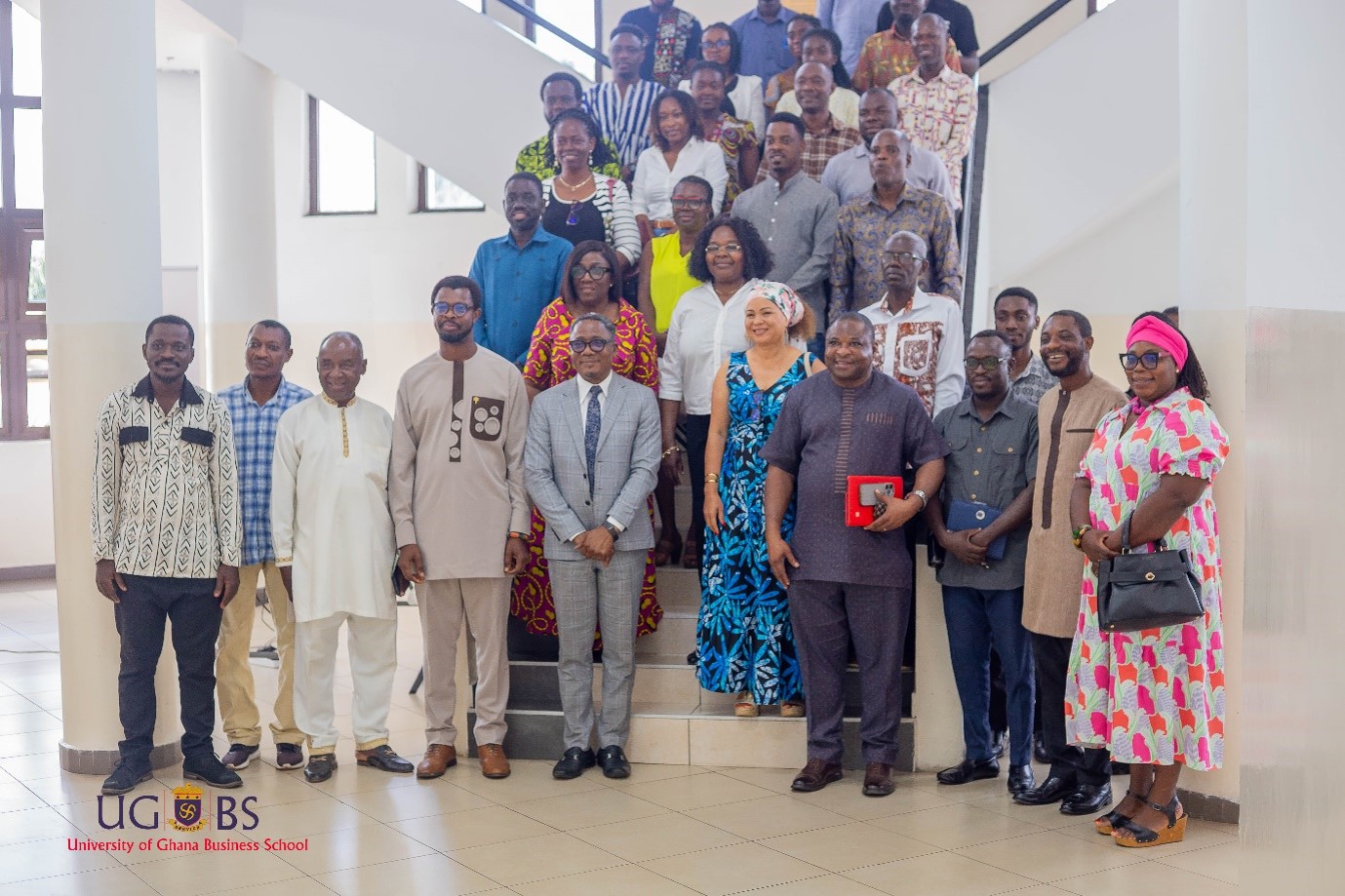
Indigenous Enterprises Seminar explores Agro-Processing, Mechanisation and Ghana’s Industrial Transformation
The Bank of Ghana Chair in Finance and Economics, Prof. Yegandi Imhotep Paul Alagidede in collaboration with the College of Basic and Applied Sciences (CBAS) at the University of Ghana, has held the seventh edition of the Indigenous Enterprises Seminar Series under the theme, “Beyond the Farm Gate: Agro-Processing, Mechanisation and the Making of an Industrial Countryside”. The seminar was held on 11th September 2026 at the Cedi Conference Centre and streamed online. It brought together voices from academia, industry and financial policy to examine how Agro-processing and mechanisation can transform Ghana’s rural economies into engines of industrial growth. The programme was moderated by Prof. Daniel Adu Ankrah of the Department of Agricultural Extension, University of Ghana. In his welcome address, Prof. Edward Nketia-Amponsah, Head of the Department of Economics, spoke about the contribution of agriculture to the Ghanaian economy and introduced the key areas of focus for the seminar.
Prof. Sandow Mark Yidana, Provost, College of Basic and Applied Sciences, raised concerns about the limited participation of some investors and stakeholders in programmes where research and innovations with potential national benefits are presented. He noted that the University has several innovative ideas and programmes, but stakeholders are sometimes unaware of them. He further observed that when some organisations are invited to such engagements, they either send junior representatives who may not fully appreciate the innovations being presented or do not attend. According to Prof. Yidana, the University has demonstrated its capacity to support Ghana’s economic development but requires the necessary investment and support to expand and translate its innovations into wider impact. He explained that Ghana loses significant value at the farm gate and in the period between harvest and the market, adding that both challenges are, to a large extent, engineering problems. He noted that the College of Basic and Applied Sciences already possesses, within one institutional boundary, much of the capability required to address these challenges.
Prof. Yidana also drew attention to Ghana’s dependence on vegetables from countries in the Sahel, particularly Burkina Faso and Niger, despite the potential for domestic production of crops such as tomato, onion and pepper. He cited the example of farmers along the Keta corridor who informally bring in Niger’s high-yielding onion seed in small bottles because no comparable local variety is readily available. He said this represents the kind of gap that the West Africa Centre for Crop Improvement (WACCI)’s breeding pipeline seeks to address. He further pointed to the need to embrace and resource research and innovation centres within the College, including WACCI, the Soil and Irrigation Research Centre (SIREC) and the Biotechnology Centre, particularly in areas such as crop variety development, irrigated dry-season production and seed multiplication. Prof. Yidana cautioned that the opportunity for addressing these challenges would not remain open indefinitely, noting the need for timely investment to support the country’s vegetable import-substitution efforts.
He also spoke about indigenous knowledge and its potential contribution to agricultural transformation, describing it as a specification awaiting the appropriate instruments. According to him, Ghana’s post-harvest practices represent tested techniques rather than folklore but require the necessary instrumentation and technological support to translate them into scalable solutions. Prof. Yidana further highlighted the work of WACCI in developing new crop varieties for Africa. He noted that some of the varieties bred through the Centre are already outyielding the national average. He identified the key challenge as the gap between what has already been developed in the laboratory and what reaches the ordinary farmer’s field. He explained that a district processing node would require a reliable, high-yielding and uniform harvest to operate at capacity, making WACCI’s crop-breeding pipeline an important upstream component of the agro-industrial value chain.
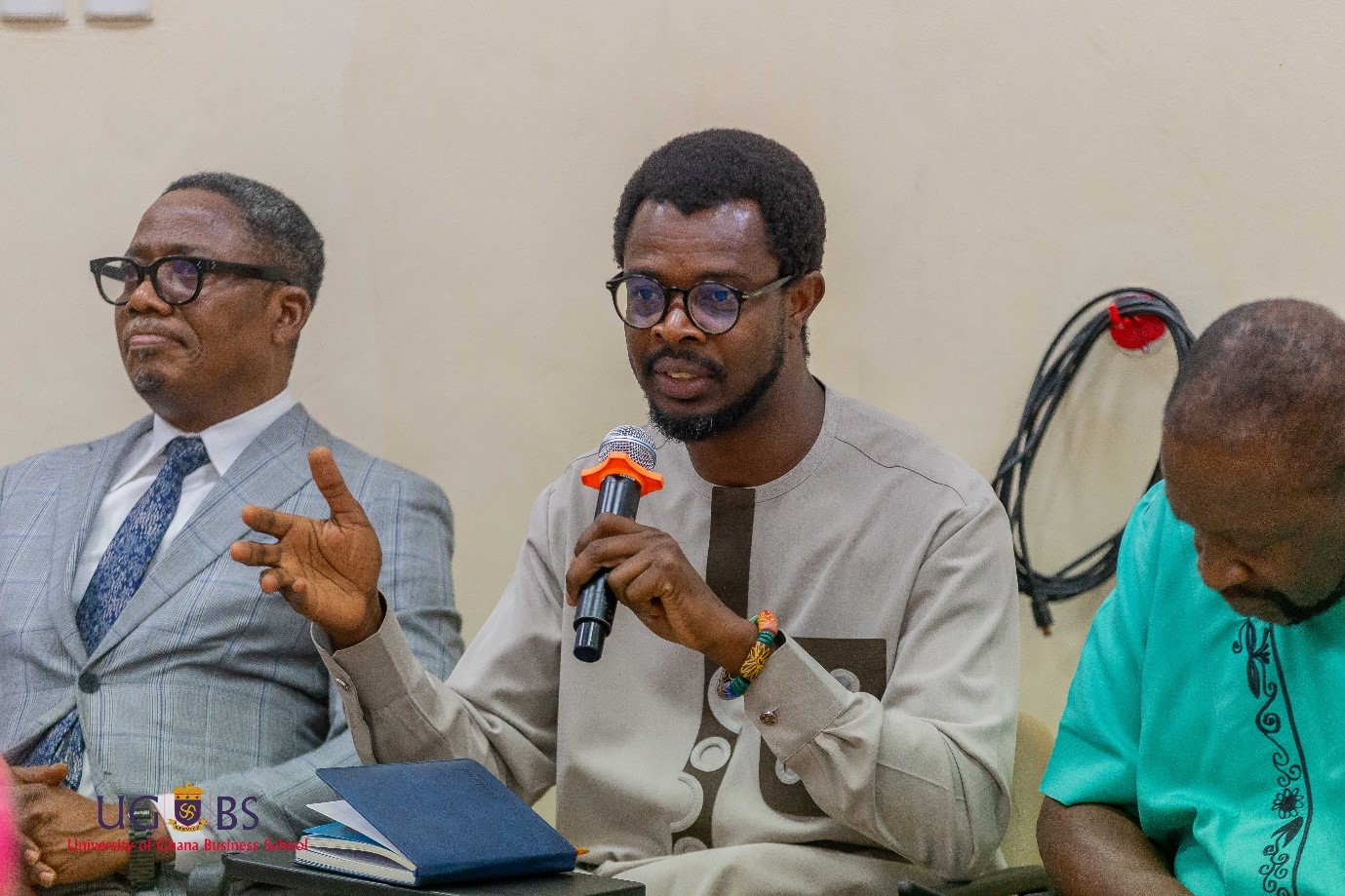
Prof. Alagidede and other speakers engaging participants at the seminar
A major presentation at the seminar was delivered by Prof. Yegandi Imhotep Paul Alagidede, Bank of Ghana Chair in Finance and Economics, who presented on “Metanomics and Indigenous Agriculture: The Gnostic Agritech Limitless System – The Living Library: A Higher-Order Demonstration of a Living Reality.” Prof. Alagidede explained the purpose of the seminar and examined how Ghana’s abundant resources could contribute to economic growth and development. In moving “From thesis to findings to action,” he argued that scarcity in Ghanaian agriculture is a feature of design rather than a reflection of the country’s endowment. He contrasted what he described as “Monodox”, which counts what leaves the farm gate, with “Omnidox”, which designs what stays within the farm gate, stressing that the country’s endowment is abundant. He cited figures indicating that 6.2 million hectares of agricultural land remain uncultivated, while 98% of irrigable land is undeveloped. He also pointed to gaps in the agricultural value chain, including the observation that only 3–6% of final value reaches growers, up to half of perishables are lost, and 77.6% of farm work is done by hand.
Prof. Alagidede proposed three principles for closing the loop: closure, integration and completeness, through which value can be recovered on one site and subsequently scaled through a network. He presented the concept of three meta farms in three ecologies, based on the country’s factor endowments. The first principle, Closure, requires every output to have a named destination before an enterprise starts. The second, Integration, treats plant and animal production as one enterprise with two metabolisms. The third, Completeness, brings production, processing, commerce, education and distribution together in one location. He noted that water would be the first asset purchased under the model and that every enterprise would inherit its reliability. He explained that pond water could be used to fertigate beds, litter could feed the mushroom house, while spent substrate could return to the soil and livestock system.
Dr. Gloria Ladjeh Essilfie of the Department of Crop Science, also spoke on “From Laboratory to Line: From the Bench to a Working Commercial Line.” In her introduction, Dr. Essilfie noted that the real value of a commodity extends beyond what happens in the field, with much of that value being created through activities undertaken after a crop leaves the farm. She explained that when a country stops at the farm gate, it loses the opportunity to capture a greater share of the value created through agricultural production. Using cocoa exports and tomato imports as examples, she noted that every tonne of agricultural produce exported without processing represents jobs that could have been created, businesses that could have been supported, skills that could have been developed and income that could have remained within the Ghanaian economy. Dr. Essilfie subsequently introduced participants to the activities of the Postharvest Innovation Hub (PI Hub) and its approach to research and development. She showcased some of the products developed through the Hub, including dried fruits and vegetables, natural tea bags, powdered indigenous spices and other food products. She explained that the PI Hub also undertakes capacity-building programmes and training for stakeholders both on and outside the University campus. Dr. Essilfie discussed the Hub’s processes for technology adaptation and dissemination, incubation of post-harvest agribusinesses and the funding of viable ideas from participants.
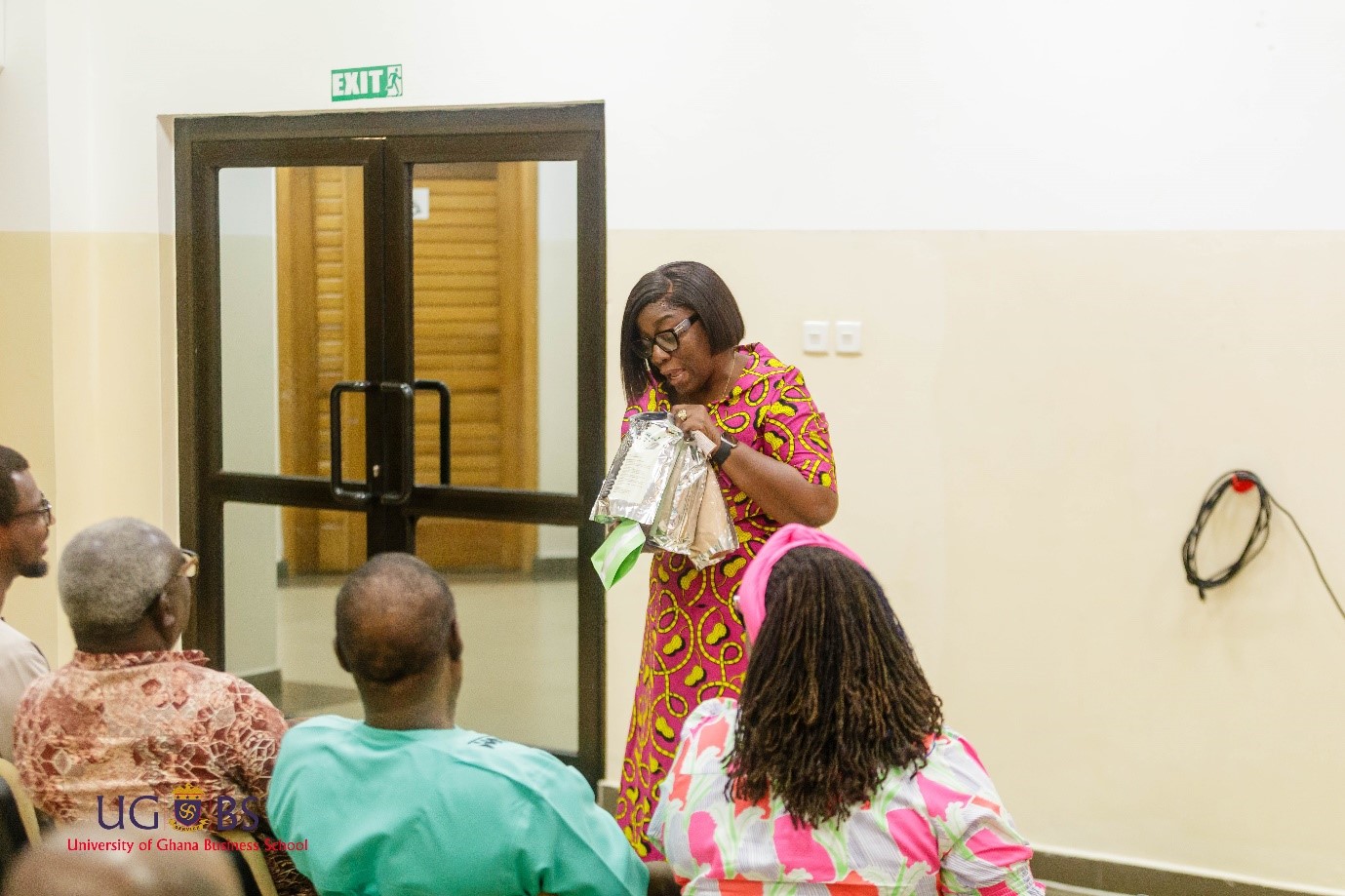
Dr. Gloria Ladjeh Essilfie exhibiting some of the products developed at PI Hub
One of the models presented was contract processing, through which stakeholders with surplus or perishable produce can use the Hub’s facilities to convert their produce into value-added, shelf-stable and packaged goods without having to own the required processing facilities. The Hub also operates in-house retail lines, sourcing produce from smallholder farmers and processing them into products such as dried vegetables and flours for sale to customers. Another component is the technology showroom, where technologies such as solar dryers, cold storage systems and food-grade packaging are demonstrated, tested and showcased to stakeholders. Dr. Essilfie identified several reasons why some agricultural prototypes fail to make it to the market. These include the dispersed nature of smallholder farmers and their relatively small production volumes, certification gaps and financial constraints. She therefore advocated the establishment of zonal processing hubs to support smallholder farmers and bridge some of the gaps between production, processing and commercialisation.
Dr. Samuel Tengey, Head of Learning and Development at the Bank of Ghana, presented on “From Prototype to Pension: The National Agricultural Transformation Framework – From Farmer Need, Productivity, Prosperity and Pension Security.” He noted that Ghana continues to experience low agricultural productivity despite significant participation in the sector, arguing that the situation could change if the country takes its mechanisation gaps seriously. Dr. Tengey also drew attention to the financial challenges faced by small and individual businesses, citing examples such as artisans, seamstresses and hairdressers. He noted that many of these businesses contribute to the economy but may not pay taxes at a level that adequately supports the wider economy. He further observed that farmers feed the nation but often face difficulties in accessing loans, lack retirement plans and remain isolated from some of the processes required for long-term economic stability and sustainability.
As a proposed national solution, Dr. Tengey presented an Integrated Framework built around three mutually reinforcing pillars linking innovation, financing and digital integration. The first pillar, Collaborative Research-to-Machine Programme, seeks to convert verified agricultural needs and research outputs into tested, certified and locally manufactured machinery. The second, Ghana Agricultural Productivity and Mechanisation Development Fund, is designed to mobilise sustainable financing for mechanisation, innovation, commercialisation and agricultural productivity. The third, National Digital Integration Platform, seeks to connect farmers, service providers, financial institutions and public systems through verified digital activity.
Speaking on “Engineering Ghana’s Agricultural Future,” Dr. Kofi Korsah, Chief Executive Officer of KERSL Automation, outlined some of the requirements for the company to manufacture land preparation and planting machines locally. Dr. Korsah noted that one of the most complicated components to manufacture is the small engines, which require investment across several stages of production, including the casting and forming of major engine components. According to his presentation, establishing a foundry would be necessary for producing components such as the engine block, cylinder head and crankcase. This would typically require die-casting machines for aluminium, which is commonly used in small engines, or sand-casting equipment, together with melting furnaces and moulds. He added that some other engine components, including pistons, are also commonly produced through casting or forging. The proposed manufacturing capacity forms part of KERSL Automation’s broader efforts to develop machinery across the farm value chain. For land preparation, the company is working towards machines such as compact tillers, power weeders and unit cultivators suitable for small plots.
Dr. Korsah also identified opportunities for collaboration between KERSL Automation and the University of Ghana. These include joint applied research and development prototyping, technical and vocational training, business incubation and commercialisation, as well as student internships and work-study placements. Through such collaboration, he noted that students could contribute to capstone and thesis projects grounded in real deployment data, while engineering, agricultural and business students could gain hands-on, industry-based experience at KERSL Automation. The presentations were followed by a panel discussion, which provided an opportunity for participants to seek further clarification and engage the speakers on the issues raised during the seminar.
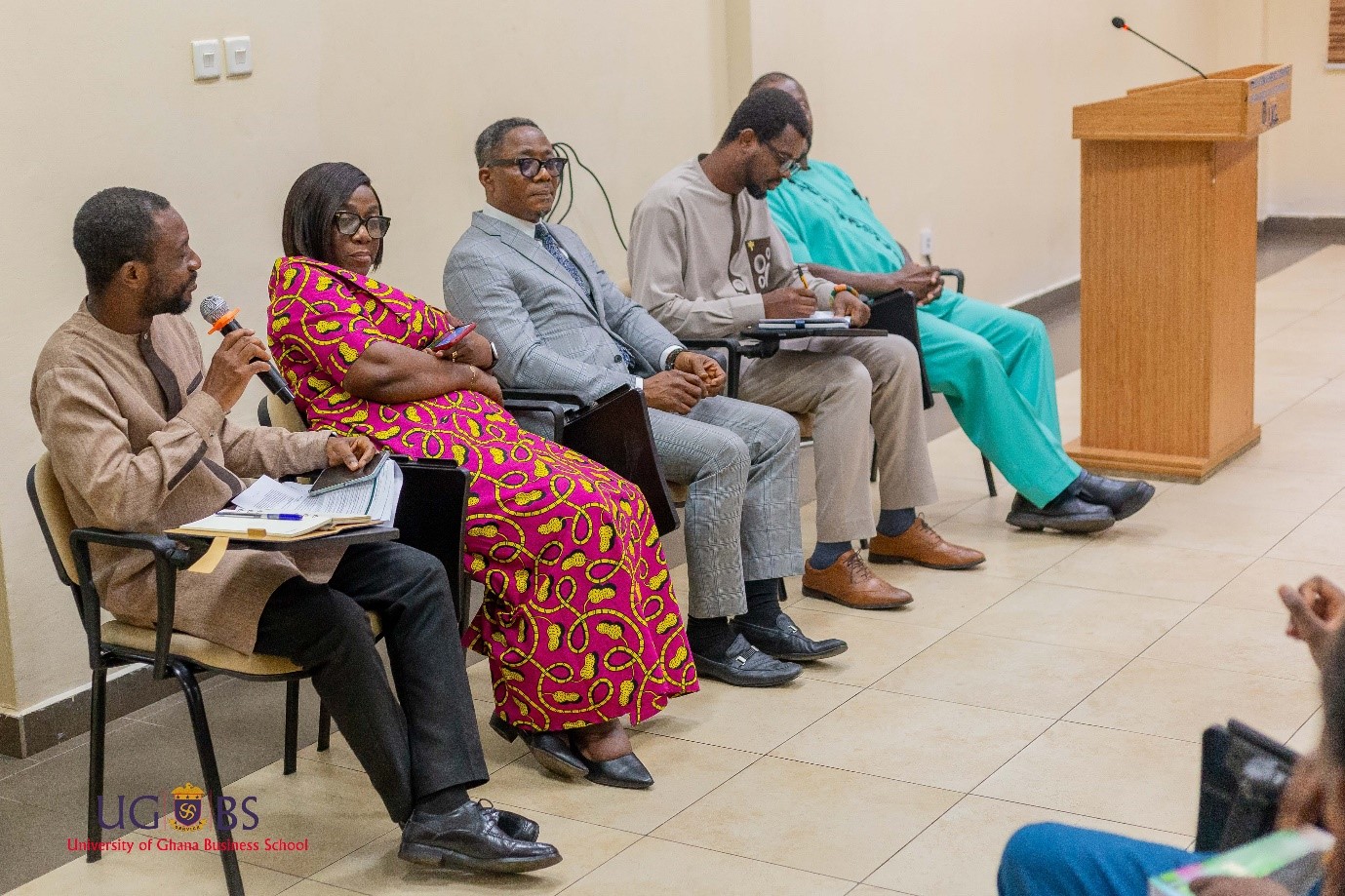
During the panel discussion