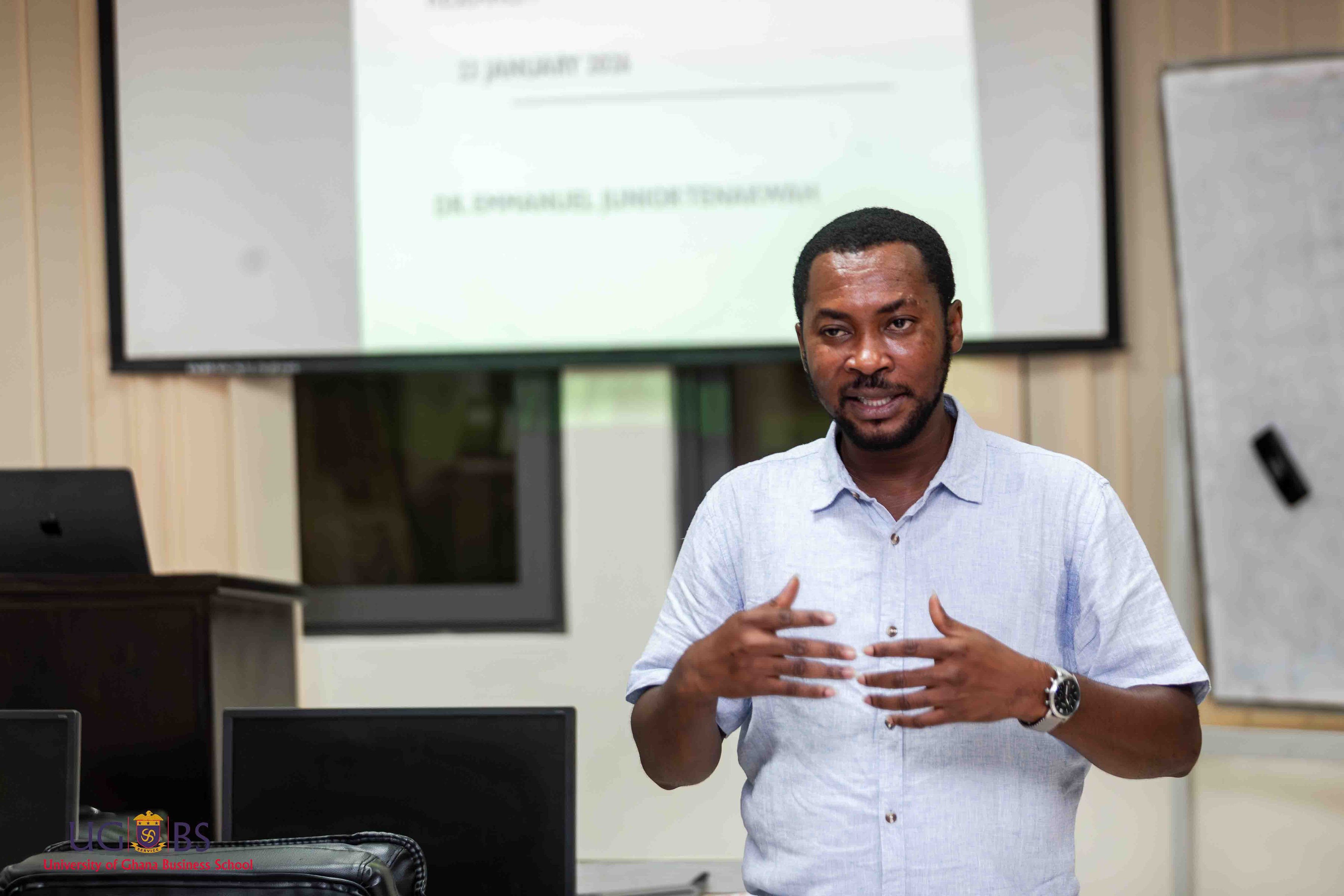
UGBS PhD Programmes Unit Holds a Research Seminar Featuring Dr. Emmanuel J. Tenakwah
The PhD Programmes Unit of the University of Ghana Business School (UGBS) organised another research seminar for MPhil and PhD candidates on Thursday, 23rd January 2026, at the UGBS Graduate Building. The seminar, which forms part of the Unit’s continuous capacity-building efforts, was coordinated by the Unit Coordinator, Dr. Emmanuel Joel Aikins Abakah. In his welcome address, Dr. Abakah expressed appreciation to participants for their consistent participation in the seminar series. He noted that the ongoing sessions are designed to strengthen students’ research capabilities and enhance the quality of doctoral scholarship at UGBS.
The speaker for the seminar was Dr. Emmanuel Junior Tenakwah of the Canterbury Institute of Management, Australia, who delivered a presentation on the topic “Why This Study, Why Here, Why Now? Context and Contribution in PhD Research. In his presentation, Dr. Tenakwah emphasised that the failure of many PhD proposals is often due to a lack of clear and meaningful research contribution rather than methodological weaknesses. He stressed that context is frequently misused as a substitute for theory and noted that journals and examiners no longer accept claims of “under-researched contexts” as sufficient justification for a study. According to him, a country or location alone does not constitute a contribution.

A participant interacting with the class
He explained that a strong research contribution should lead to a change in at least one of the following: what we know, how it works, why it works, or when it works, including boundary conditions. He added that location by itself does not alter any of these dimensions. Dr. Tenakwah further outlined different ways in which context can be applied in research, including a setting or background, a boundary condition, or a causal mechanism. He elaborated on the concept of explanatory context, citing examples such as weak enforcement in developing countries, political risk in emerging markets, cultural values and power relations, and institutional voids. He added that these factors must be theoretically grounded and not assumed.
He cautioned that context does not add value when it merely repeats established relationships, when existing theories work unchanged, when contextual variables are not theorised, or when explanations end simply with claims such as “because it is a developing country.” He also discussed stronger approaches to theorising context, including the use of robust control mechanisms and core diagnostic frameworks.

A participant answering trial questions during the session
Addressing the issue of research framing, Dr. Tenakwah explained that the question “Why now?” should not be justified by recent data availability, fashionable topics, crisis narratives, or regulatory changes alone. Instead, he encouraged participants to adopt strong framing by clearly identifying contributions and articulating how their studies advance theory. He concluded by noting that examiners and journal reviewers increasingly look for mechanisms rather than maps, theory stress-tests, clear boundary conditions, and a respectful and disciplined use of context in doctoral research.