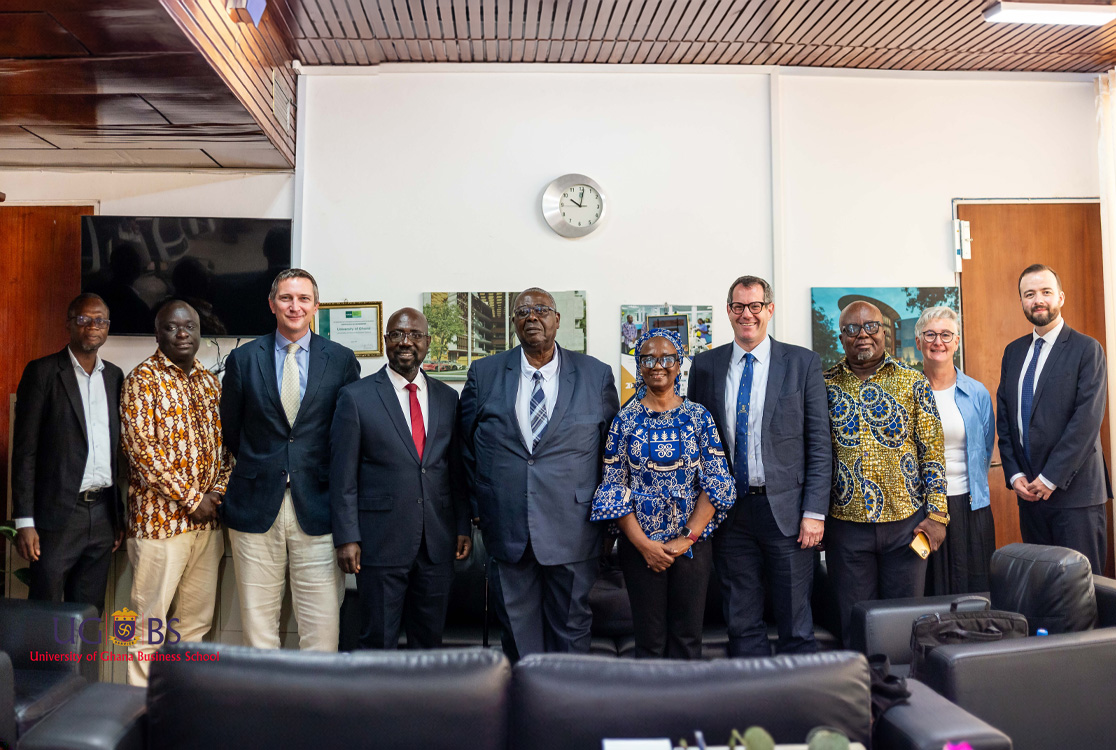
UGBS engages University of Warwick delegation on potential areas of collaboration
The University of Ghana Business School (UGBS) hosted a delegation from the University of Warwick, United Kingdom, to explore opportunities for academic collaboration, student engagement, innovation and entrepreneurship development. The meeting took place on 9th November 2026 at the Dean’s Office and brought together representatives of both institutions to discuss possible partnerships that would create opportunities for students and faculty to collaborate on academic and entrepreneurial projects. The University of Warwick delegation comprised Prof. Franklyn Lisk and Prof. Daniel Branch- Deputy Pro-Vice-Chancellors (Africa); Mr. Michael Haymes- Associate Director of International Strategy and Relations; Ms. Elizabeth Heimann, Prof. Robert Kerr, and Mr. Michael Sasto.
The Dean of UGBS, Prof. Ernest Yaw Tweneboah-Koduah, welcomed the delegation and provided an overview of the school, its administration and its international relations activities. He discussed UGBS’s existing international partnerships and initiatives that provide opportunities for students to participate in international summits and conferences, network with colleagues from other institutions and gain wider exposure. Prof. Tweneboah-Koduah also spoke about the school’s proposed joint degree initiative with the University of Manchester and the Institute of Statistical, Social and Economic Research (ISSER), describing it as an ongoing funded programme. He further discussed student collaboration and the possibility of developing joint Master of Arts (MA) programmes between UGBS and the University of Warwick. The discussions also explored opportunities in innovation and entrepreneurship, following the delegation’s interest in understanding how UGBS supports students in developing and commercialising innovative ideas.
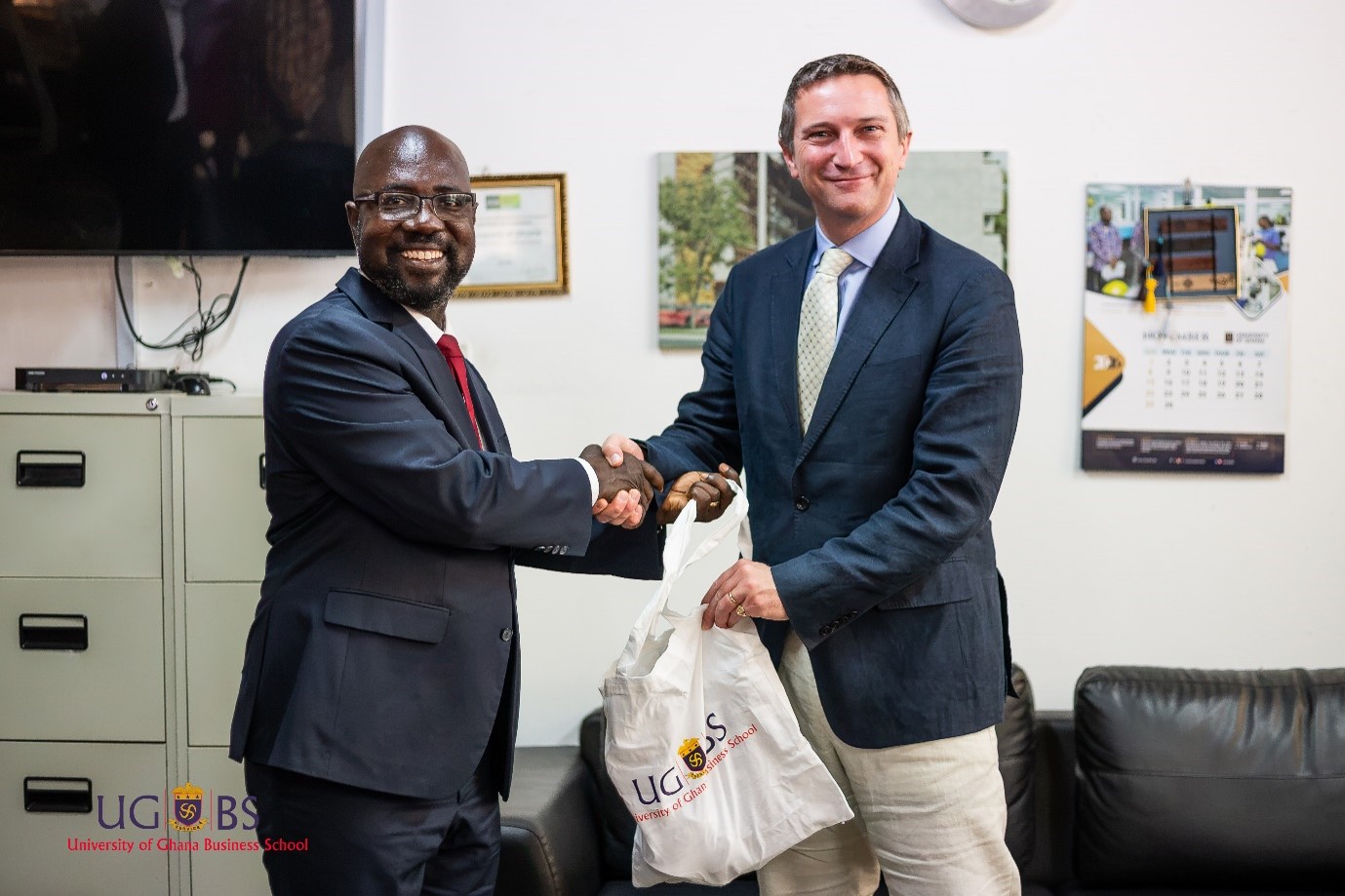
Prof. Ernest Yaw Tweneboah-Koduah presenting a package on behalf of UGBS.
Prof. George Acheampong of the Department of Marketing and Entrepreneurship, UGBS, provided an overview of the activities of the UGBS NEST, explaining that the facility receives support primarily from the British Council and other stakeholders. He outlined the formal and informal structures through which UGBS promotes entrepreneurship, with particular attention to the hub’s prototyping and acceleration activities. He explained how the facility brings together students from different departments and academic disciplines to work collaboratively on technical projects and transform their ideas into practical solutions. Prof. Acheampong also discussed the hub’s mentorship structures, and some of the programmes it runs to support student entrepreneurs and emerging businesses.
He noted that although several businesses emerging from the incubation process had gained access to local markets, there was a need for greater international exposure to enable them to expand their reach. He therefore expressed interest in partnerships that could connect the hub’s incubates to international markets and networks. Among the opportunities he proposed were collaborative projects involving students from UGBS and the University of Warwick, the hosting of joint summits and other platforms that would bring student innovators together. He also spoke briefly about UGBS’ collaboration with Copenhagen Business School, and its student exchange programmes as examples of international engagement. Further discussions focused on how both institutions could strengthen relationships with other international business schools and create opportunities for students to interact and work with their counterparts during innovation and entrepreneurial projects.
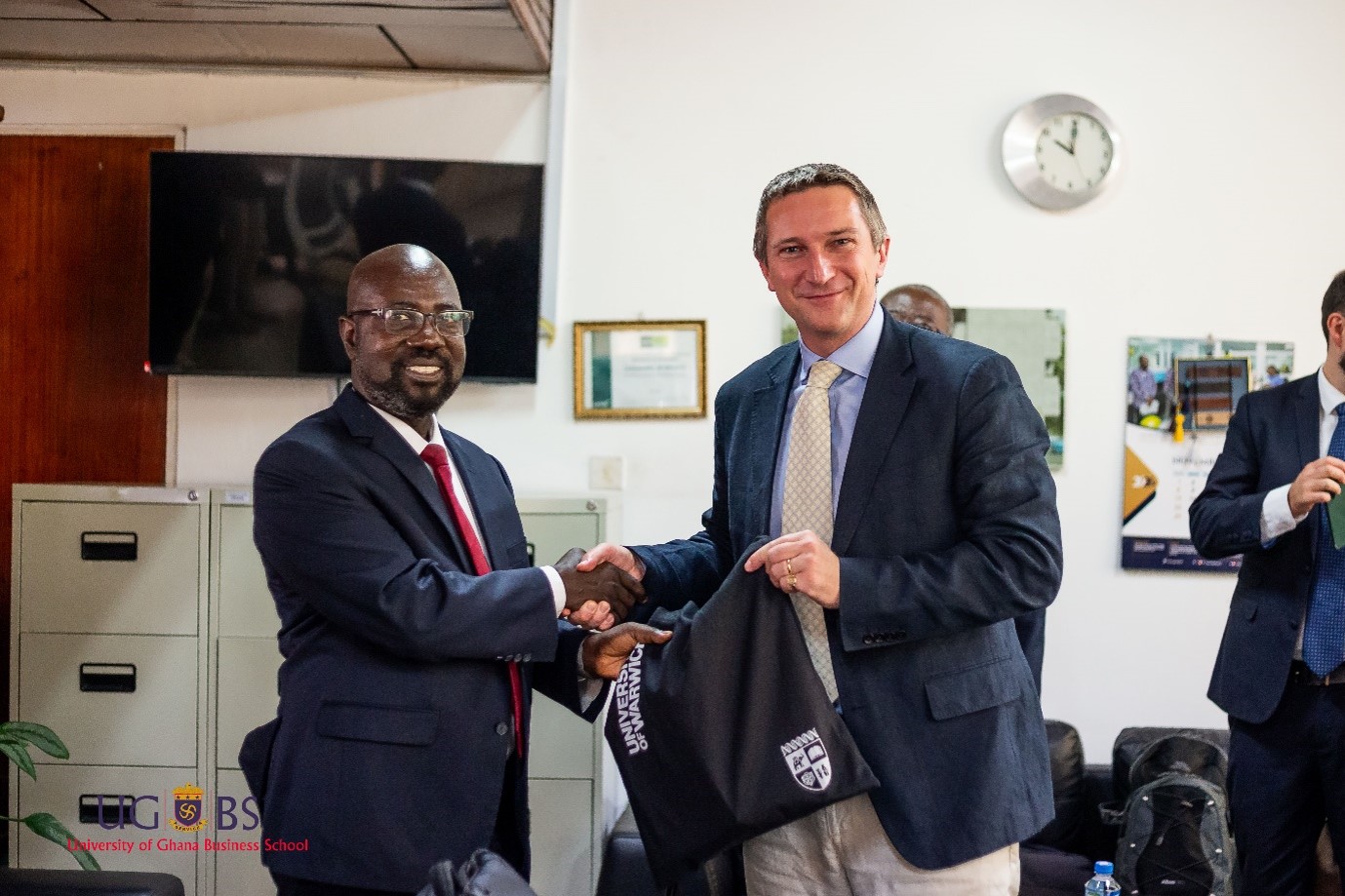
Prof. Ernest Yaw Tweneboah-Koduah receiving a package on behalf of UGBS.
The discussion also featured extracurricular programmes, online collaborative activities and teamwork initiatives that could allow students from both universities to share ideas, learn from one another and develop solutions to challenges in their respective markets. The possibility of organising joint programmes that would provide students with international exposure and networking opportunities was also discussed. Members explored the development of a joint online MA programme that would enable students to learn about and gain insights into the different markets in which the two institutions operate. Other areas considered included how both universities address intellectual property issues relating to innovations developed by students working jointly on projects, as well as opportunities for faculty exchange to facilitate collaborative research and project development. The engagement provided an opportunity for UGBS and the University of Warwick to explore areas of mutual interest and consider possible avenues for strengthening academic, student and institutional relations. The discussions are expected to provide a basis for further consideration of collaborative initiatives that could benefit students, faculty and both institutions.