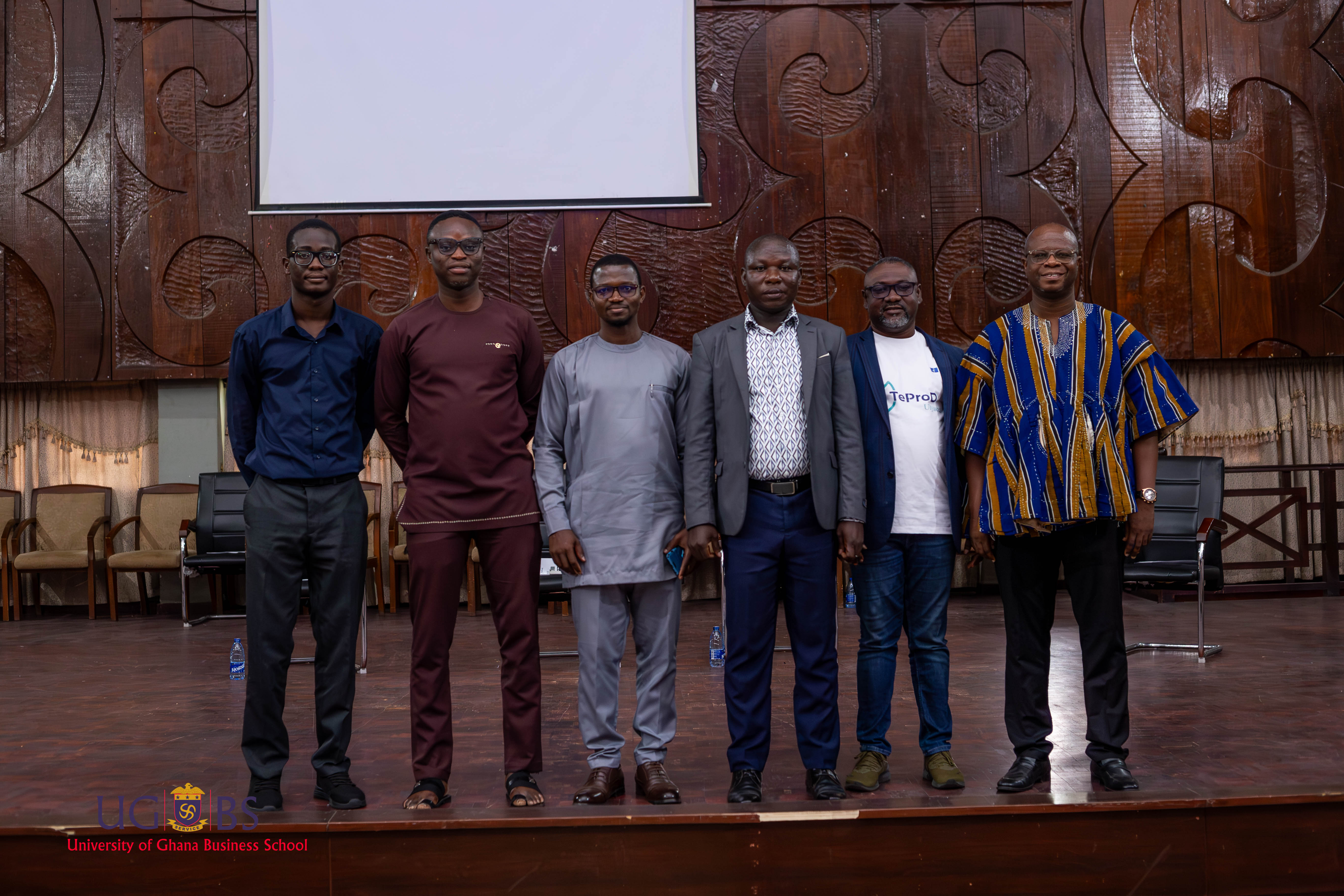
UGBS TeProD Team Promotes Twin Transition Skills Through a Collaborative Event with Stakeholders
The University of Ghana TeProD Team has organised a Twin Transition programme for stakeholders, under the theme “The Nexus of AI and the Green Deal in Higher Education.” The collaborative event, co-funded by the European Union, took place at the R.S. Amegashie Auditorium on 1 April 2026 and brought together faculty, industry representatives and students to explore the integration of artificial intelligence and sustainability in higher education. The programme formed part of a series of workshops organised by the project team. It aims to provide a platform for students to examine how artificial intelligence (AI) can be integrated into systems that support the attainment of the United Nations Sustainable Development Goals while maintaining academic integrity and responsibility.
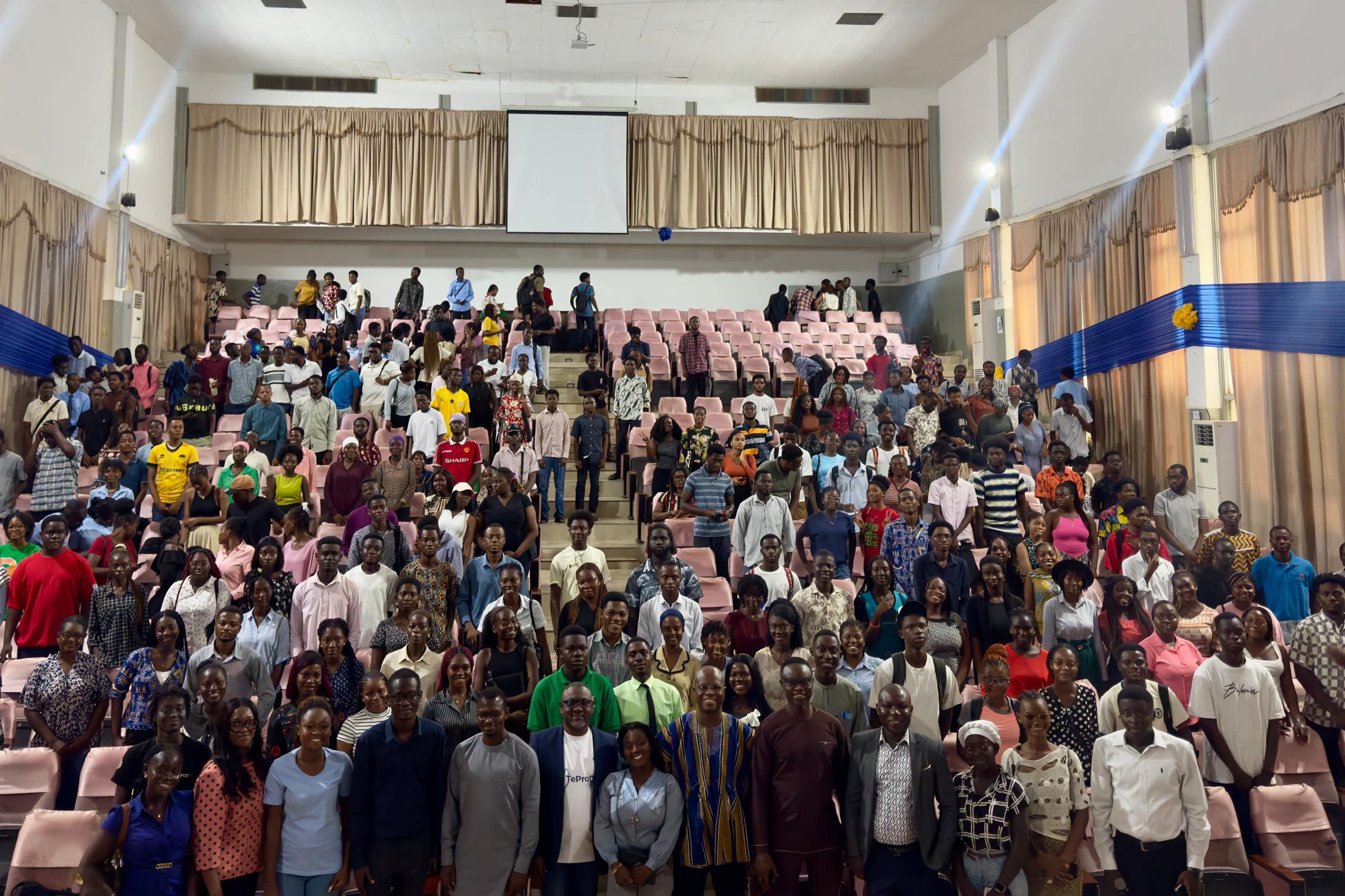
A group picture of the team with students
Delivering the welcome address, the Dean of UGBS, Prof. Ernest Yaw Tweneboah-Koduah, explained that the project seeks to identify competencies required for a rapidly evolving labour market and support curriculum development. Prof. Koduah noted that UGBS plays a central role in the project alongside partners from Finland, Slovakia and Namibia. He credited the successful acquisition of the project to the efforts of UG team members (Prof. Emmanuel Awuni Kolog, Prof. Owusu Acheampong, Dr. Abeeku Sam Edu, UGBS and Dr. Samuel Atarah, Department of Physics) and others. According to him, the initiative reflects UGBS’s growing contribution to international research and collaborative projects. “At UGBS, we recognise that business education must evolve in response to the changing dynamics of the global economy. He said.
According to him, “the integration of artificial intelligence, digital technologies and sustainability principles into teaching, research and practice is no longer optional; it is essential,”. He added that the project would help shape graduates equipped with technical knowledge, critical thinking abilities and adaptive skills for a digital and sustainable future. He further emphasised that the theme was timely, as it encouraged reflection on how higher education institutions can prepare students to meet the dual demands of technological advancement and environmental sustainability. He commended the organising team and encouraged participants to actively engage in discussions and share perspectives.
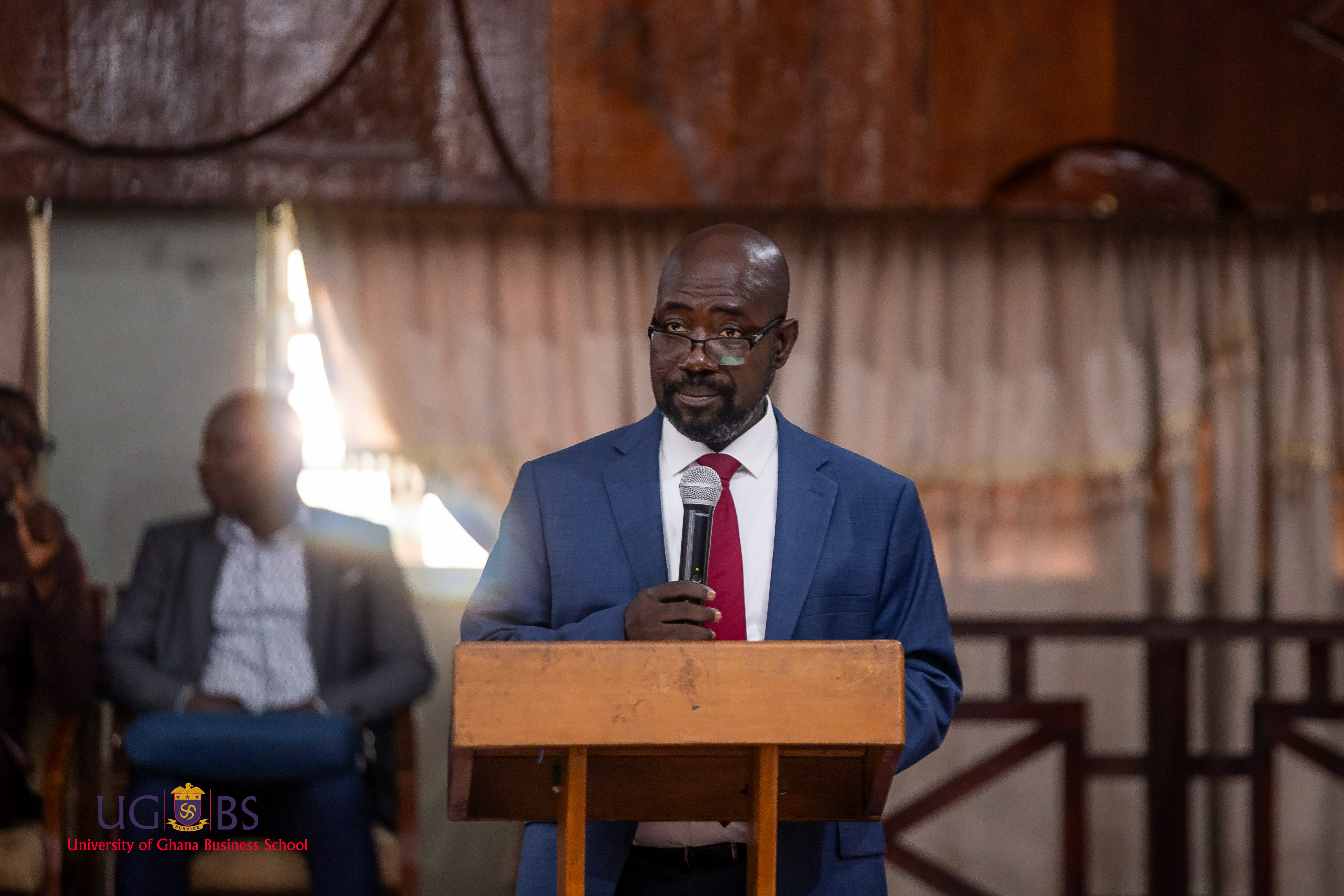
Prof. Ernest Yaw Tweneboah-Koduah delivering his remarks
Delivering opening remarks on behalf of the Head of the Department of Operations and Management Information Systems (OMIS), Prof. Eric Afful-Dadzie, Dr. Joshua Ofori-Amanfo highlighted that the world is confronted with two defining forces: rapid advancement in artificial intelligence and the urgent need to address climate change. He explained that the intersection of these forces presents both challenges and opportunities for higher education institutions. Dr. Ofori-Amanfo noted that AI offers immense potential to enhance sustainability efforts, including optimising energy consumption and enabling data-driven environmental decision-making. However, he cautioned that AI systems require significant computational resources and energy consumption, stressing the need for responsible adoption aligned with sustainable principles.
Providing an overview of the TeProD Project, Prof. Acheampong Owusu noted that the project aims to address green and digital transformation challenges in Africa, particularly in Ghana and Namibia, using digital technologies. He indicated that the project adopts a participatory design approach and adapts the Technological, Pedagogical and Content Knowledge framework to enhance teacher professional development. He added that AI integration will support the development of smart guides, co-pilots and interactive content to improve capacity building in circular economy and pedagogy. According to him, the project has two principal outcomes: enhancing teachers’ competencies in twin transitions and updating curricula and teaching methods with AI integration. He concluded that UGBS is responsible for leading planning, curriculum development and dissemination of results.
A panel discussion featured Prof. James K. Mensah of UGBS, Mr. Gilbert Kpelim-Etime Mombazaa of AT Ghana, and Mr. Marzuq Yussif Etsie Adam, a Physics and Mathematics student at the University of Ghana. Discussions centred on education and the future of work, embedding sustainability into higher education, and aligning digital and green transitions in an ethical and inclusive manner. Moderating the session, Dr. Abeeku Sam Edu spoke about the twin transition in higher education, its implications for curriculum and skills development, as well as institutional readiness, policy concerns, opportunities and risks for Ghana. He encouraged students to actively participate in the discussion, stressing that their engagement was critical. “The future of work is about you, so get involved and let’s have the conversation together,” he stated.
Prof. Mensah provided an overview of the twin transition, stressing the importance of embracing AI while maintaining ethical use. He explained that AI should assist students in generating ideas rather than making them dependent. He also highlighted sustainability challenges in Ghana, including food and water wastage, and advocated integrating AI and sustainability into university curricula. He identified inadequate infrastructure, capacity and mindset as barriers to effective AI utilisation. Mr. Mombazaa emphasised that while AI has simplified processes, critical thinking must not be lost. He urged students to apply knowledge practically and develop hybrid skill sets required by industry to solve local problems. He also highlighted competencies needed for the evolving workplace. Mr. Yussif noted that students are increasingly using AI for academic work and advocated learning to build AI tools to solve real-world problems. He explained that AI is energy-intensive and stressed the importance of environmental consciousness. He encouraged students to use AI as a complement rather than a replacement for their efforts.
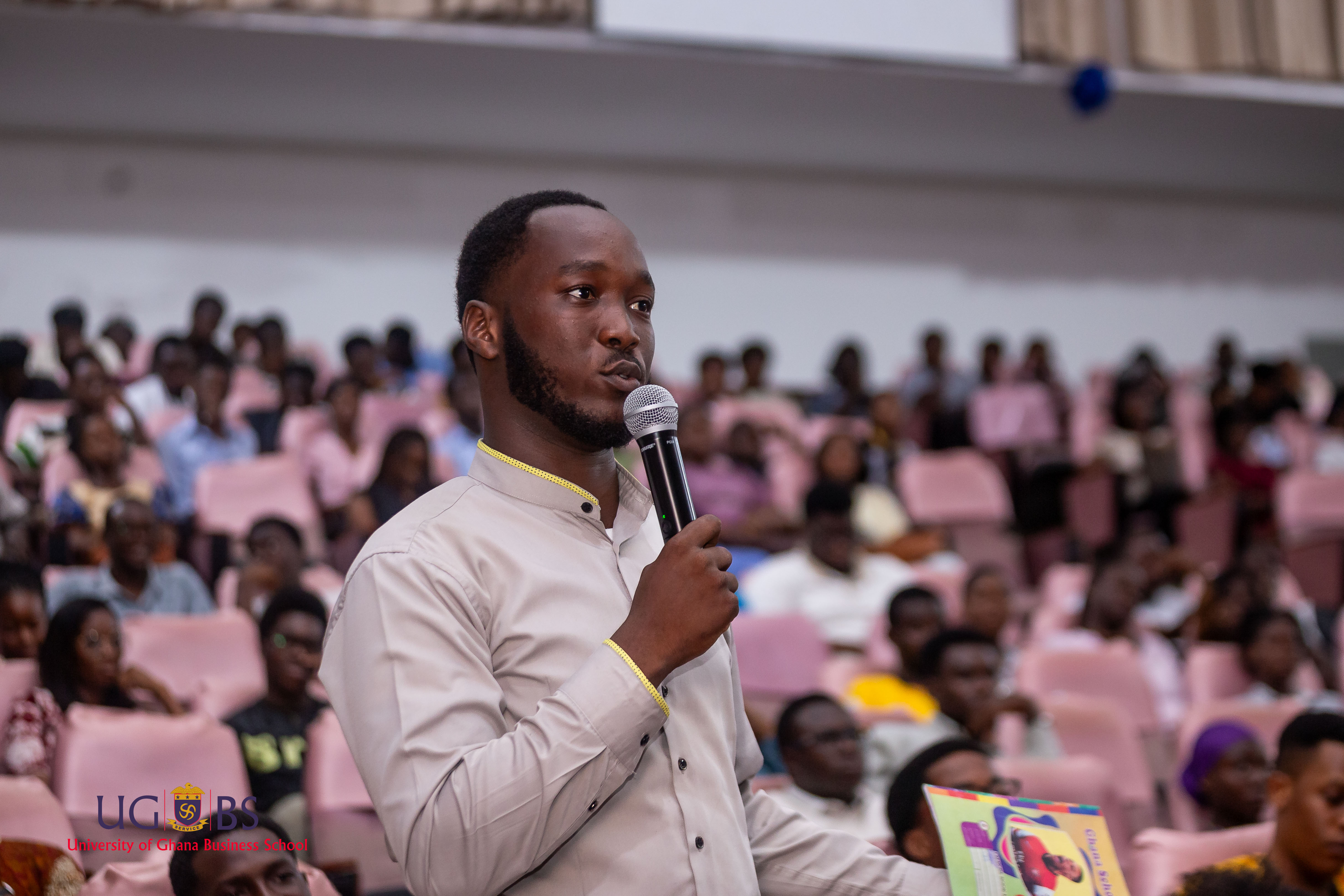
A participant engaging panellists at the workshop
In his remarks, Prof. Awuni encouraged Business Analytics students to develop a strong conceptual understanding of AI rather than relying solely on prompts. He cautioned that dependence on generated scripts without comprehension undermines technical development. He urged students to understand algorithms, neural networks and model creation processes. He also announced an upcoming Innovation Challenge under the TeProD Project. He explained that teams of four students from the University of Ghana would be invited to submit innovative AI and sustainability ideas. Shortlisted teams would participate in an intensive brainstorming session, after which two teams would be selected to travel to Finland and Slovakia, with all expenses covered.