DBG and UGBS Host Development Finance Dialogue on Innovative Financing for MSMEs
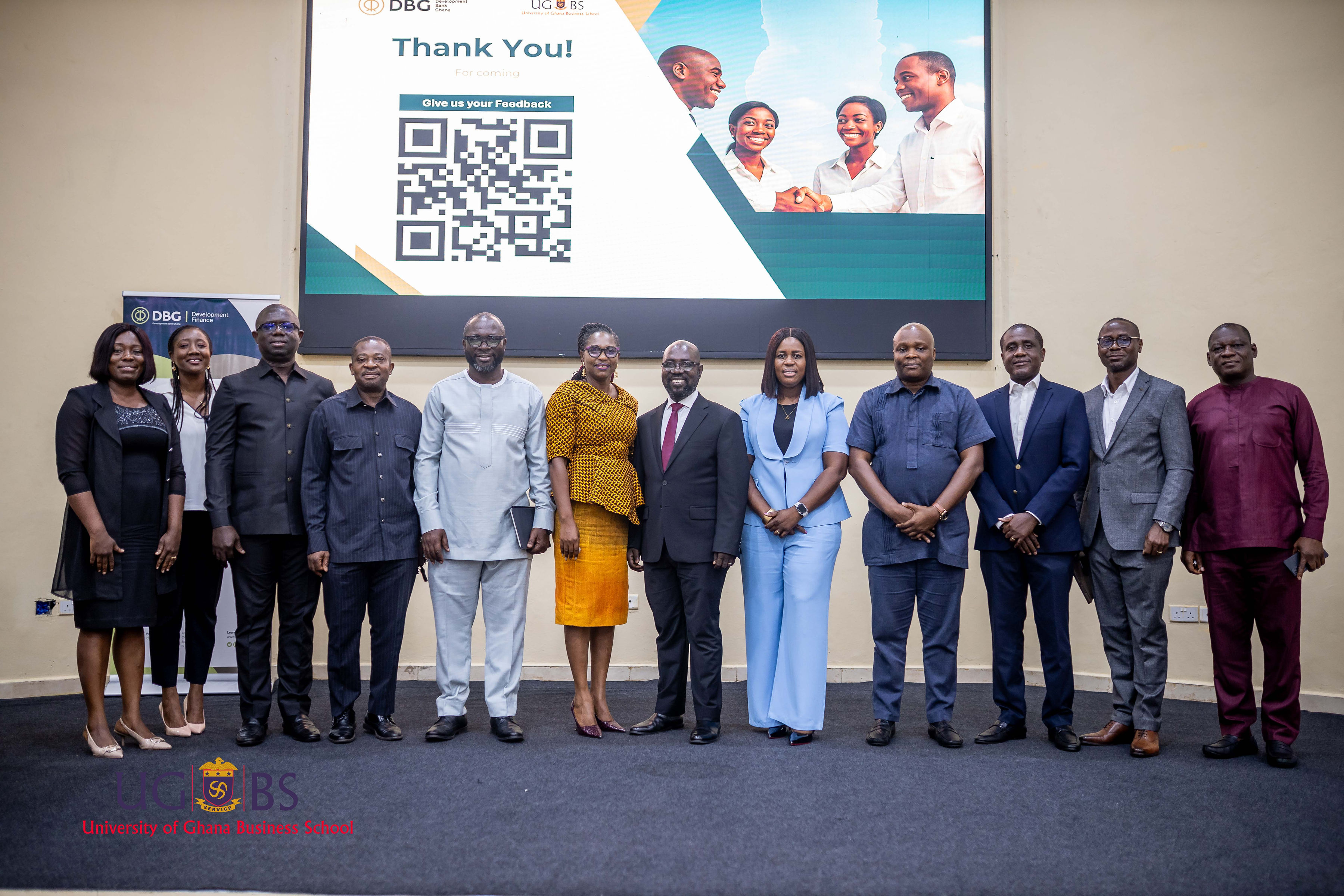
The University of Ghana Business School (UGBS), in partnership with Development Bank Ghana (DBG), has held a Development Finance Dialogue Series on the theme “Innovative Finance for MSMEs in Ghana: From Research Insights to Actionable Policy.” The event, hosted on 4 December 2025 at the ISSER Conference Room, convened policymakers, industry figures, researchers and financial sector stakeholders to examine emerging challenges and opportunities in financing Ghana’s Micro, Small and Medium-sized Enterprises (MSME) sector.
In his opening remarks, the Dean of UGBS, Prof. Ernest Tweneboah-Koduah, underscored the significance of the Dialogue, noting that it demonstrates the value of robust institutional partnerships and reinforces the School’s role in linking academic research with industry practice. He expressed appreciation to DBG and the Bank of Ghana (BoG) for supporting the collaborative research initiative, emphasising that such engagement reflects confidence in the expertise of local researchers to inform national policy and strategic decision-making.
Prof. Randolph Nsor-Ambala, Chief Executive Officer of DBG, reaffirmed the Bank’s commitment to reducing extreme poverty and strengthening the private sector. He explained that private-sector capitalisation remains central to DBG’s mission and highlighted the Bank’s efforts to provide appropriate loan facilities while enabling enterprises to operate sustainably. He stressed that deepening the financial ecosystem is fundamental to enhancing financial inclusion, outlining DBG’s support in capacity-building, technology access, technical assistance and policy advocacy. He further noted that collaboration with UGBS is critical for generating research that responds directly to Ghana’s development priorities.
Presenting the context of the collaborative study, DBG’s Chief Economist, Prof. Osei-Assibey, observed that MSMEs require both internal and external financing to function effectively within the broader market economy. Although MSMEs are major contributors to national output and employment, many continue to face acute financing constraints. He noted that formal finance remains vital for job creation, productivity enhancement and access to specialist services. He explained that the joint initiative by BoG, DBG and UGBS sought to assess how recent policy reforms, the domestic debt exchange, and shocks such as the COVID-19 pandemic have shaped MSME access to finance.
The Head of the UGBS Department of Finance, Prof. Vera Ogeh Fiador, presented findings from the study titled “Innovative Financing of MSMEs in Ghana: Demand–Supply Evidence and Policy Options.” She highlighted the indispensable contribution of MSMEs, which account for roughly 70% of Ghana’s Gross Domestic Product and 80% of private-sector employment, thereby supporting livelihoods across women, youth and other vulnerable groups. Despite this contribution, persistent financing barriers continue to impede MSME growth, innovation and formalisation. In the context of the African Continental Free Trade Area, she emphasised that access to affordable capital will be central to determining which firms scale competitively.
Prof. Fiador outlined several policy recommendations. Demand-side proposals included enhancing MSME financial resilience, strengthening basic risk management practices, improving investment-readiness support, and promoting financial literacy, accounting competence and sound record-keeping. She further recommended targeted support for fintech adoption and improved digital literacy to enhance engagement with digital lending platforms. On the regulatory side, she called for the establishment of a modernised fintech regulatory framework, clear guidelines for digital lending, alternative credit-scoring systems, and enabling environments for crowdfunding, peer-to-peer lending, regulatory sandboxes and secure data-sharing mechanisms, including the use of AI-enabled credit assessment tools.
Speaking on industry perspectives, the Chief Executive Officer of the Association of Ghana Industries, Mr. Seth Twum-Akwaboah, reiterated long-standing obstacles faced by MSMEs, such as high interest rates, stringent collateral demands and complex documentation processes. He advocated a shift away from short-term financing structures that constrain competitiveness and encouraged the creation of formal mechanisms to support MSME membership in business associations for shared learning and collective advocacy.
The Chief Executive Officer of the Ghana Association of Banks, Mr. John Awuah, responded to the study’s findings by noting that inconsistent policy shifts create difficulties for both financial institutions and enterprises. He highlighted the reluctance among banks to finance agricultural ventures due to weather-related risks and unstable commodity prices, which complicate loan recovery. He also pointed to specific challenges that limited the sustainability of the YouStart initiative within the MSME financing ecosystem.
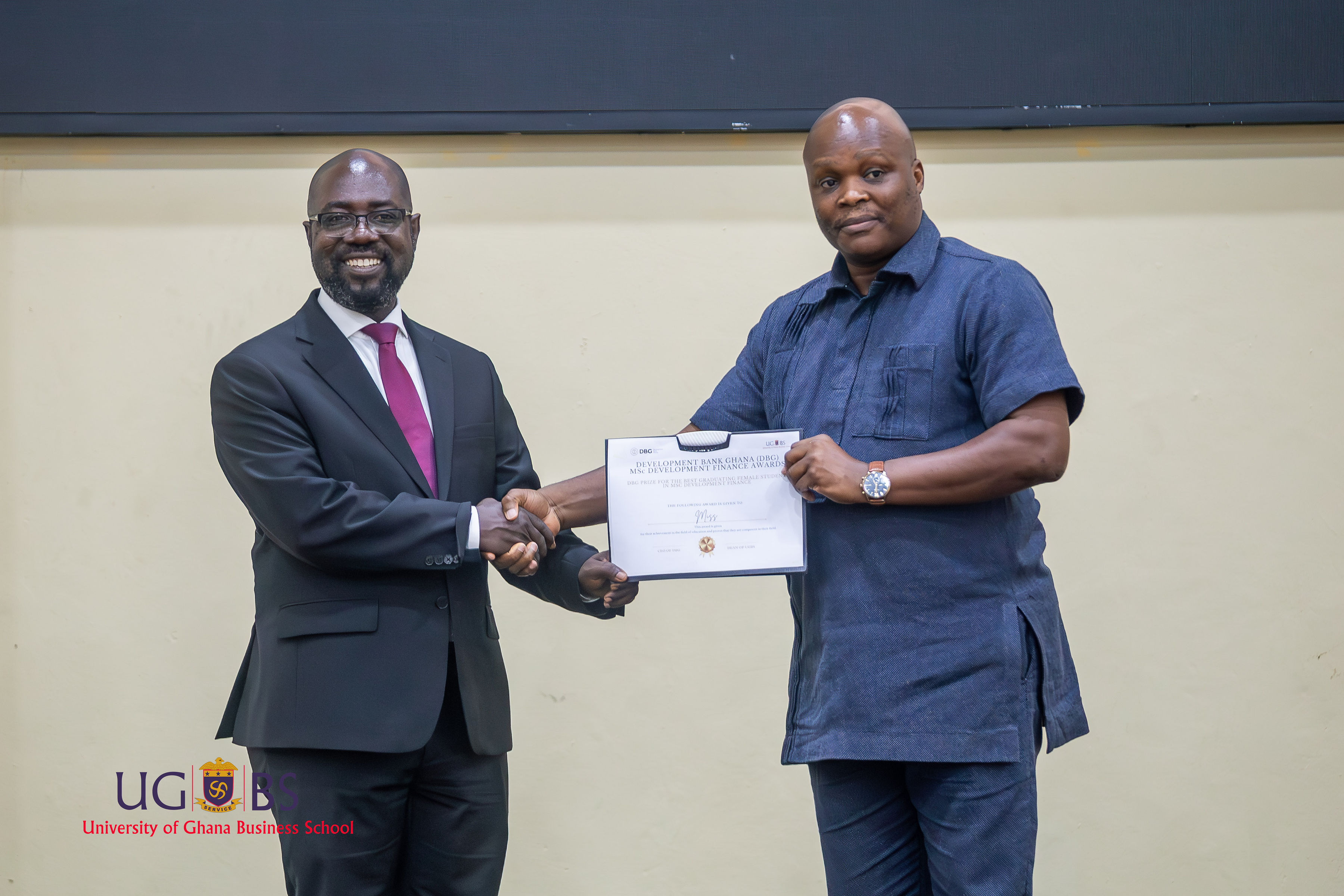
The event concluded with the launch of the DBG Academic Prize Awards, jointly unveiled by Prof. Nsor-Ambala and Prof. Tweneboah-Koduah. Prof. Nsor-Ambala explained that the awards are designed to cultivate interest in Development Finance as a professional field and to recognise excellence among students. The prizes will honour the Best Graduating Female Student in the MSc. Development and Finance programme and the Best Graduating Student in the MSc. Development Finance programme.