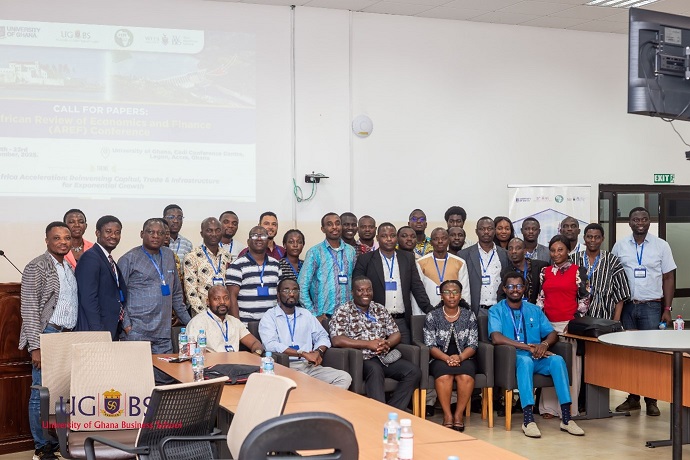
UG–BoG Chair in Finance and Economics Hosts the Africa Review of Economics and Finance Conference
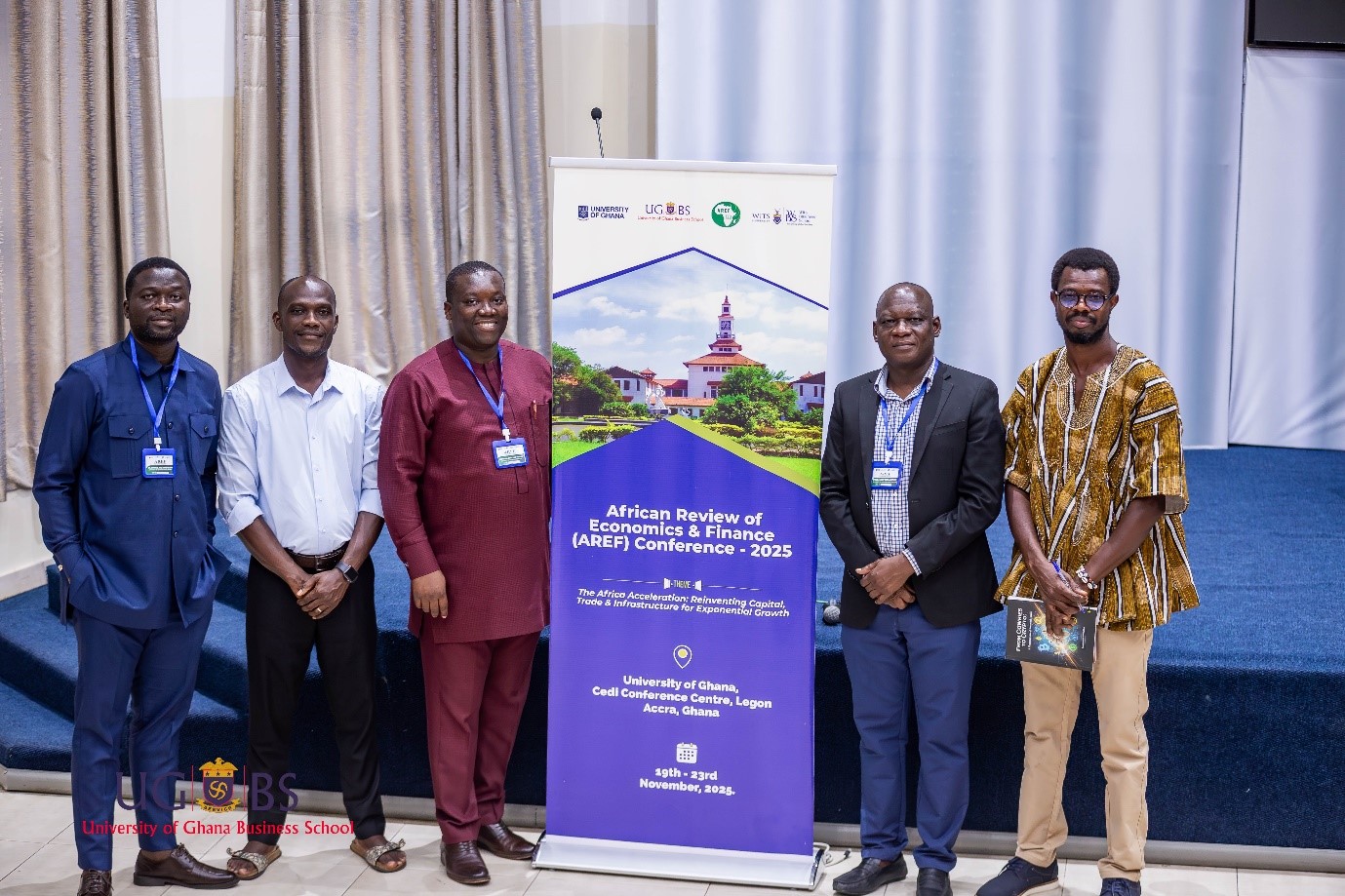
The Bank of Ghana Chair in Finance and Economics at the University of Ghana, Prof. Paul Y. Imhotep Alagidede, organised the Africa Review of Economics and Finance (AREF) conference from 19th to 23rd November 2025 at the Cedi Conference Centre of the University of Ghana. The conference brought together academics, industry experts, and traditional leaders to discuss how Africa can accelerate growth through a reimagined economic and financial architecture. Centred on the theme “The Africa Acceleration: Reinventing Capital, Trade & Infrastructure for Exponential Growth”, the conference featured multidisciplinary presentations exploring how policy, technology, artificial intelligence (AI), and African indigenous knowledge systems can shape a new development model for the continent.
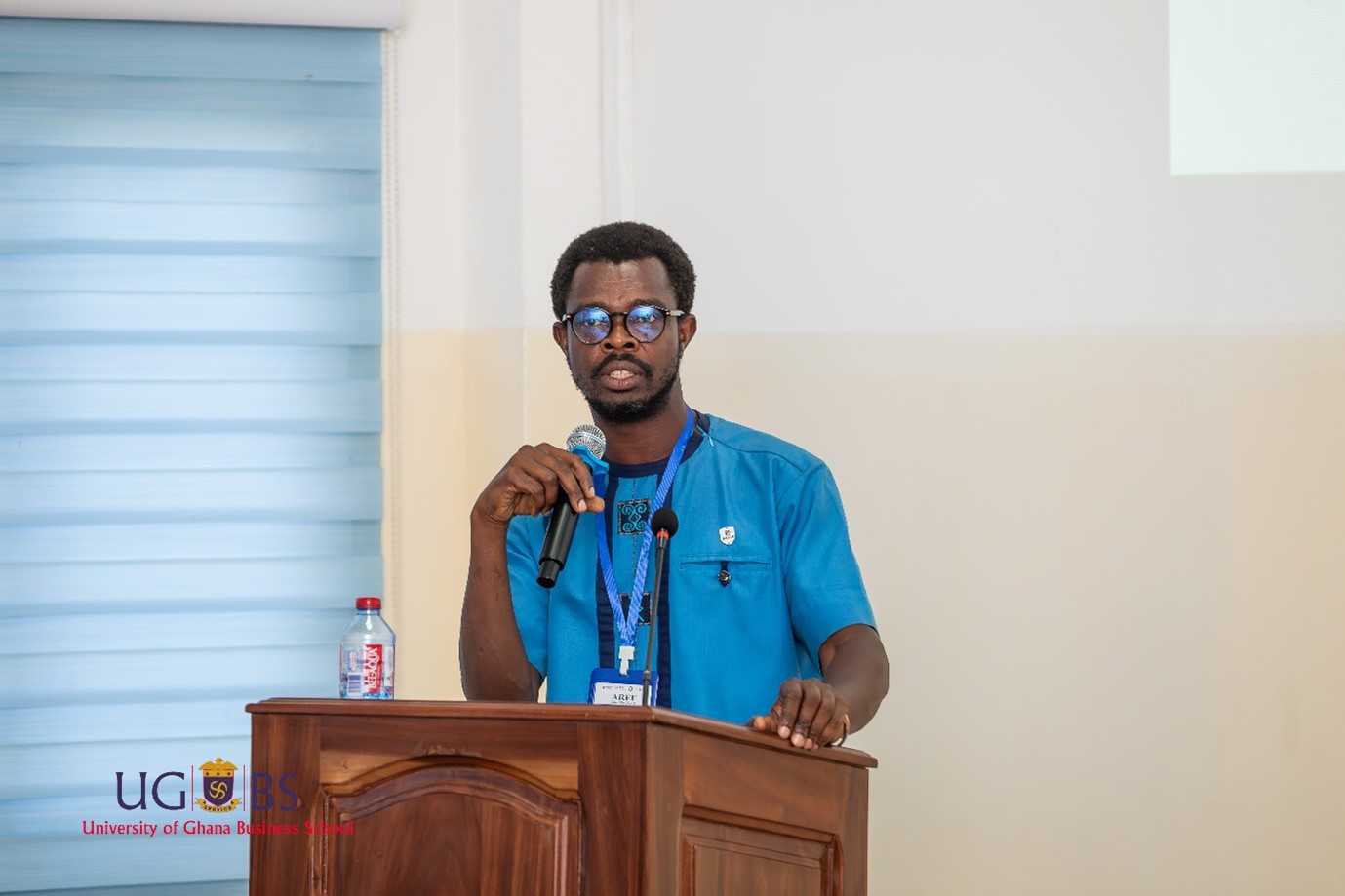
Prof. Paul Y. Imhotep Alagidede
Moderated by Prof. Jones Odei-Mensah, Conference Chair, Prof. Godfred Amewu, and Dr. Emmanuel Joel Aikins Abakah of the University of Ghana Business School (UGBS), the sessions interrogated emerging economic ideas and provided a platform for doctoral researchers to share research works. Mr. Gideon Owusu Agyeman, Director at Gracecoms and Lecturer at both the Ghana-India Kofi Annan Centre of Excellence in ICT (GI-KACE) and Ghana Communication Technology University (GCTU), highlighted the dual challenge researchers face in adopting AI. He noted that while AI offers accelerated capacity for knowledge production, it also introduces heightened ethical risks. His presentation examined opportunities for research innovation, ethical concerns, and practical strategies to minimise AI-related dangers.
Dr. Simeon Coleman provided practical guidance for doctoral candidates, covering proposal development, thesis completion, and early-career publishing. He shared communication strategies for managing supervisor interactions and committee meetings. Dr. Coleman also introduced checklist-driven approaches for converting thesis chapters into publishable manuscripts, techniques for handling literature and coherence, and effective responses to paper rejections. Dr. Peterson Owusu Junior led a technical session on econometric and empirical research methods. His presentation covered tetra analysis, time horizon considerations, ensemble techniques, connectedness analysis, information transmission, tail risk assessments, and the concepts of instrument validity and endogeneity.
Prof. Alagidede also delivered a presentation titled “Africans Must Tell Their Stories in Their Own Journals”, underscoring the need for African scholars to shape global discourse and correct misrepresentations in existing literature. He introduced Porthologos Press as an avenue to promote African-led scholarship, emphasising the need to design research systems that better engage indigenous researchers in finance and economics.
Prof. Jasper Ayelazuno, University for Development Studies, presented on Indigenous Economics and Commerce, describing indigenous economic systems as “a living archive for ancestral intelligence”. Drawing on the work of Sabelo Ndunu-Gashemi, he argued for “resetting the arms to African time” rather than returning to the past. He asserted that indigenous economics offers an alternative trajectory grounded in ecological harmony, moral responsibility, and sustainable production, challenging the profit-driven path of neoliberal globalisation.
Dr. Genevieve Nrenzah of the Institute of African Studies examined Ancestral Veneration as Cultural Capital, showing how festivals, textiles, music, ritual objects, and sacred practices rooted in Akan cosmology are increasingly transformed into cultural and economic assets. Drawing on ethnographic research, she demonstrated how ancestral veneration shapes identity, spirituality, and market value in contemporary Ghana, enriching creative industries while preserving authenticity. She explained that lavish Akan funeral practices reflect the belief that the dead continue life in the unseen world and subsequently become ancestors. Nana Yaw Wi Asamoah Boadi of the Nile Valley Multiversity spoke on “When the Gods Meet the Machines: Metanomics, Ancestral Intelligence and the Re-enchantment of Economic Thought”. He drew parallels between AI as a technological intelligence and ‘Bosom/Suman’ as a form of African spiritual intelligence. He argued that integrating both creates “systems that are smart and sacred”, blending efficiency with human and ecological well-being. He further highlighted how metanomics could support resource-backed, decentralised economic models that reconnect communities with ancestral knowledge.
Mr. Senyo Kpelly, Executive Director of Eco-Restore Limited, presented on “Understanding African Theology: Sacred Knowledge versus Blind Faith”, examining the political economy of African spiritual systems. He urged participants to embrace indigenous culture and critically examine whose interests are served by their thoughts, actions, and consumption patterns, stating that “the best way to fight an alien culture is to live your own”. The conference also featured multiple research paper presentations by PhD candidates across finance, economics, and related fields. Participants received feedback from senior academics and industry experts, enhancing the scholarly value of the discussions. Across all sessions, speakers emphasised the need for policymakers to rethink Africa’s developmental trajectory by combining modern tools such as AI and advanced research techniques with indigenous knowledge systems, cultural philosophies, and community-based economic ethics.
Ɔbenfo Ọbádélé Bakari Kambon, Associate Professor and founder of Abibitumi, interrogated The Political Economy of Kmt(yw) Spirituality’s Material Culture. He exposed how imported ritual commodities create dependency, questioning whether they serve liberation or subtle forms of enslavement, and offered pathways toward genuine Abibifahodie; African freedom rooted in sovereign spiritual practice.
A defining feature of the 2025 AREF Conference was the profound presence of Africa’s ancestral custodians, whose contributions grounded the event in spiritual intelligence, cultural continuity, and indigenous economic philosophy. Nsumankwahene Nana Baffour Ababio Kogyawoasu III, spiritual guardian of the Asante Kingdom and Chief Priest to Otumfuo Osei Tutu II, sent an official delegation that underscored the urgency of recognising African traditions as foundations for advanced forms of harmony, governance, and economic renewal. Their message affirmed that no sustainable development model can emerge without honouring the cosmologies that have long sustained African civilisation.
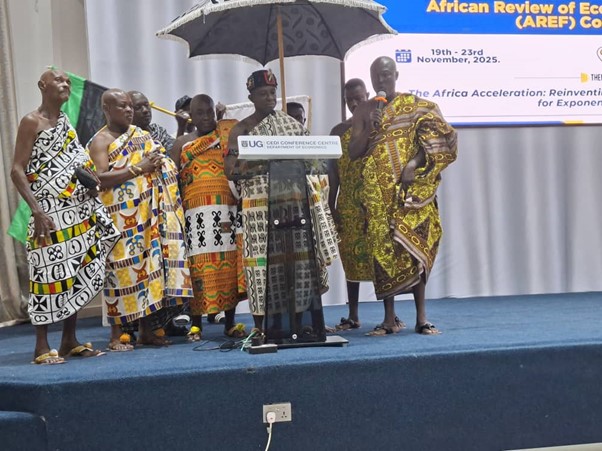
Komfoɔ Baffour Gyau, custodian of a five-generation shrine lineage, invoked the powers of Asuo Paamuu and his allied pantheon including Asante Nkae, the philosopher-spirit and master teacher whose ancestral economics illuminates pathways for prosperity. His interventions revealed how spiritual diagnostics can break cycles of misfortune, strengthen enterprise, and cleanse economic and psychological blockages.
Komfoɔ Nana Akosua Owusuaa, enthroned as Obrempong Taa Kwadwo Komfo, offered teachings rooted in a 40-year priesthood cycle, drawing on the unseen realm to articulate principles of ecological balance and collective well-being. From the Sheawora Shrine, Nana Yaw Kyei, Head Priest and Grandmaster of NATAV, contributed deep interpretive wisdom, enriching discussions on indigenous economic systems and ancestral stewardship. Together, their presence affirmed that Africa’s economic renaissance must be intellectually rigorous, spiritually grounded, and culturally sovereign.