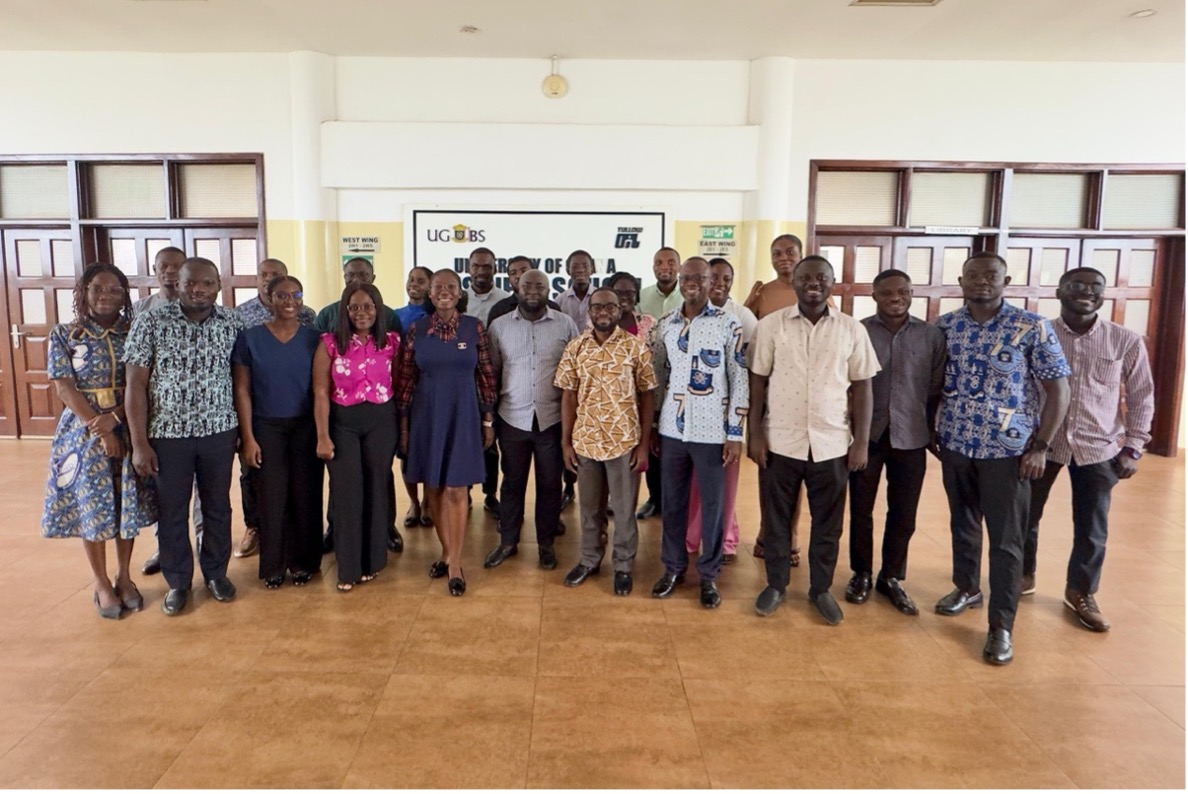
UGBS- STEG Workshop Trains Next Generation of Researchers on Ghana's Structural Transformation
University of Ghana Business School (UGBS) hosted a two-day training workshop on structural transformation from 22nd to 23rd June 2026 under the Structural Transformation and Economic Growth (STEG) research programme, bringing together graduate students and early-career researchers from economics, finance, accounting, and public policy backgrounds to strengthen local research capacity and deepen understanding of Ghana’s development challenges. Opening the workshop, the convener, Prof. Edward Asiedu, mentioned that the programme seeks to build a new generation of researchers who will continue advancing analytical and policy work on structural transformation as senior academics transition out of active research over the next fifteen to twenty years.
He explained that while an earlier STEG training focused on industrial transformation, this phase expands attention to migration and urbanisation, areas where Ghana’s development trajectory differs from traditional economic expectations. According to Prof. Asiedu, although people continue to move into urban centres, the shift has not generated the industrial employment opportunities commonly associated with urbanisation in other contexts. Instead, many migrants remain in low-skilled work, limiting the productivity gains that typically accompany structural transformation. He noted that the workshop attracted nearly 70 applications, but participation was intentionally limited to fewer than 25 participants to create a more interactive environment and enable closer engagement between facilitators and participants. Selection was based on the alignment between applicants’ research interests and the workshop content. He explained that the organisers intend to retain a core group of between 10 and 20 participants throughout the full sequence of modules, drawing participants from the School of Economics, UGBS, and departments engaged in geography, migration, and risk studies.
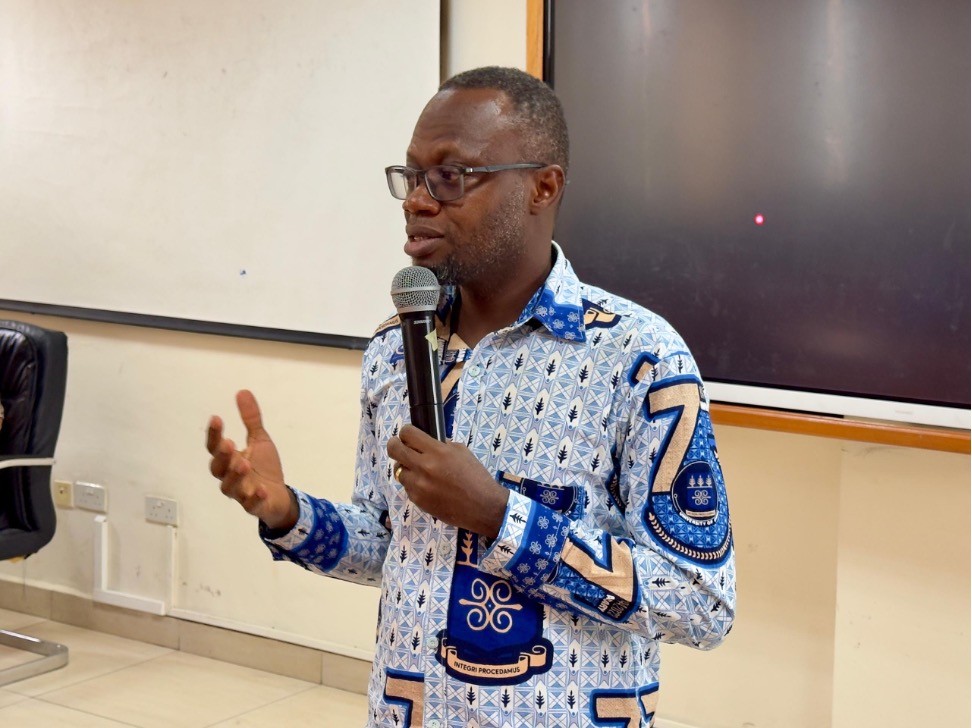
Prof. Edward Asiedu addressing participants at the STEG training
Facilitated by Prof. Richmond Atta-Ankomah and Dr. Richmond K. Egyei, the sessions progressed from conceptual foundations to measurement approaches, data sources, and drivers of structural transformation, with an additional applied session focused on welfare outcomes. Participants first explored the distinction between structural change and structural transformation through group discussions before formal presentations. Facilitators explained that structural change refers broadly to shifts in output and employment across sectors, while structural transformation describes productivity-enhancing movement of labour and capital from lower-productivity sectors into higher-productivity activities. Drawing on Lewis’s 1954 dual economy model and later contributions by Chenery and Kuznets, discussions framed transformation as movement from low-productivity agrarian systems toward more productive modern economies, usually accompanied by urbanisation and rising living standards.
Subsequent sessions focused on measuring transformation using tools including the Structural Change Index, the Lilien Index, the McMillan and Rodrik shift-share approach, and the De Vries decomposition. Using Ghana as a case study, facilitators highlighted findings from Osei and Jedwab’s 2016 study and the Ghana Statistical Service’s 2025 national productivity report, both of which suggest that although structural change has occurred, productivity improvements remain constrained because labour and capital are not moving quickly enough into higher-productivity sectors. Participants also examined the strengths and limitations of major data sources used in structural transformation research. National accounts from the Ghana Statistical Service were presented as useful for producing internationally comparable time series but less effective in capturing informal economic activity. Population and housing censuses were discussed for their broad geographic coverage, while household surveys such as the Ghana Living Standards Survey and the Ghana Socioeconomic Panel Survey were presented as valuable for understanding household experiences but limited in estimating aggregate productivity. Enterprise surveys were also examined for their firm-level insights despite gaps in informal sector coverage. To strengthen practical application, participants completed a hands-on Stata exercise using AHIES data and national accounts data to construct employment shares and apply shift-share decomposition methods.
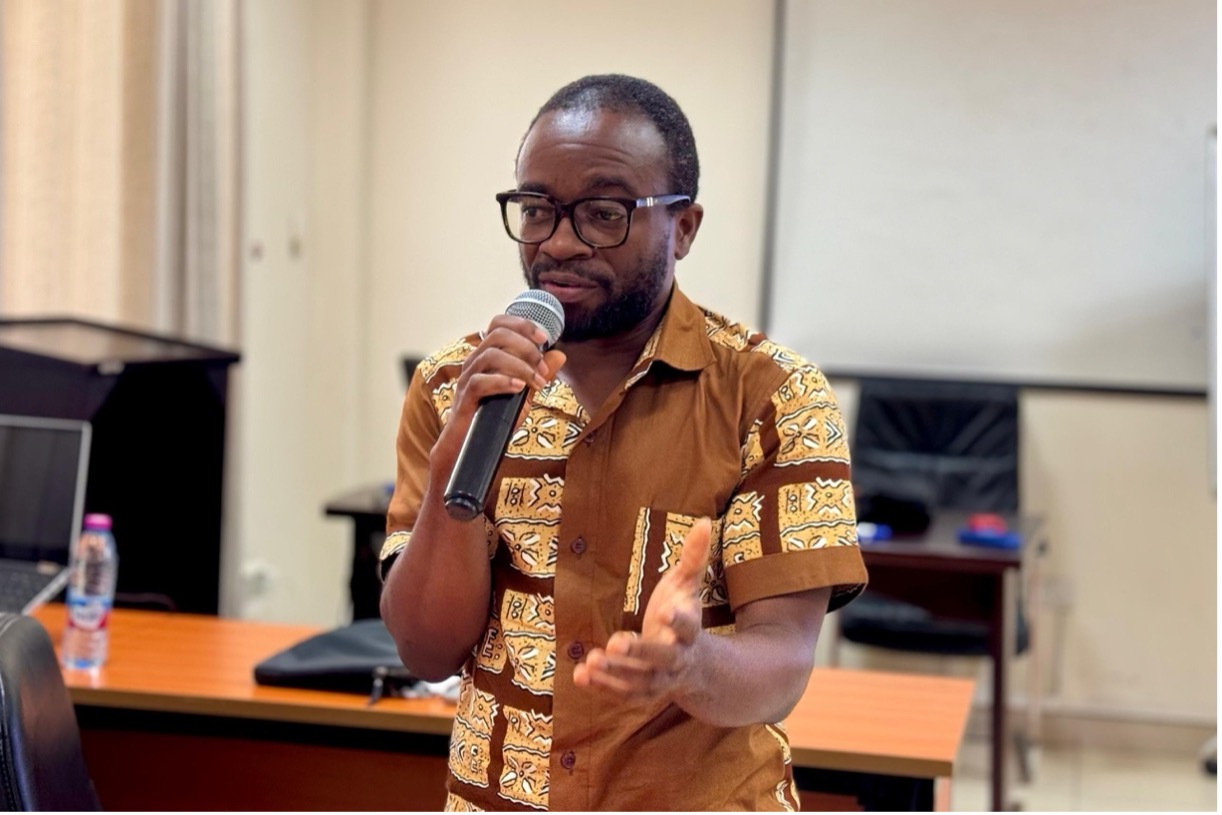
Prof. Richmond Atta-Ankomah delivering a presentation at the STEG training
Day two focused on the drivers of structural transformation across nine interconnected channels. Discussions explored demand-side shifts guided by Engel’s Law, productivity differentials, capital accumulation, human capital development, infrastructure, urbanisation, digital technology, and industrial policy. Mobile money and platform-based employment were discussed as emerging areas whose long-term implications remain under examination. Participants also examined Acemoglu, Johnson, and Robinson’s colonial origins thesis and discussed how institutional structures established during colonial periods continue to influence income differences across former colonies.
In an applied session, Prof. Atta-Ankomah connected the theoretical discussions to household outcomes using two waves of the Ghana Socioeconomic Panel Survey collected in 2009/2010 and 2013/2014 through collaboration between ISSER and Yale University’s Economic Growth Centre. His analysis showed that households transitioning from agriculture into services were significantly more likely to move out of poverty, while households moving back into agriculture faced increased risks of falling into poverty. The findings also showed stronger benefits for younger people and women, while education appeared to have no measurable effect on these outcomes. Prof. Atta-Ankomah further noted that Ghana’s absolute poverty rate declined from 51.7 percent in 1992 to 23.4 percent in 2017 and suggested that structural transformation contributed meaningfully to this reduction despite rising inequality.
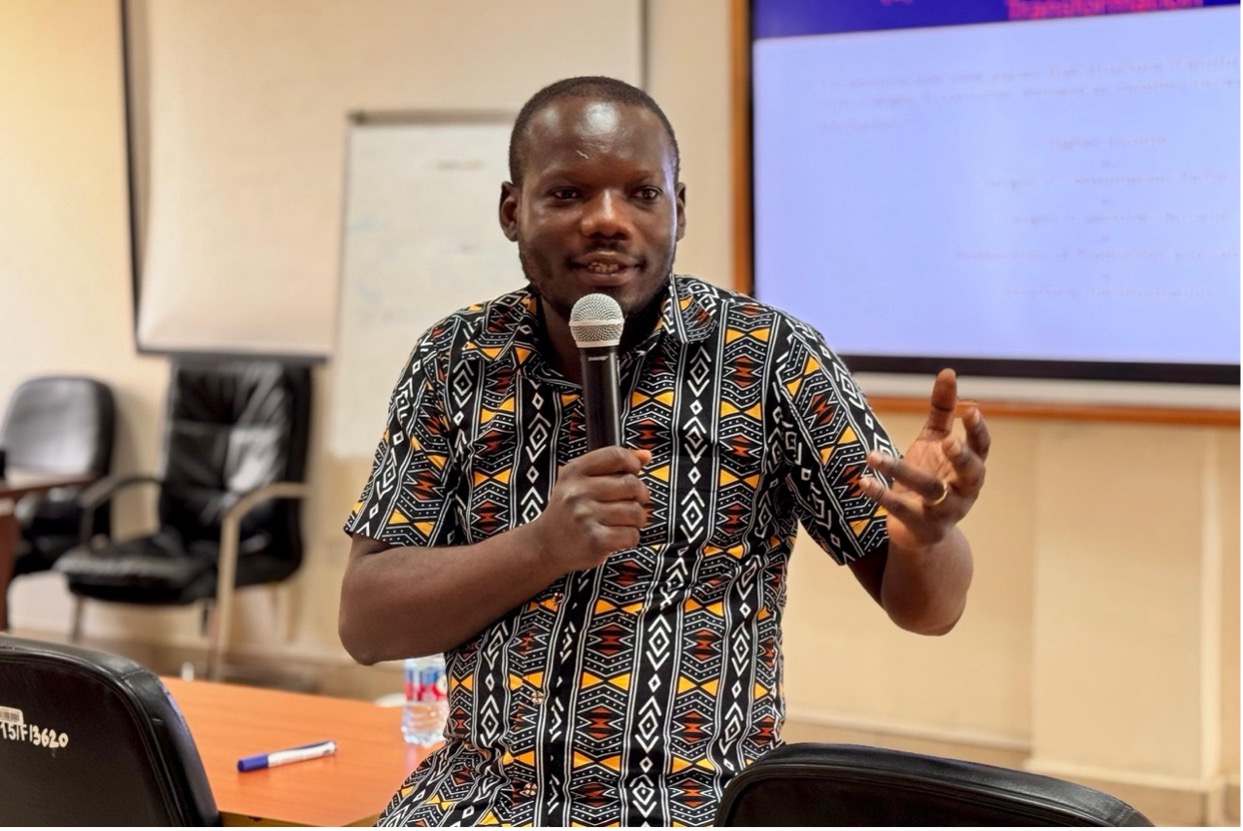
Dr. Richmond K. Egyei delivering a presentation at the STEG training
Closing the workshop, Prof. Asiedu outlined the next phase of the programme. He mentioned that the modules will focus on agricultural transformation and impact evaluation, delivered in collaboration with specialists from the Agricultural Economics Department, a visiting researcher from Germany, and the Director of the School of Economics. The programme will also include soft-skills training in policy brief and poster design, academic publication support, funding opportunities for fieldwork and data collection, and sponsorship for at least one graduate student to present research at an international conference. Reflecting on the broader purpose of the initiative, Prof. Asiedu shared that much of his own research development came from exposure to seminars outside his immediate field and encouraged participants to remain open to interdisciplinary learning. He noted that STEG ultimately seeks to create sustained collaboration across economics, business, climate science, and agriculture to build research capacity that can respond to Ghana’s evolving development needs.
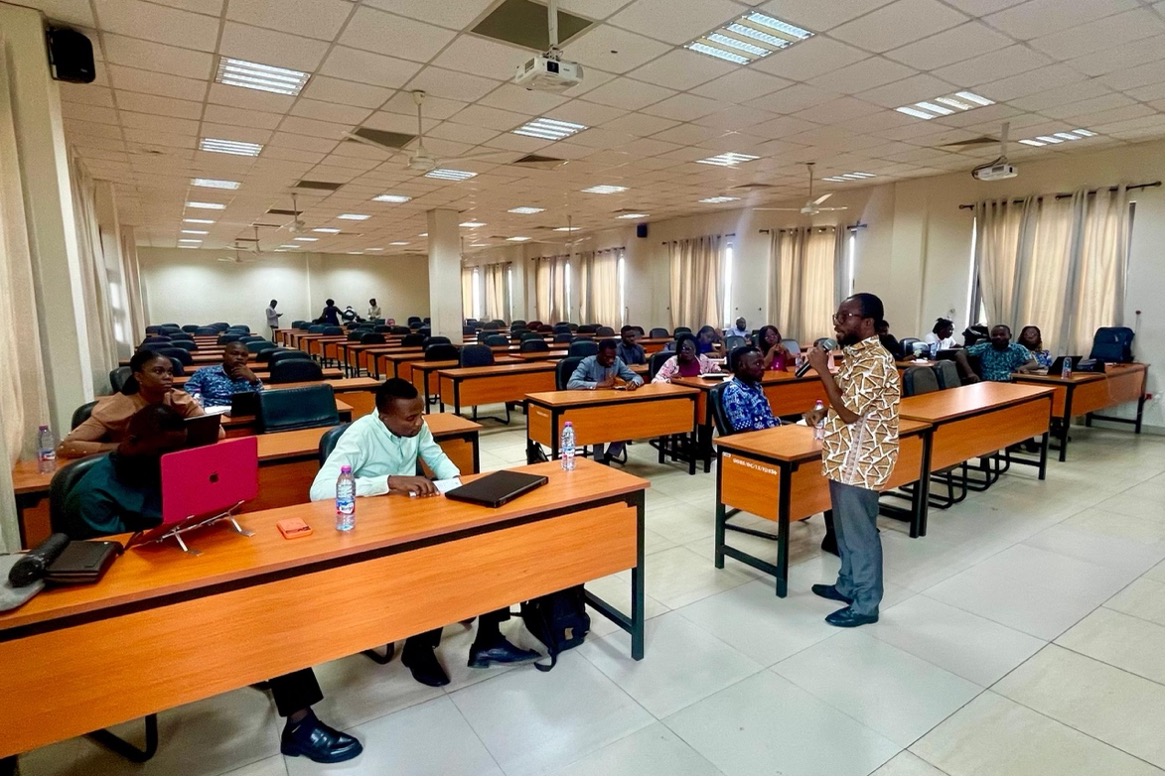
Cross- section of the STEG training on structural transformation